
Useful tips
How to properly connect a battery to an inverter: engineer's advice


Correct how to connect a battery to an inverter — it's not just about connecting two wires. Voltage, current, cable cross-section, terminal type, connection sequence, and short-circuit protection are important here. An error in one step can burn the terminals, cause the wiring to heat up, or damage the inverter itself.
In private homes, apartments and small commercial properties an inverter with a battery often works as a backup power supply for the boiler, router, lighting, cash register equipment or server cabinet. That's why connecting a UPS in the house should be performed not “by eye”, but according to basic engineering rules.
The most common problem is that the user sees that there is a voltage at the inverter output. 220V, and underestimates the danger from the low-voltage circuit. But it is on the battery side that large currents flow. For the system 12V Even a 1000 W inverter can consume more than 80 A, which is a serious load on the wiring and contacts.
If you need reliable components, you should immediately choose high-quality ones. terminals for UPS battery, fuses, cables and connectors. Saving here often leads to sparking, melting of insulation and voltage drop under load.
What to check before connecting
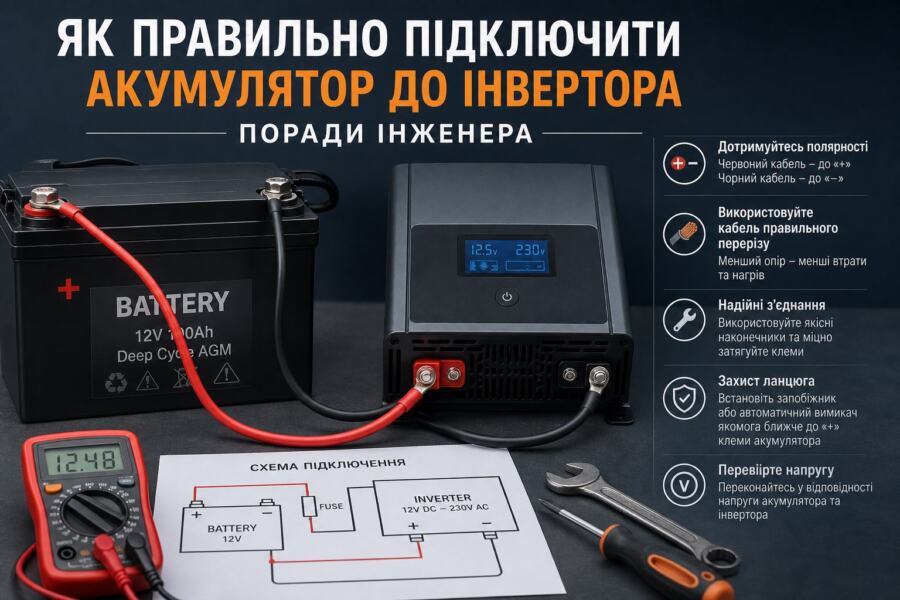
Before installation, three parameters are checked: battery voltage, inverter input voltage and permissible charge/discharge current. Most often, systems are used in everyday life on 12V, 24V or 48V. The higher the voltage of the battery pack, the lower the current for the same inverter power, and therefore the lower the losses in the cables.
For example, an inverter on 1500 W in the system 12V may require a current of more than 125 A, taking into account losses. For the same power in the system 24V the current will already be about half as much. This means less heating, smaller cable cross-section requirements, and more stable operation.
Separately, check the polarity: the "plus" of the battery should go to the "plus" of the inverter, the "minus" to the "minus". Mixing up the contacts is one of the most common reasons for electronics failure. If there are several batteries in the system, you should understand in advance whether they are connected in series, parallel or combined.
.
The condition of the battery itself is also assessed: no-load voltage, charge level, absence of swelling of the case, oxidation at the terminals and mechanical damage. If the battery is old or has voltage sag under load, the inverter may turn off even when it is «seemingly fully» charged.
In service practice, a situation often occurs: the inverter works with the boiler for a few minutes, then a breakdown occurs. The reason is a thin cable, weak clamps or oxide on the terminals. For such systems, not only the battery capacity is important, but also the quality of the entire current path.
What cables, terminals and fuses to use
The main rule is that the cable must withstand the maximum current with a margin. For short lines in low-power systems, copper cable of sufficient cross-section is used: for small inverters this can be 10–16 mm², for more powerful ones — 25–50 mm² and above. The exact choice depends on the line length, power and system voltage.
The terminals must be crimped properly, without play. Weak contact creates local heating, and at high currents this quickly turns into melting. That is why UPS battery terminals It is better to take it from thick metal, with an anti-corrosion coating and a suitable hole for the bolt connection.
The fuse is installed as close as possible to the positive terminal of the battery. This is critical: if the cable is damaged somewhere, it is the fuse that must break the circuit. For inverter systems, fuses or ANL/MEGA fuses are most often used, selected for the operating current and cable cross-section.
| Parameter | Small inverter | More powerful system |
| High-voltage | 12V | 24V or 48V |
| Typical current | 60–120 A | 30–80 A |
| Cable | 10–25 mm² | 16–50 mm² |
| Risk of loss | Higher | Lower |
For fixed installation, it is advisable to avoid "twists" and random adapters. Everything is connected via normal crimp terminals, bolted terminals and insulation of the appropriate class. If there are vibrations or periodic maintenance, it is better to provide a detachable connection with a reliable lock.
Spark-free and error-free connection procedure
The best practice is to first completely de-energize the inverter, check that there is no load on the output, and only then connect the battery. The contacts should be clean and dry. If there is oxidation, it should be removed before installation, otherwise the voltage drop will increase.
First connect the cable to the inverter, then to the battery, observing the polarity. Many inverter models have input capacitors inside, so a short-term discharge may occur when the terminals touch. Easy spark when connecting the battery sometimes acceptable, but a strong pop or persistent sparking indicates either an error or excessive capacitance/discharge of capacitors without a prior charging circuit.
To avoid a sharp pulse, pre-charging through a resistor or a special anti-spark connector is used. This is especially important for systems where the battery is large and the inverter has a significant input capacitance. In everyday life, for small installations, the correct procedure and reliable contact tightening are sufficient.
After connection, check the voltage at the inverter terminals under load. If the difference between the battery voltage and the inverter input is large, then there is a problem with the cable, contacts or fuse. For the master, this is a quick way to find a hidden error without complete disassembly.
A typical mistake is to connect the battery "live" when the inverter is already turned on and the load is working at the output. At the moment of switching, a starting current occurs, and without protection it hits the contacts. For a safe circuit, first assemble the battery circuit, and only then start the inverter itself.
Battery Safety: What You Can't Ignore
Safety when working with batteries starts with simple things: no metal jewelry, dry hands, insulated tools, and eye protection. A watch, ring, or screwdriver, accidentally shorting the terminals, can cause severe heat and burns.
During operation, do not allow a short circuit on the battery. Even a brief touch of the key between the "plus" and "minus" creates a large current. For lead-acid batteries, this also poses a risk of gas release, and therefore an additional explosion hazard in a poorly ventilated room.
Batteries should be installed in a dry, ventilated place, away from heat sources. Batteries should not be placed near fire, in sealed boxes without ventilation, or on soft surfaces where heat dissipation is impaired. For a large system, it is advisable to provide a separate cabinet or technical area.
If the system operates under load for a long time, it is necessary to monitor the temperature of the terminals, connectors and cables. Heating above the norm is a signal to immediately stop operation and check the contact. In a normal circuit, the contact elements should not heat up noticeably even after prolonged operation.
For home backup power It is important to consider not only the inverter itself, but also the quality of the entire installation. That is why it is advisable to plan the connection of a UPS in a house as an electrical system, and not as a temporary solution "until the evening".
Common user mistakes and how to avoid them
The first mistake is underestimating the currents. A person sees a small device, but does not take into account that tens or hundreds of amperes go through the battery cable. As a result, they put a thin wire that heats up, causes losses and voltage drops. For an inverter, this is almost always a problem of starting under load.
Second error - bad UPS battery terminals. Cheap metal, weak clamping and soft washers do not hold current. At first it looks normal, but after a few weeks darkening, an overheating smell and periodic system shutdown appear.
The third mistake is ignoring the fuse. Some people think that it is «superfluous» because the system works like that. In fact, it is the fuse that saves from fire in the event of a cable failure or installation error. Its absence is one of the most dangerous things in a backup power supply.
The fourth mistake is connecting without checking the polarity. This is especially dangerous at night, in tight panels, or when the wires are the same color. Before work, you should mark the cables or at least ring them with a multimeter once.
The fifth mistake is to buy equipment without a margin for the actual load. If an inverter is chosen in an online electronics store only based on peak power, but the boiler's starting currents are not taken into account, pumps or refrigerator, the system may operate unstable. Not only the nominal value is needed, but also a high-quality margin in current and thermal mode.
Practical conclusion
That as connect the battery to the inverter safely and reliable, three things must be observed: correct system voltage, sufficient cable cross-section and high-quality contact without sparking. For most domestic and commercial applications, a circuit with short copper wires, normal fuses and well-crimped terminals works best.
If you assemble the system without skimping on connections and protection, the inverter will operate stably, the battery will last longer, and the backup power supply for the house will not fail at a critical moment. This is what competent connecting a UPS in the house: not just connect elements, but create a safe and predictable energy circuit.