
Useful tips
Carbon monoxide detector: how to choose an autonomous alarm for your home


“`html
Carbon monoxide is odorless, colorless, and does not irritate the mucous membranes, so a person does not feel the danger until symptoms of poisoning appear. This is critical for a private house, an apartment with a gas boiler or fireplace, as well as for a small office: a CO leak can occur due to incomplete combustion, poor draft, a clogged chimney, improper boiler installation, or a generator operating near the room.
A properly selected carbon monoxide detector not only creates a sense of security, but also actually reduces the risk of poisoning. The best option for a home is an autonomous alarm with its own power supply, a loud siren and a clear indication of a malfunction. If you need not only protection from CO, but also smoke control, you should consider the complex: autonomous fire detection via a separate smoke detector or a combination device.
When users search carbon monoxide detector buy, they often compare only gas detector price, but ignore important parameters: sensor type, service life, alarm algorithm, battery autonomy, permissible temperature range, and compatibility with a specific room. It is these characteristics that determine whether the device will work on time.
For the electro-shop.com.ua store, this is a practical category of goods: here solutions are relevant for apartments, boiler rooms, dachas, private houses and technical premises. If local service and fast logistics are needed, the request electro shop dyunayavtsi is often chosen by residents of the region, for whom consultation, availability and a clear selection without unnecessary technical errors are important.
What exactly does a carbon monoxide detector detect and why is it not the same as a smoke detector?
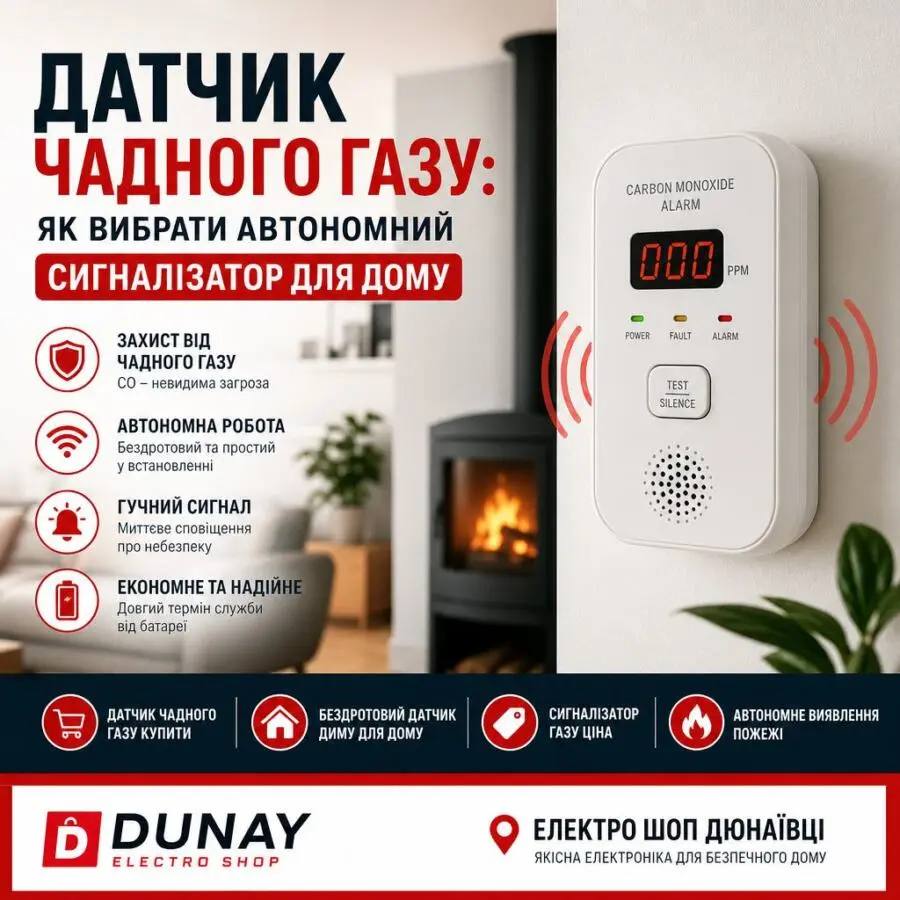
A CO sensor responds to the concentration of carbon monoxide in the air. It does not see a flame and does not measure smoke in the classical sense. These are different physical phenomena: smoke is a product of combustion with particles, and carbon monoxide is a toxic gas that is formed when there is a lack of oxygen or poor removal of combustion products.
In everyday life, this means the following: the boiler may still be working, the flue is partially drawing, but the concentration of CO in the room is already increasing. A person will not feel this, but the sensor should detect the danger. That is why it is important for safety not to confuse wireless smoke detector for home with a CO alarm. The first protects against fire, the second against carbon monoxide poisoning.
The most reliable models for home use an electrochemical sensor. It responds more accurately to low and medium concentrations of CO and is less responsive to random household factors. For a home user, it is important that the device is autonomous, does not require a separate power supply and can work even when turned off. 220 V.
Practical example: in a house with a gas boiler, the owner installed only a smoke detector in the hallway. When the chimney was partially blocked, there was no smoke in the room, but the CO level rose right near the boiler room. Only a separate carbon monoxide detector gave an alarm. This situation is possible in the off-season, when ventilation is unstable and heating devices are used unevenly.
How to choose an autonomous alarm: sensor, power supply, service life
The first criterion is the type of sensor. For residential premises, electrochemical models should be considered. They are usually more stable than semiconductor solutions and may have fewer false alarms. The second criterion is autonomy. A battery-powered device should operate independently of the mains and report a discharge with a separate signal, rather than being silent until completely turned off.
The third criterion is the sensor’s lifespan. In household models, it is usually 5–10 years. If the manufacturer does not specify the sensor’s lifespan, this is a reason to check the specifications more carefully. A carbon monoxide detector is not an eternal device, and after its lifespan ends, it must be replaced, even if it looks good from the outside.
The fourth criterion is alarm levels. A home alarm should emit a clear audible signal when a dangerous CO concentration is reached, and also separately report a malfunction or low battery. A test button will be useful. The device should be checked regularly according to the manufacturer's instructions.
Below is a brief comparison of the main types of devices.
| Device type | Advantage | Limitation |
|---|---|---|
| Standalone CO sensor | Works without connection to the 220 V network, easy installation | Does not transmit a signal to the remote control without additional modules |
| Combined smoke and CO detector | Protection against two risks in one housing | More expensive, requires careful selection of installation location |
| Wired alarm device | Stable power supply and system integration | More complicated installation |
For a private house It is useful to assess where exactly the danger may arise: boiler room, kitchen, garage, generator room or room with fireplace. If there are several sources, one sensor near the entrance may not be enough. Safety depends on whether the sensor is installed in the appropriate place, and not just for formality.
Where to install the sensor and what mistakes owners most often make
Carbon monoxide has a density close to that of air, so the installation height should be determined according to the recommendations of the manufacturer of the specific model. The sensor can be mounted on a wall or ceiling, depending on the design of the device and the requirements of the instructions. It should not be installed close to the ceiling, unless otherwise specified by the manufacturer, or hidden behind a closet or curtain.
A typical mistake is installing it near a hood, window, ventilation duct, or air conditioner. The air flow can direct the gas past the sensor or affect its operation. Another mistake is installing the device in a boiler room without taking into account the specifics of the room. Sometimes it is more correct to install it in an adjacent room or in a corridor near the bedrooms, following the manufacturer's recommendations.
It is equally important to understand that the test button does not simulate the actual operation of the carbon monoxide sensor. It checks the electronics, siren and power supply, but does not calibrate the sensor. If the manufacturer provides for regular maintenance, it must be performed according to the instructions. Periodically check the indication, battery condition and cleanliness of the housing.
In homes with a fireplace or solid fuel boiler, it is advisable to combine a CO sensor with smoke control. This is not duplication, but different levels of protection. Wireless smoke detector for home helps detect fires, and a separate CO alarm detects dangerous concentrations of carbon monoxide, even if there is no visible smoke.
What to look for when buying: technical parameters without marketing noise
When choosing, you need to check the passport specifications, not just the design. Important parameters: power type, battery life, permissible temperature and humidity, indication method, siren sound level, self-diagnosis, certification and sensor service life. If replaceable batteries are used, it is desirable that they be of a standard type and easily replaceable.
A compact standalone alarm is usually suitable for an apartment. For a boiler room, a summer cottage or a house with a generator, you need to choose a model whose characteristics correspond to the operating conditions. If the security system already consists of several devices, it is worth considering a comprehensive approach: control of CO, smoke, combustible gas leakage and power.
When compared gas detector price, it is important not to buy the cheapest option without verified sensor characteristics. An unknown device may have a short lifespan or may not meet the stated parameters. In matters of safety, confirmed quality and timely replacement of the device are important.
Main priorities when choosing:
- Electrochemical sensor for CO detection.
- Autonomous power supply with battery discharge indication.
- Clear audible alarm and test button.
- The manufacturer's declared sensor life is at least five years.
- Confirmed compatibility with specific premises and operating conditions.
Installation, testing and maintenance in real conditions
Installation is simple, but has its own nuances. If the device is mounted on self-tapping screws or a double-sided base, the surface must be dry, clean and dust-free. Do not install the sensor behind furniture, in direct sunlight, near a radiator or near a steam source. The kitchen is only suitable if the manufacturer expressly allows the model to be used in such conditions.
After installation, you need to test it, check the siren and record the installation date. For a home or business, it is useful to note the date of battery replacement and the device itself. It is important not only to install the sensor, but also to regularly test it according to the instructions.
In country houses, it is common to see a situation where the heating is turned on at the beginning of the season and the sensor is left in the box. When the equipment is first started, problems with draft, condensation in the chimney, or fuel combustion may occur. Therefore, the device should be installed and checked before the heating season begins.
If possible indoors power outage, an autonomous alarm has the advantage of not being dependent on network stability 220 V. This is especially important for facilities with backup power, where a boiler or generator can operate during emergencies.
Which sensor to choose for your home without unnecessary compromises?
For an apartment, house or small business, it is worth considering a standalone carbon monoxide detector with an electrochemical sensor, backup power and a clear status indication. If there is a boiler, fireplace or stove in the room, a CO alarm will help to detect dangerous gas concentrations in time. To control the fire, additionally install wireless smoke detector for home or choose a compatible combined solution.
Don't just focus on the lowest carbon monoxide detector buy price. The practical choice depends on the type of sensor, the correct installation location, autonomy and the declared service life. This approach helps to organize autonomous fire detection and dangerous concentrations of carbon monoxide, rather than just creating the illusion of safety.
To select a device for a specific house, apartment, or technical room, you should focus on proven models and consultations from the electro-shop.com.ua store, in particular, on requests like electro shop dynaivtsi.
“`