
Useful tips
Inverter for a boiler: why a cheap one can burn out equipment


Inverter for boiler — it is not just a box that provides electricity when the power goes out. For a modern gas boiler, it is a node on which the stability of the control board, circulation pump, fan and ignition system depends. That is why a mistake in choosing a backup power supply can end not with comfort on a cold night, but with expensive repairs or complete failure of the equipment.
Many home and apartment owners are guided only by price: if the device “turns on the boiler,” it means it is suitable. In practice, everything is more complicated. Cheap inverter can produce unstable voltage waveforms, sags, high starting currents or electrical interference. For household appliances this is often imperceptible in the first minutes, but for boiler equipment such modes are dangerous. That is why, when it comes to backup power at home, it is important to look not only at watts, but also at output signal quality, load compatibility, and protections.
Below is a practical analysis of why cheap solutions sometimes burn out equipment, and how to choose the right one. inverter for boiler and what to pay attention to so that the backup power system works for years, and not until the first blackout.
Why is the boiler sensitive to power quality?
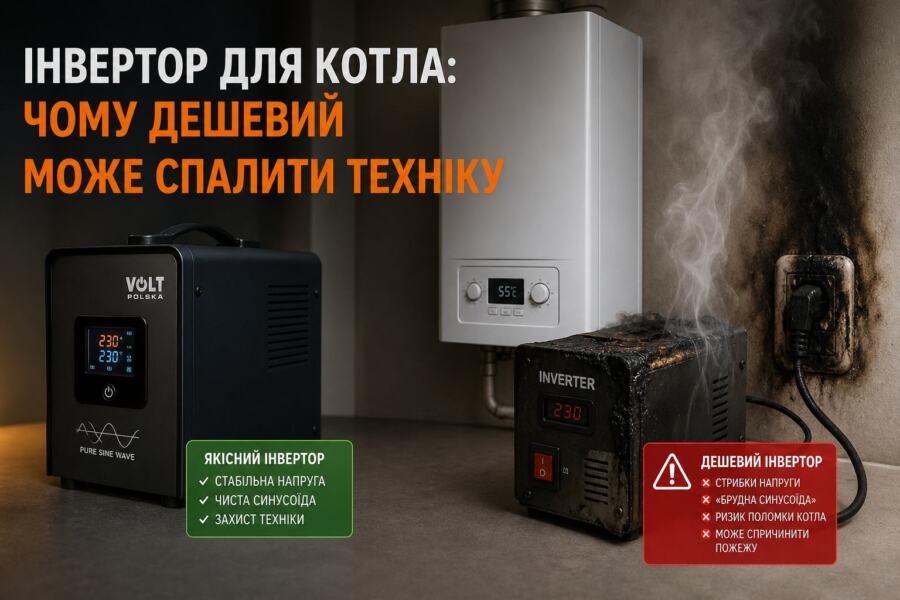
A gas boiler is not just a heater. Inside there is an electronic board that controls the start-up, gas supply, fan operation, sensors, valves and coolant circulation. Most modern models have electronics designed for a relatively stable mains voltage. 220–230 V and the correct waveform.
The most sensitive nodes:
- electronic control board;
- circulation pump;
- turbocharged boiler fan;
- ignition system;
- gas valve;
- thrust, temperature and pressure sensors.
If the voltage is “dirty”, has sharp edges or strong distortions, the electronics may work unstable. At best, the boiler will reboot, give errors or the pump will hum. At worst, the power supply, varistors, relays, part of the board or the pump motor will fail.
What is a pure sine wave and why is it critically important?
The key concept when choosing a backup power source is pure sine wave. This is a form of alternating voltage that is as close as possible to that found in the city's electrical grid. This is the form that most boilers, pumps, and electronic units “love.”.
There are three common inverter output signal options:
- Pure sine wave — the best option for the boiler and sensitive equipment.
- Modified sine wave — a simplified form that can cause noise, overheating, and errors.
- Rectangular or pseudo-sinusoidal signal — unsuitable for most modern boilers.
Why is this important? The pump and fan in the boiler are electric motors. They can consume more current at start-up, and with an incorrect signal shape they heat up more, work with vibrations and noise. Electronic boards also do not like impulse distortions. Therefore inverter for boiler should not be just “12 V and 220 V”, but rather with pure sine wave on the way out.
What is dangerous about a cheap inverter?
Cheap inverter often attracts with its low price, but savings here easily turn into losses. The main problem is that the device may look normal on the outside, but inside it may have simplified circuitry, weak protection elements, and inflated specifications on the label.
Typical risks:
- poor quality voltage form — the boiler operates intermittently or makes a humming sound;
- overstated power “on paper” — in fact, the inverter does not start the pump;
- lack of normal cooling — overheating and failure;
- weak defenses from short circuit, overvoltage and deep battery discharge;
- high internal current consumption — the battery drains much faster;
- electromagnetic interference that interferes with the boiler board.
A separate problem is starting currents. When a pump or fan starts, they can briefly consume several times more than the nominal current. If the inverter is weak, it will either go into protection or “drop” the voltage. At the moment of drop, the boiler can restart, and repeated start cycles are very harmful to the electronics.
What damage can a faulty inverter cause?
The most dangerous thing about poor-quality backup power is that the breakdown does not always happen instantly. Sometimes the equipment works for weeks, and then suddenly fails for no apparent reason. Below are the most typical consequences.
- The control board is burnt out. — due to overheating, pulse interference or unstable voltage.
- The pump is out of order. — the engine was operating in abnormal mode, heating up and losing its resource.
- Power supply damage — weak components cannot withstand constant stress.
- Ignition errors — the boiler does not start or shuts down in an emergency.
- Wiring heating — due to excessive load or poor-quality connections.
It is especially dangerous when the owner sees only a short-term operation of the boiler and concludes that everything is fine. In fact, the electronics can age faster, and the pump life decreases imperceptibly. Such “minor” consequences later turn into expensive maintenance.
How to choose the right inverter for a boiler
That inverter for boiler worked safely, it is necessary to evaluate it not only by price. Several parameters are important that directly affect stability.
- Output voltage type — only pure sine wave.
- Capacity — with a reserve of at least 20–30% from the boiler and pump consumption.
- Peak power — must cover starting currents.
- Battery operating voltage — 12 V, 24 V or 48 V depending on the system.
- Own consumption inverter without load.
- Availability of protections from overheating, overload, short circuit, low battery voltage.
- Stabilization quality and permissible deviations in output voltage.
For most domestic boilers, an inverter is often sufficient. with denomination 300–600 W, but this is not a universal rule. If the system has a powerful pump, several circuits or additional equipment, the margin should be larger. It is more correct to calculate the total consumption of all connected devices, and not to focus on the “average on the Internet”.
| Parameter | What is desirable for a boiler | Why is this important? |
|---|---|---|
| Output voltage shape | Pure sine wave | Safe for electronics, pumps and fans |
| Capacity | 300–600 W or higher as calculated | Start-up and peak load margin required |
| Peak power | 2–3 times higher than the rated load | Helps survive pump or fan start-up |
| Battery discharge protection | Necessarily | Protects the battery from deep damage |
| Cooling | Active or effective passive | Reduces the risk of overheating during prolonged operation |
Battery: no less important than the inverter itself
Even the best inverter for boiler will not save the situation if an unsuitable battery is connected to it. For backup power, the capacity, type of battery and its condition are important. An old car battery is worn out, has a small real resource and does not tolerate deep discharges well.
For household backup power for the house usually used:
- AGM — a common option for backup systems;
- GEL — works well in cyclic modes, but is sensitive to improper charging;
- LiFePO4 — a modern solution with a long service life, but more expensive at the start.
If the boiler consumes little and the outages last 2–6 hours, the battery is 40–100 Ah may be sufficient. But the actual autonomy time depends on the load, inverter efficiency, temperature and degree of battery wear. Very often people buy a powerful inverter and think about the battery “later”. As a result, the system works for 20–30 minutes and turns off.
Typical connection errors
Even the right equipment can be ruined by improper installation. Here are the most common mistakes.
- Connecting a cheap inverter without checking the waveform.
- Undersized cable cross-section, which causes the wires to heat up and the voltage to drop.
- No fuse near the battery.
- Connecting the boiler via an extension cord of questionable quality.
- Ignoring grounding where it is needed.
- Using an old battery with an unknown resource.
- Trying to feed through inverter for the whole house at once without load calculation.
The biggest danger is overconfidence. If the boiler “somehow started up”, this does not mean that the system is safe. Proper testing should include a load test, case temperature monitoring, input and output voltage measurement, and checking the boiler’s response to start-up and mode changes.
How to understand that the inverter is right for your boiler
To avoid making mistakes, it is worth going through a simple practical algorithm. It will help you assess compatibility without complex electrical terminology.
- Look at the boiler passport and find power consumption.
- Consider separately pump, fan and additional units.
- Check if it has pure sine wave inverter.
- Compare the inverter rating with the actual load and add a margin.
- Evaluate the battery: will it have enough capacity for the required battery life?.
- Check the quality of cables, terminals and protective elements.
- Perform a test run and see if there is any noise, heating smell, or boiler errors.
If the boiler has electronic control, a circulation pump and turbocharged combustion product exhaust, cheap inverter without normal sine wave — this is almost a guaranteed risk. In such a system, saving a few hundred or thousands of hryvnias can result in repairs for a much larger amount.
When you can save money and when you can't
You can save on minor things: careful installation, price comparison, choice of case or installation method. But you can't save on something that directly affects the quality of power.
You shouldn't save on:
pure sine wave - cheap inverters with a modified sine wave are suitable only for lighting or charging phones. Sensitive household appliances (especially gas boilers, refrigerators and circulation pumps) only need a pure sine wave, otherwise their motors and control boards will quickly burn out;
the correct battery type — an attempt to save money and install a regular car (starter) battery instead of a specialized AGM, GEL or LiFePO4 will destroy it in a few months. Energy independence systems require batteries that are designed for deep and regular discharges;
inverter power reserve — equipment should not constantly operate at the limit of its capabilities. If the total peak load of appliances in the house is 2 kW, the inverter should be at least 3 kW so that it can easily withstand the starting currents of the equipment;
high-quality cables and protection automation — in 12V or 24V systems, huge currents flow. Using wires that are too thin will lead to their critical heating and energy loss. And the lack of the right fuses and DC circuit breakers is a direct risk of short circuits and fires;
reliable BMS board (for lithium systems) — if you buy modern LiFePO4 batteries, the management board (BMS) must be as reliable as possible. It is it that protects expensive cells from overheating, overcharging, critical discharge and balances them for long service life.
📌 The golden rule of energy independence: Everything that is directly responsible for fire safety, current transformation, and energy storage should be purchased once and from proven brands. However, you can save absolutely safely on aesthetics, choosing the brand of the housing itself, shelves for installation, or comparing prices from different suppliers.