
Useful tips
How to properly install a battery and UPS: engineer's tips


Proper installation of the battery and UPS determines not only the stability of the backup power supply, but also fire safety, battery life, and the absence of problems with odors, overheating, and corrosion. Errors during the installation stage are often more expensive than the system itself: the battery ages faster, the UPS operates in emergency mode, and risks appear in the room that could have been avoided by simple technical actions.
For an apartment, a private house or an office, the logic is the same: the battery should be located where it is provided with a normal temperature, minimal dust, access for inspection and a safe connection. If you ignore the basic requirements, even a high-quality unit on 12V or a large set for UPS will lose part of its life in the first season. That is why the question is not only which battery to buy, but also where to keep the battery in the summer, how to organize ventilation and how not to violate safety rules.
In the practice of engineering services, three mistakes are most often made: the battery is placed near the boiler or close to the inverter, it is closed in a cramped cabinet without air exchange, or it is connected UPS through thin wires with a large voltage drop. All this reduces the efficiency of the system. Instead, safe installation UPS — this is not a complex scheme, but a sequence of technically correct solutions.
Especially many questions arise about whether it is possible to install a gel battery in an apartment. The answer depends not on the "gel" as such, but on the state of charge, operating mode and room conditions. AGM, GEL and less commonly used flooded batteries behave differently, but temperature, ventilation and the correct charging profile are critical for all.
Where to place the UPS and battery in a home or facility
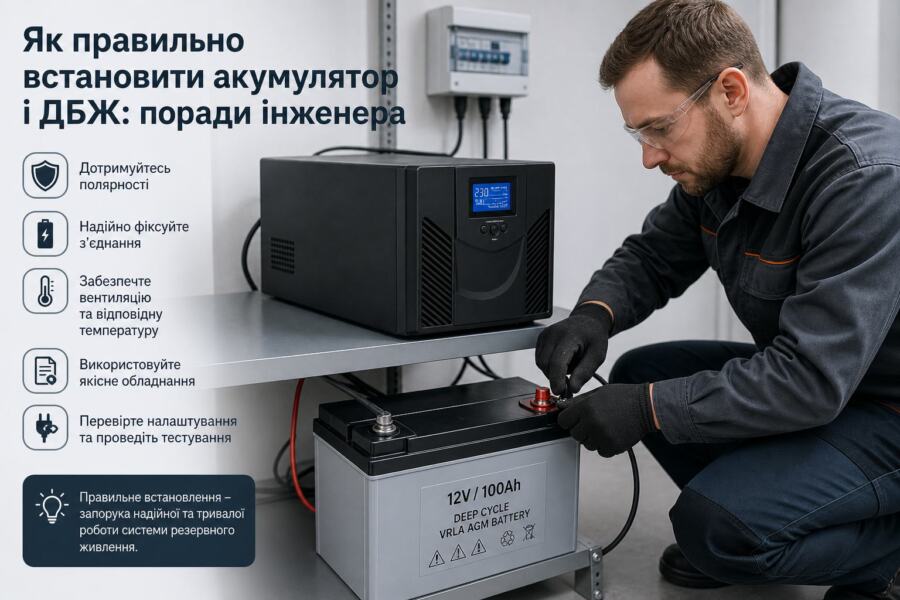
The optimal place is a dry room with a temperature close to room temperature, without direct sunlight, without heating devices nearby and without the risk of flooding. For an apartment, this can be a technical closet, pantry or a separate corner in the hallway. For a house, it can be a boiler room, pantry, garage or insulated utility room, but not a place with sharp temperature jumps.
The UPS should not be placed on soft surfaces, carpet or close to a wall. The housing should dissipate heat, and the ventilation holes should not be blocked. Another thing is important for the battery: it does not like spot overheating and constant operation in high current mode in a confined space. If the battery pack is in a cabinet, it definitely needs a gap for air circulation.
The rule of thumb is simple: the higher the capacity and discharge current, the more serious the requirements for the installation space. The router and lighting kit can still be placed compactly, but the system for the boiler, pumps and server room already requires a separate shelf, access to the terminals and normal cable routing.
If the system backs up critical loads, such as the boiler, circulation pumps, internet, and alarm, leave access to the circuit breaker, circuit breakers, and terminals without dismantling the entire unit. In the event of a failure, this saves minutes and sometimes prevents equipment damage.
Temperature, humidity and where to keep the battery in summer
The most important life parameter is temperature. For most lead-acid systems, including AGM, the optimum temperature for AGM is battery is approximately 20–25°C. The higher the temperature, the faster the plates age and the electrolyte dries out. Any excess 10°C can significantly shorten battery life.
That is why the question of where to keep battery in the summer, you can’t decide on the principle of «where there is a place». You should not place the battery near a window, on a sunny wall, above a boiler or in a closed metal box that heats up. In the heat, the room should be ventilated, but without a direct flow of hot air on the case.
High humidity is also undesirable. It provokes oxidation of the terminals, worsens the contact and can cause parasitic currents on a dirty surface. For the technical area, dryness, absence of condensation and periodic inspection of the terminals are sufficient. If the battery operates in the basement, it is necessary to control not only the humidity, but also the temperature in winter: hypothermia reduces the efficiency of the capacity.
For apartments and offices, a simple approach works well: the battery is located away from windows, radiators and kitchen appliances, and the air around it should be freely renewed. This is especially important when The UPS is charging the battery. after a long network outage.
Can I install a gel battery in an apartment?
Yes, you can, if it is a sealed battery in good condition, is properly charged and does not overheat. Gel and AGM batteries do not require topping up with water, so for domestic use they are much more convenient than the old open types. But this does not mean that you can put them anywhere.
In an apartment, the main restrictions are access by children, a closed niche without air exchange, proximity to heat sources and the risk of mechanical shock. If the battery is mounted under a countertop or in a cabinet, it must stand on a flat, non-flammable surface. The terminals must be covered from accidental contact, and the cables must be secured to prevent tension.
For a household backup, it is important not to confuse tightness with the complete absence of gassing. In normal operation, modern batteries work without problems, but during overcharging or a faulty UPS, gases and heating may appear. Therefore, safe installation The UPS always includes charge voltage monitoring and matching the charging profile to the battery type.
A short rule for an apartment: you can install a sealed battery if there is a normal place, access for maintenance and a stable charging mode. You cannot hide the battery in a «dead» closed niche without air, near a radiator or in an area of direct sunlight.
Ventilation for UPS batteries: when is it needed?
Ventilation for UPS batteries is needed not only because of gases, but also because of heat dissipation. The more intensive the charge and discharge, the more heated both the battery and the UPS itself. In small systems, natural air exchange is sufficient, if the room does not overheat. In large battery cabinets or technical rooms, controlled air exchange is required.
A practical sign of proper ventilation is that the enclosures do not become hot to the touch, there is no odor, and the temperature in the battery area does not exceed the recommended range. If the enclosure is completely closed, heat accumulates inside, which accelerates degradation. This is especially noticeable in the summer or during long charging after a power outage.
For a small UPS in the apartment It is often sufficient to leave a few centimeters on all sides and not to cover the grilles. For a more powerful system, it is advisable to provide ventilation holes at the bottom and top of the cabinet to allow natural convection. If multiple batteries are installed, a gap is also required between them.
It is important to remember: ventilation is not just a «gap in the door». If the room is poorly ventilated, even a sealed battery can create dangerous conditions in the event of an emergency. Therefore, ventilation solutions depend on the system capacity, number of batteries and charging mode.
| Parameter | AGM | GEL |
| Operating temperature | 20–25°C | 20–25°C |
| Sensitivity to overheating | High | High |
| Need for ventilation | Desirable | Desirable |
Typical installation errors: from cable to terminals
The most common technical mistake is too long or thin cables between the battery and the UPS. This causes voltage drops, heating of the wires and incorrect operation of the inverter. In systems on 12V and 24V Even a few extra meters can reduce efficiency. The cable must not only be of high quality, but also of sufficient cross-section.
The second mistake is weak terminal connections. If the contact is not tightened, local overheating occurs. It is often not visible immediately, but after a while darkening, melting of the insulation and unstable operation of the UPS appear. During any installation, it is necessary to check the tightness, cleanliness of the contact surfaces and the absence of backlash.
The third mistake is mixing batteries of different ages or types in the same circuit. The old and new batteries in a pair work unevenly, which is why one of them is constantly overloaded. This dramatically reduces the service life of the entire assembly. If you need a new set, it is better to take identical models from the same series.
Short-circuit protection is also often forgotten. There must be a fuse or circuit breaker next to the battery, rated for the system current. This is a basic requirement for a safe UPS installation, not an optional extra.
How to check the system after installation
After connecting, you should check not only the start-up, but also the behavior under load. First, the system works from the network, charges the battery and does not overheat. Then you need to disconnect the input network and see if the UPS switches to standby without a pause. If there is a delay, blinking of the lamps or restarting of the load, you need to look for an error in the connection.
Next, you should check the temperature of the UPS case, cables, and battery after 20–30 minutes of operation. If the elements are noticeably hot, it means there is either an overload, or a bad contact, or an insufficient conductor cross-section. For a household system, normal operation is when the equipment does not generate excess heat and does not emit an odor of overheating.
An equally important test is recovery after discharge. After return network, the UPS should switch to standard charging without errors. If the voltage "jumps" or the indicators show a malfunction, this means that either the battery is already exhausted, or the charging algorithm does not correspond to its type.
For business facilities, it is useful to keep a simple log: installation date, battery type, open circuit voltage value, inspection date and temperature notes. This approach allows you to predict replacement before an accident, rather than after the system stops.
Practical conclusion
The battery and UPS are working reliably only when they are installed in a dry, cool and accessible place, with normal cables, protection and without blocked ventilation. For an apartment, you can install sealed batteries, but only on condition that there is air exchange and there is no overheating. For a home and a business, not only the parameters of the battery itself are critical, but also competent placement, checking of contacts and temperature control.
If you focus on engineering discipline, and not on random installation, the system will work for a long time, quietly and safely. It is such a safe installation of the UPS that provides real energy independence without unnecessary risks for housing and equipment. In the electro shop catalog, it is easy to choose solutions for household and professional tasks, but the final result is always determined by the correct installation.