
Useful tips
Where to install the battery and UPS correctly: engineer's advice


The right place for the battery and UPS determines not only the battery life, but also fire safety, power stability and ease of maintenance. In practice, most problems arise not because of a «bad brand», but because of improper installation: the battery is placed near a radiator, in a closed cabinet without air exchange, or simply on the floor near a sunny window.
For lead-acid systems, particularly AGM and gel, three factors are critical: temperature, ventilation і access to the service. If these conditions are met, the UPS operates as expected, and the battery delivers its rated life without premature degradation. If not, the battery loses capacity faster than it was visible at the time of purchase.
A common question is simple: Can I install a gel battery in an apartment?? Answer: yes, but only if there is proper ventilation, normal temperature and no risk of short circuit. «Safe» does not mean «put it anywhere and forget it». For UPS and batteries require a technical approach, not everyday intuition.
Below are practical installation rules that engineers use when installing backup power for apartments, private houses, offices, cashier areas, server rooms and systems. video surveillance. This is where costly errors most often occur: from reducing the AGM life to overheating the inverter and stopping the entire system.
Where to physically place the battery and UPS
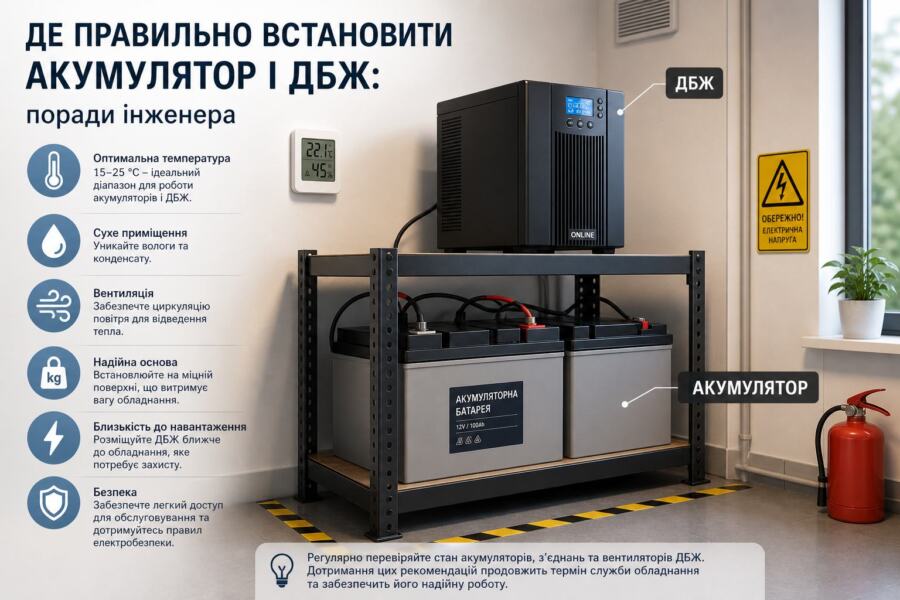
The best place is dry, protected from direct sunlight, with a moderate temperature and minimal vibration. For an apartment, this can be a technical niche, a pantry, a spacious closet with ventilation holes or a separate corner near the shield, if there are no heating devices there. For a house, a boiler room, a technical room or a communication area, but not near gas equipment without taking into account safety standards.
UPS and battery should not be placed close to the wall or close to each other without a gap. For most household solutions, it is enough to leave 5–10 cm on the sides and back for heat dissipation and easy access to the terminals. If the system is more powerful, and batteries several, the gap should be larger, especially in closed furniture or server cabinets.
A typical mistake is installing it on a windowsill, near a radiator, or in the attic. In winter, it can be colder there than normal, and temperature for AGM battery must be stable. In the summer, overheating accelerates the corrosion of the plates and the drying of the electrolyte. That is why the question where to keep battery in the summer The solution is simple: in the coolest, most stable technical area, not where "there is free space.".
If it is a residential backup power supply, the load-bearing capacity of the shelf or stand is checked separately. One battery per 12V 100 Ah weighs a lot, and a block of two or three batteries can create a dangerous load on light furniture. In service practice, there have been cases when the shelf bent, the terminals shifted, and a spark contact appeared. This is no longer a question of resource - it is a question of an accident.
.
Ventilation, heating and why you can't "lock it in the closet"«
Battery ventilation UPS required even for sealed AGM and gel models. Such batteries are not "vapor" but can still release trace amounts of gas through the valves during charging. If the space is closed, thermal energy accumulates and the temperature of the case rises. This reduces the battery life and increases the risks to the plastic, terminals and electronics UPS.
For household monitoring, a simple rule is enough: if the closet is warmer than the room and there is no natural air movement, the conditions there are already bad. Closed cabinets under the TV, metal shields without grilles, pantries without gaps are questionable places. For more serious systems, ventilated closets or separate rooms with supply and exhaust are installed.
The heating itself should be controlled separately. UPS. The inverter converts energy, and therefore heats up. If there is no free space around it, the fan spins at high speeds, the noise increases and the life of the electronics decreases. In real objects, this manifests itself as follows: it seems that the battery is working, but the UPS goes into overload protection due to overheating. 220V.
| Condition | Gel battery | AGM battery |
| Sensitivity to heat | High | High |
| Permissible room installation | Yes, for ventilation | Yes, for ventilation |
| Best mode | Stable 20–25°C | Stable 20–25°C |
| Main risk | Overheating and overcharging | Overheating and undercharging |
To put this into perspective, a 10°C increase in temperature in the battery area can significantly shorten the life of a lead-acid battery. That is why installing it close to a boiler, water heater, sunny window, or system unit with poor ventilation is a bad idea.
Temperature, humidity and seasonal risks
Most lead-acid batteries operate optimally at moderate room temperatures. For practical purposes, the range is 20–25°C. This is where the battery delivers capacity stably and the UPS charger operates without undue stress. At temperatures below zero, the available capacity drops, and overheating accelerates the aging of the plates.
Not only temperature is important, but also its stability. If the battery heats up during the day and cools down at night, the chemical processes inside it change cyclically, which affects the resource. Therefore Where to keep the battery in the summer — it's not about "where is cooler now," but about a place without sharp temperature jumps.
Humidity also matters. Condensation on the terminals or the UPS board causes oxidation, increased resistance and local heating. If the system is located in a basement, garage or technical room, be sure to check for dampness, leaks and direct contact with the cold floor. It is better to place the equipment on concrete through a stand or insulating platform.
In apartments, batteries are not placed near the sink, washing machine, or in the bathroom. It's banal, but this is how UPSs are often "hidden", hoping not to spoil the interior. The result is moisture, steam, a chemical environment, and then complaints about the smell, rust, and reduced autonomy.
Can I install a gel battery in an apartment?
Yes, Can I install a gel battery in an apartment? — it is possible, if it is a sealed battery in good condition, with a correctly selected charge and normal heat dissipation. Gel models are convenient in that they do not require topping up electrolyte and are better able to tolerate household installation. But they do not cancel safety rules: they cannot be installed without ventilation, short circuit protection and charge control.
AGM batteries are also suitable for residential premises, but for them it is especially important temperature for AGM battery. When overheated, they lose their life quickly, and when constantly undercharged, they lose capacity due to sulfation. If UPS works in the apartment As a backup for a router, alarm system, or lighting, the battery should be located where the temperature does not "walk" from the kitchen to the balcony.
For apartment buildings, it is critically important not to exceed the permissible load on the network and not to connect homemade sockets without protection. Safe UPS installation requires a separate line, a suitable circuit breaker, high-quality terminals and no kinks. If the system is large, it is better to move it to a technical cabinet with a ventilation hole and a temperature sensor.
From practice: in an apartment on the 3rd floor there are two batteries 12V 100 Ah were standing in a closed cabinet near the radiator. After one season, one battery started to "sag", and the UPS turned on the alarm signal under load. The reason was not in the inverter, but in overheating and poor air exchange. After moving it to a cool pantry with ventilation holes, the problem disappeared.
Safe connection, cables and common installation errors
Connections begin with checking the polarity. Mixing up the «+» and «-» on the battery means you risk damaging the fuse, the board UPS or battery itself. The cables must have a sufficient cross-section, and the terminals must be tightened without play. A weak contact heats up under load, and this heating is sometimes more dangerous than the battery itself.
It is advisable to protect the terminals with caps or insulation. A metal tool that accidentally touches two contacts will cause a short circuit with a very high current. This is especially critical for large batteries on inverter systems. There should be no metal objects, liquids, paper and flammable materials nearby.
One common mistake is installing the battery close to the UPS without taking heat into account. The battery and the inverter itself «"set fire" to each other in the sense of overheating: the battery loses its resource, and the UPS goes into protection more often. Another mistake is storing it in a discharged state. Even the best battery does not like long downtime at low voltage.
Another practical detail: if there are several batteries in the system, they should be placed as close as possible in terms of temperature and charged equally. Mixing old and new batteries in one circuit without checking the parameters is a direct path to current imbalance and premature failure of one of the elements. This applies to both household systems and small offices.
When you need a separate closet or room
A separate cabinet is needed when the system has a larger capacity, operates for a long time, or is located in a room with high aesthetic and security requirements. For an office, store, cash register area, or server room, this is often the best solution: the batteries do not interfere with people, access is limited, and ventilation can be organized correctly. For an online store or warehouse, backup power is often configured in such a way as not to lose the cash register, the Internet, and access control.
If the installation is done through an electrical shop or professional supplier, it is worth specifying not only the capacity and type of battery, but also the installation requirements: mass, placement, operating temperature, charging method and warranty conditions. In stores like electro-shop.com.ua Usually, you can choose not only the battery or UPS itself, but also compatible cables, automation, and accessories for safe installation.
If the room is small, but you need a powerful battery, it is wiser to use a ventilated metal cabinet with service access, rather than "hiding" everything in furniture. This simplifies voltage control, battery replacement, and terminal maintenance. Additionally, you can install a thermometer or a simple sensor to monitor overheating before an accident occurs.
Practical conclusion
Battery and UPS place where there is dryness, stable room temperature, access for maintenance and normal air movement. For apartments, houses and small businesses the main rule is simple: not near heat, not in a sealed cabinet, not on a damp floor and not without contact protection. Safe UPS installation It doesn't start with the purchase, but with the right installation location. If you follow these requirements, the system will work longer, quieter and without surprises.