
Useful tips
Solar power plants without permits: how to install a solar station on the roof of a house in 2026 (Resolution No. 77)


Solar panels without permits 2026 year can be installed on the roof or facade of a private residential building according to a simplified procedure, if the work does not change the geometric dimensions of the building and does not affect its load-bearing structures. Resolution of the Cabinet of Ministers of Ukraine No. 77 has fixed such work in the list of those that do not require documents for the performance of construction work and after completion do not require the acceptance of the facility into operation. However, "without permits" does not mean "without a project, electrical safety rules and approval from the network operator" if the station will provide electricity to the outside.
What exactly does Resolution No. 77 allow?
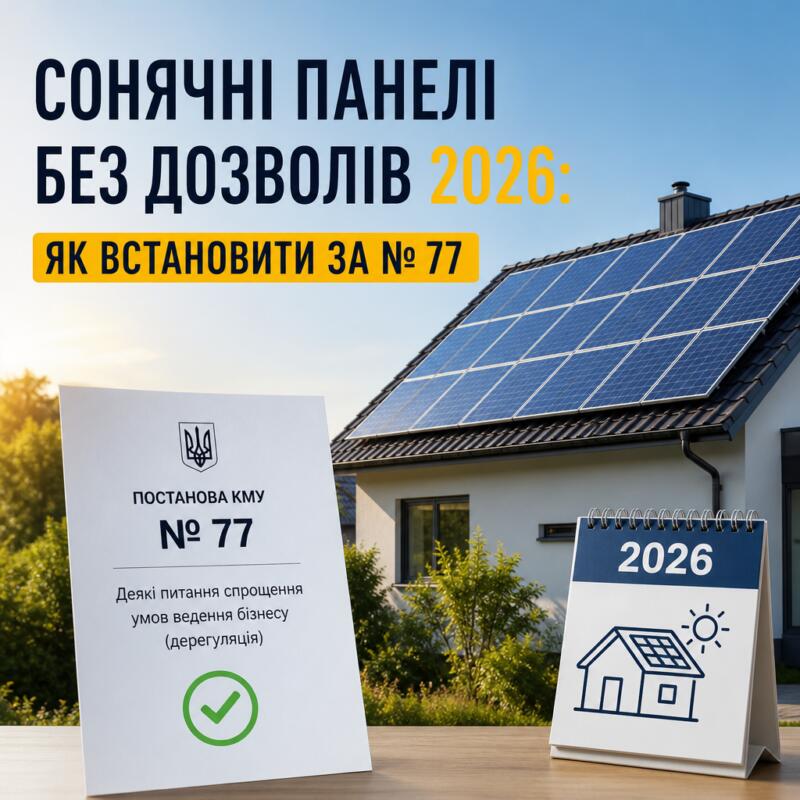
Resolution No. 77 primarily concerns construction part Installation of equipment. The owner may install solar panels on the roof or facade of a building without obtaining a notice or building permit if the installation:
- does not change the external geometric dimensions of the house;
- does not involve roof reconstruction;
- does not damage or change supporting structures;
- is performed within the legal property;
- does not violate special restrictions for monuments, protected areas or common property.
For example, installing rails on an existing rafter system and installing panels on them is usually a simplified option. However, if the roof needs to be raised, supports added, its shape changed, or the structure reinforced with interference with load-bearing elements for the sake of the solar power plant, the situation may already require design and construction documentation.
Importantly: The resolution does not repeal the Rules for the arrangement of electrical installations, fire safety requirements, technical conditions for connection, and contractual procedures with the distribution system operator.
When documents are not needed, and when you can't do without them
| Scenario | Building permit | Contacting your network operator | What to consider |
|---|---|---|---|
| Autonomous solar power plant without physical connection to the grid | Usually not needed | Usually not needed | Grounding, protection, roof condition |
| Hybrid solar power plant without electricity export | Usually not needed | Depends on the connection scheme | A guaranteed export restriction is required |
| Grid-connected solar power plant with surplus return | Not required for typical installation | Required | Counter, scheme, contractual relations |
| Installation with a change in the roof or supporting structures | May be needed | Depends on the type of solar power plant | Survey, design, construction procedures |
| Panels on an apartment building | Depends on the work | May be needed | The roof is the joint property of the co-owners. |
For an autonomous system, the logic is simple: the panels charge the battery via a controller or hybrid inverter, and the backup lines are powered separately. If the system does not have parallel operation with the external grid, generation coordination usually does not occur.
Another thing is a network inverter. Even a household station on 5 kW can feed the surplus into the general network. Unauthorized connection is unacceptable: it creates a risk of reverse voltage during emergency work and may give rise to claims from the distribution system operator.
How to properly plan a rooftop solar power plant
It's worth starting not with buying panels, but with an energy audit. Write down the daily consumption of critical appliances: refrigerator, pump, boiler, lighting, router, computers. Separately consider the starting currents of motors.
Practical example: a refrigerator, gas boiler, circulation pump, router and light consume on average about 5–7 kWh per day. For their summer cover, an array is often enough. 3–4 kW, but in winter the output can be several times lower. Therefore, the system should not be calculated based on summer indicators.
Before installation, check:
- roof condition — the residual resource must correspond to the service life of the panels;
- carrying capacity — the weight of the modules and fasteners is supplemented by snow and wind loads;
- orientation — the southern slope gives maximum annual output, the east-west slope equalizes generation throughout the day;
- shading — a chimney, tree or neighboring building can significantly reduce the result;
- cable route — without sagging, sharp bends and contact with hot surfaces;
- inverter and battery location — dry, ventilated, protected from sun and frost.
It is better to repair the old roof before installing the station. Removing twenty panels to replace a leak will cost more than timely roof preparation.
What scheme to choose for the house
Autonomous solar power plant suitable for facilities without a network or for separate backup lines. It requires battery of sufficient capacity, and sometimes a generator for long cloudy periods.
Hybrid solar power plant combines panels, a battery and an external network. This is a practical option for energy independence: during the day the house consumes solar energy, the excess charges the battery, and during a power outage the inverter powers the critical load.
Grid-connected solar power plant operates without batteries or with minimal storage and focuses on its own consumption or sale of surplus. A conventional grid-connected inverter during the disappearance of external power voltage 230/400 V turns off. This is a mandatory anti-islanding function, so the mere presence of panels does not guarantee light during outages.
For most private homes, a 5 kW hybrid inverter with a LiFePO4 battery is the golden mean: it allows you to power the house during blackouts and at the same time effectively use solar energy during the day.
Rules for legal connection and return to the network
Although Resolution No. 77 simplified construction procedures, interaction with the electrical grid requires following clear steps:
- Generation restrictions (Zero Export): If you do not plan to sell electricity or are waiting for paperwork, the output limitation function must be enabled in the inverter settings. This prevents energy from being transferred to the external network without approval.
- Bidirectional counter: For work on green tariff or Net Billing mechanism It is necessary to submit an application to the Distribution System Operator (DSO) and install a smart meter with ASKOE.
- Power matching: The installed power of the inverter must not exceed the permitted power according to the grid connection agreement.
Main conclusions and recommendations
Resolution No. 77 significantly simplifies the lives of private homeowners by removing bureaucratic barriers when installing solar panels on roofs. However, for stable and safe operation of the solar power plant, follow three main rules:
- Assess the condition of the roof: Before installation, check the strength of the rafters and the condition of the covering to avoid expensive dismantling in the future.
- Choose a hybrid system: For protection against outages, choose hybrid inverter with modern LiFePO4 battery.
- Take care of your protection: Use quality DC and AC switchboards, automation, grounding, and lightning protection.