
Useful tips
Battery sulfation: how to revive a battery after discharge


Battery sulfation is one of the most common reasons why a seemingly healthy battery suddenly stops holding a charge, sags under load and no longer starts an inverter, UPS or car. Over the years, I have seen dozens of cases where people scrapped a battery, even though the problem was not the “death” of the battery, but strong deep discharge, prolonged downtime in a discharged state and the formation of lead sulfate crystals on the plates. If you understand the physics of the process, it becomes clear: not every battery can be revived, but many can still regain some of their capacity and working life.
What is battery sulfation and why does it occur?
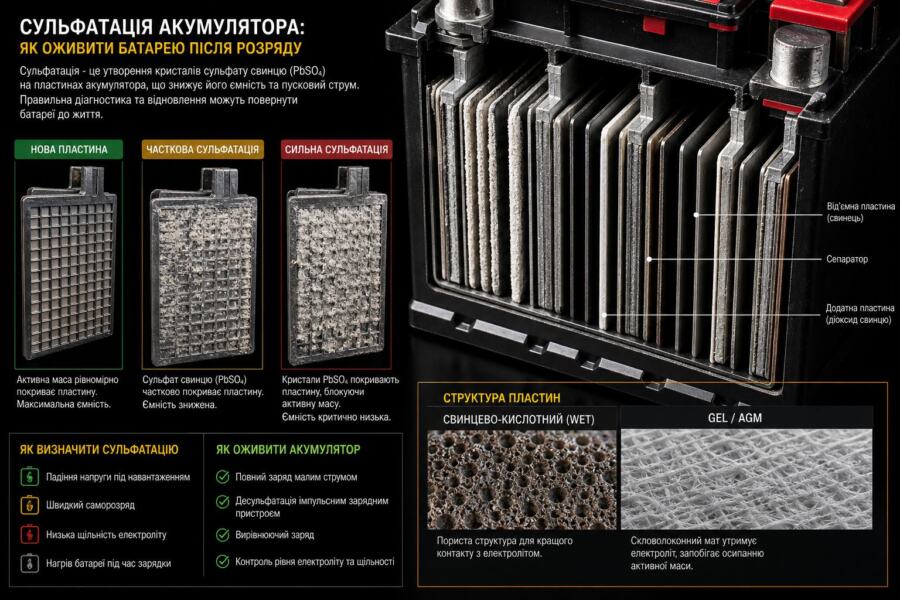
Lead-acid batteries form lead sulfate on the plates during normal operation. This is a natural process. The problem begins when the battery is left in storage for a long time. discharged state or regularly receives deep battery discharge. In this case, the sulfate becomes not finely crystalline and reversible, but dense, coarse, and poorly soluble.
As crystals grow, they:
– reduce the active area of the plates;
– increase internal resistance;
– reduce charge reception;
– cause strong heating during charging;
– reduce the actual battery capacity.
The worst thing is that sulfation is often disguised as a “normal” charge. The voltage at the terminals can rise to 12.6–12.8 V, but under load the battery immediately drops. This is a classic symptom when the battery seems to be alive, but can no longer give off energy.
Which batteries suffer the most from deep discharge?
Not all batteries react the same to discharge and downtime. This is very important in practice, because gel battery restoration has its limits, and a regular “flooded” starter battery tolerates errors differently.
| Battery type | Deep discharge resistance | Recovery probability | Features |
|—|—:|—:|—|
| Starter lead-acid | Low | Average | Does not tolerate long-term discharge, likes high currents |
| AGM | Average | Higher than starter | Sensitive to overcharging, but recovers well with early intervention |
| Gel | High, but with nuances | Medium | Does not like high charging voltages, severe sulfation and overheating |
| Traction lead-acid | Higher | High | Designed for cyclic operation, better withstands discharges |
Gel and AGM batteries are often tried to be “resuscitated” incorrectly: they apply too much voltage, boil the electrolyte inside, or destroy the separators. Therefore gel battery restoration You need to be much more careful than with a regular car battery.
Signs that the battery is already sulfated
There are several typical symptoms that can help you suspect a problem almost without any equipment:
– the battery charges “to full” very quickly;
– after charging, the voltage seems normal, but under load it drops sharply;
– the inverter or UPS turns off after a few minutes;
– the case may be slightly warmer than normal during charging;
– the charger quickly switches to “float” mode, although the capacity is not restored;
– after a night without load, the voltage drops below 12.4 V;
– the starter battery only starts the car after several attempts.
If the battery has been standing after a deep discharge a week, a month or longer in a discharged state, the chance of significant sulfation is very high.
How to revive a battery: a practical recovery scheme
Before looking for miracle modes, we need to understand the basic logic: we are not “curing” the battery with magic, but trying slowly dissolve some of the crystals and restore the chemical activity of the plates. This is possible only if there is no physical destruction of the cans, a short circuit inside, or a critical loss of electrolyte.
1. Check the real battery status
We need:
– multimeter;
– charger with current and voltage regulation;
– preferably a load fork or at least a test load;
– thermometer or body touch control.
What we are watching:
1. No-load voltage.
2. Deflection under load.
3. Case temperature while charging.
4. Presence of swelling, cracks, odor, leaks.
If the case is swollen, there are signs of overheating, or the can is clearly closed, there is almost no point in “reviving” it. This is a matter of safety, not economy.
2. Start with a small current
A sulfated battery does not need to be charged with a high current right away. On the contrary, charging it too hard will only heat the plates, accelerate gas formation, and can damage a weakened battery.
In practice, I recommend:
– starting current 0.03–0.05C;
– for the battery 100 Ah this is approximately 3–5 A;
– for gel and AGM sometimes even less, depending on the passport.
The charge voltage depends on the type:
– for regular lead-acid – approximately 14.4–14.8 V;
– for AGM — usually 14.4–14.7 V;
– for Gel – often 14.1–14.4 V, no more than recommended by the manufacturer.
Importantly: If the manufacturer has specified other values, you should take them, not the “hospital average”.
3. Do a long slow charge
Severe sulfation is not cured in half an hour. Sometimes the process takes 12–48 hours, and sometimes longer. This is not a whim, but chemistry: the crystals dissolve gradually.
Signs that the process is going well:
– the voltage increases slowly;
– the current gradually decreases;
– the body remains barely warm, not hot;
– the battery starts to hold a higher voltage after settling.
Danger signs:
– the temperature rises sharply;
– the battery hisses, swells;
– the voltage increases very quickly, and the current almost does not drop;
– charging starts to “jerk” or disconnects.
In that case, you need immediately reduce the current or stop the charge.
4. Use desulphation with caution
Some chargers have a desulfation or pulse recovery mode. It can help, but not always. The physics here is this: short pulses sometimes break down surface sulfate better and improve charge acceptance. But it is not a “magic button”.
Useful when:
– the battery is not completely dead yet;
– moderate sulfation;
– banks are not closed;
– there is voltage and temperature control.
Useless or dangerous when:
– the battery has been recharged repeatedly;
– there is mechanical shedding of the active mass;
– the battery has been at zero for a very long time;
– this is a gel with very tight voltage limitations.
5. Conduct a control cycle
After a full charge, you need to not just look at the voltage, but check it with real work:
– discharge the battery with a test load;
– measure working time;
– estimate voltage drop;
– repeat the charge and compare the result.
If after restoration the capacity has risen to at least 60–80% from the nominal value, the battery can still be used for less critical tasks: lighting, backup power for small appliances, inverter for a short time. If the result is weak, the battery is already at the limit of its life.
Gel battery restoration: what is possible and what is not
Gel battery does not like mistakes. Inside, the electrolyte is bound in a gel, so overheating and overcharging are especially dangerous for it. When I am asked if it is possible gel battery restoration, my answer is: yes, but only if deep destruction is not allowed.
What can be done:
– charge with a low current;
– use only the correct voltage;
– do not allow heating;
– let the batteries stand after charging.
What you can't do:
– apply “automotive” mode with high voltage;
– connect homemade pulse circuits without control;
– try “boiling” with high currents;
– to open the case without experience and necessity.
If a gel battery after a deep discharge does not draw normal current in the first few hours, or heats up, or sharply increases voltage without capacity, the chance of full recovery is very small.
When the battery can no longer be revived
There are situations when the question “how to revive a battery” no longer has any practical meaning. I consider the following signs to be critical:
– one or more cans are closed;
– the battery has severe bloating;
– after charging, the voltage quickly drops below 12 V;
– the case gets very hot when charging;
– there is a clear smell of overheating or leakage;
– after several cycles, the capacity hardly increases;
– the starter battery is not able to provide starting current after restoration.
In such cases, it is cheaper and safer to replace the battery than to risk equipment damage or fire.
Prevention: how to prevent re-sulfation
The best recovery is the one that wasn't needed. To battery sulfation not repeated, follow simple rules:
1. Do not leave the battery in a discharged state for a long time.
2. Do not allow deep battery discharge below the permissible level.
3. For backup systems, install the correct charger with storage mode.
4. Check the voltage at rest and under load every few months.
5. Do not overcharge gel and AGM batteries.
6. Monitor the temperature at the installation location.
7. If the system is idle, perform a preventive recharge.
For lead-acid batteries, it is important to keep the charge above the critical limit. When the battery is “left in the zero” state for a long time, the sulfates harden and become poorly soluble. This is when normal charging is of little help.
Practical table: what to do if sulfation is suspected
| Symptom | Probable Cause | Action |
|—|—|—|
| There is voltage, but there is no capacity | Sulfation of plates | Slow charge with low current |
| Battery heats up at the start of charging | High internal resistance | Reduce current, control temperature |
| Quickly builds voltage, but does not hold load | Poor charge reception | Long charge/discharge cycle |
| Inflated case | Overheating, gas formation | Stop operation immediately |
| One can “falls out” | Possible internal defect | High probability of replacement |
What result is considered a success?
In everyday life, people often think that recovery is when the battery is “like new” again. In fact, success is when the battery:
– holds the charge noticeably better than before the procedure;
– does not heat up;
– receives current normally;
– works stably under load;
– does not fail after a short downtime.
If you managed to restore at least part of the capacity and relieve the acute symptoms of sulfation, this is already a useful result. But you need to honestly understand: battery sulfation often leaves irreversible losses.
Conclusion from Engineer Gennady
If the battery is dead after being discharged, don't rush to write it off. First, check the voltage, behavior under load, and temperature during charging. That's it. slow controlled charge gives the best chance to understand whether the battery can still be revived. But remember the main thing: safety is more important than economy. If there is swelling, overheating, smell or a closed can - such a battery is no longer saved, it is replaced.
Frequently Asked Questions (FAQ)
Is it possible to completely remove sulfation?
Completely - rarely. Usually only partially restore capacity and reduce symptoms.
Is pulse charging suitable for all batteries?
No. For AGM і Gel it is permissible only within the manufacturer's recommendations. Excessive impulses can be harmful.
How long does it take to recover after a deep discharge?
From several hours to 2 days, sometimes longer. This depends on the degree of sulfation and the type of battery.
Is it possible to revive a battery that has been discharged for several months?
Sometimes it's partial, but the chance is low. If the battery has been sitting idle for a long time, especially without recharging, the damage often becomes irreversible.