
Useful tips
Solar Panels for Remote Sites: How to Choose the Best 2026


Solar Panels for Remote Sites: How to Choose the Best 2026
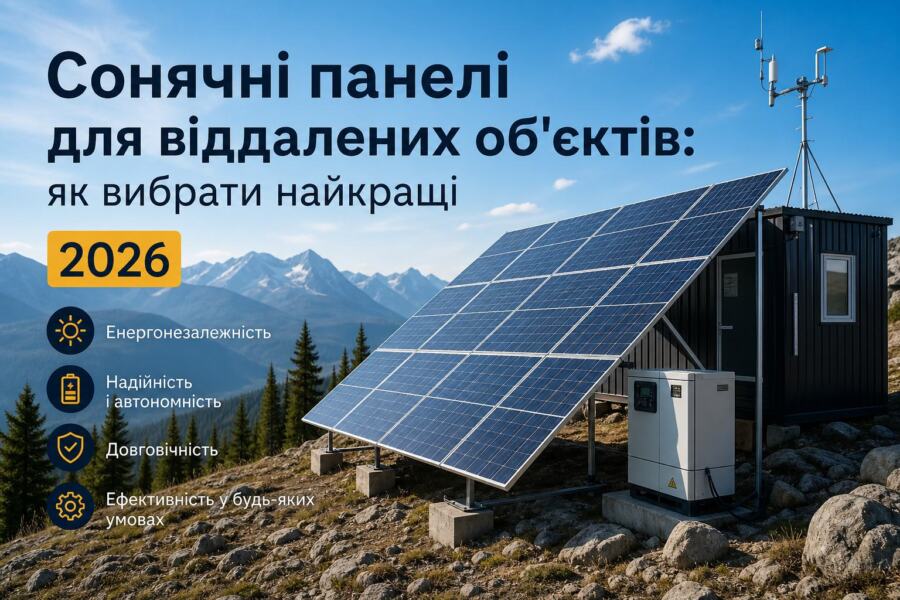
For remote homes, weather stations, telecommunications hubs, farm buildings and tourist resorts, solar energy is often not just a convenience, but the only real source of power. That's why solar panels for remote sites in 2026, they are chosen not only for price, but also for operational stability, resistance to weather conditions, and the ability to provide power without regular maintenance.
If the facility is located far from the grid, it is important to properly design the entire system: from the panels and controller to the batteries and inverter. For complex locations, especially when required autonomous power supply in the mountains, an error in choosing one component can lead to unstable operation of the entire system. Below we will analyze what to pay attention to in order to off-grid solar station was reliable and economically justified.
What tasks should an off-grid system solve?
An off-grid system operates without connection to the public power grid, so it must cover the facility's consumption independently. This means that all the energy for a day, and often for several days of autonomy, must be accumulated and distributed without external support.
Before choosing equipment, it is worth clearly determining:
- daily energy consumption in kWh;
- peak power of simultaneously turned on devices;
- seasonality of the facility's operation;
- the presence of shadows, snow, fog or strong winds;
- a reserve of autonomy of 1–3 days or more is required.
For remote locations, systems that have a capacity reserve rather than operating «close to home» work best. This is especially important in winter and in regions with unstable insolation.
Main types of solar panels for autonomous facilities
In 2026, monocrystalline solutions will dominate the market, but for a specific facility, not only the technology is important, but also the design, dimensions and behavior of the panels in difficult conditions. If necessary solar panels for remote sites, they should be evaluated by efficiency, temperature coefficient and service life.
| Panel type | Efficiency | Advantages | Disadvantages | For which objects are they suitable? |
|---|---|---|---|---|
| Monocrystalline | High | Compact, better low-light performance, long battery life | Higher price | Buildings, bases, weather stations, facilities with limited space |
| Polycrystalline | Average | More affordable price | Less efficiency, more installation space | Small systems with low load |
| Thin-film | Lower | Work better in diffused light, flexibility of individual models | Large area, less durability | Special installations, non-standard surfaces |
For most autonomous facilities in 2026, monocrystalline panels remain the practical choice. They better compensate for the limited area of the roof or ground structure and provide a more stable result in real operating conditions.
What to look for when choosing panels in 2026
Wattage alone does not guarantee anything. Two panels with the same rating may behave differently in cold, hot, or partial shade. Therefore, it is important to evaluate technical parameters comprehensively.
- Module efficiency — the higher it is, the less area is required for the same power.
- Temperature coefficient — especially important for hot regions and dark mounting surfaces.
- Resistance to PID degradation — affects the durability of the system.
- Mechanical strength — important for snow, wind, hail, and transportation to hard-to-reach places.
- Manufacturer's warranties — it is advisable to choose panels with a long performance guarantee.
For autonomous power supply in the mountains Frame strength, glass reliability, and performance retention in cold weather are especially important. Mountainous areas often experience sharp temperature drops, strong winds, and significant snow loads, so conventional urban solutions work worse here.
How to calculate the power of an off-grid station
For an off-grid system to be truly effective, it is necessary to calculate not only the total power of the panels, but also the amount of energy stored in the batteries. Insufficient reserve will lead to outages in cloudy weather, and an excessively large system will increase the budget without tangible benefits.
The basic calculation scheme looks like this:
- Sum up the consumption of all devices per day.
- Add 20–30% of margin for losses in the inverter, controller, and cables.
- Determine the required autonomy on days without sun.
- Calculate the capacity of the battery pack.
- Choose the power of the panels taking into account the worst season.
Practical advice: For remote sites, it is better to base the system not on the average annual insolation, but on the least favorable period of the year. This determines whether the station will be stable in winter, in foggy areas, or at altitude.
Batteries and inverter: without them, autonomy does not work
Panels only produce energy during the day, so batteries are a critical element of the entire system. LiFePO4 batteries are most often used for off-grid facilities due to their durability, high cycle count, and good energy return.
The inverter must also be selected correctly. If it cannot withstand the starting currents of pumps, refrigerators or power tools, the system will operate intermittently even with sufficient battery charge.
- LiFePO4 — the optimal choice for modern autonomous systems.
- AGM or GEL — are suitable for budget projects, but are inferior in resource.
- Pure sine on the inverter - mandatory for sensitive equipment.
Installation features in difficult conditions
For remote sites, installation is often more important than the brand of the panel. Even the best equipment will not give the expected result if it is installed at an unfavorable angle or with the risk of shading. In the mountains, near the forest or in the lowlands, you need to take into account the seasonal movement of the sun and the possible accumulation of snow.
To ensure that the system operates stably, follow these rules:
- avoid shading even part of the module;
- provide convenient access for cleaning from snow and dirt;
- use anti-corrosion fasteners;
- install panels taking into account wind load;
- Protect cables from rodents and mechanical damage.
If it is about off-grid solar station For continuous operation, it is worth immediately planning for service access. Remote facilities are often rarely serviced, so the design should be simple and as reliable as possible.
Practical selection criteria in 2026
The solar energy market is actively being updated, but for autonomous facilities, it is not marketing novelties that are important, but proven parameters. Solutions that combine high efficiency, durability, and compatibility with battery systems work best.
Focus on the following criteria:
- real-world low-light performance;
- manufacturer's certification and reputation;
- resistance to extreme temperatures;
- availability of capacity reserve;
- compatibility with MPPT controller;
- system scalability.
For facilities with variable loads, it is better to make a decision right away with the possibility of further expansion. This is especially useful if the system initially powers only lighting and communications, and later pumps, surveillance cameras or refrigeration equipment are added.
What to choose for different types of objects
There is no universal set of equipment for all scenarios. For each type of facility, the configuration should be selected depending on the operating mode and operating conditions. Below is a practical guideline.
- For a house in the mountains — monocrystalline panels, LiFePO4 batteries, inverter with peak power reserve.
- For a tourist base — modular system with the possibility of expansion.
- For weather station — priority of reliability, low self-consumption and long service life.
- For a pump or technical building — increased attention to starting currents and installation strength.
In each case solar panels for remote sites should be part of a holistic system, not a separate purchase. It is the integrated approach that determines whether the station will operate without failures in real conditions.
Frequently Asked Questions (FAQ)
Which solar panels are best for remote sites in 2026?
Monocrystalline panels are most often chosen because of their high efficiency, low temperature coefficient, and robust construction. They are better suited for limited space and difficult weather conditions.
What system is needed for autonomous power supply in the mountains?
You need a system with power reserves, reliable LiFePO4 batteries, an MPPT controller, and a sturdy installation designed for wind, snow, and temperature extremes. In the mountains, resistance to seasonal fluctuations in output is especially important.
Is it possible to assemble off-grid? solar station only on panels without batteries?
No, if real autonomy is required. Without batteries, energy will only be available during the day, and at night or during cloudy weather, the system will not be able to power the facility stably.
Competently selected components, correct load calculation, and high-quality installation allow you to create an autonomous system that will work for years even where there is no network and access to maintenance is limited.