
Useful tips
AVR and manual switch: how to safely connect a UPS in 2026


Connecting a backup power supply is not about "connecting two cables", but about controlling the flow of energy. If an inverter, UPS or generator can be connected to the city grid at the same time, a switching error creates the risk of fire, breakdown of electronics and the appearance of a dangerous counter voltage inverter in the line. That is why in private homes, apartments and small business facilities it is necessary not only to choose the right backup source, but also to correctly separate the inputs.
The key rule is simple: a load should only receive power from one source at a time. To do this, use reserve input switch, manual tipping device or AVR automation for the generator. The choice depends on what exactly is in the system: a UPS with an inverter, a gasoline generator, a solar hybrid inverter, or a combined circuit.
Mistakes here are common and costly. People often ask, how to connect inverter for home network, and try to simply "mix" it into one line with the city input. The result is reverse power supply, incorrect operation of automation, overheating of contacts or tripping of protections. A safe solution always starts with understanding the circuit: what powers the house, what charges the battery, and who has the right to be connected to the buses at what moment.
In 2026, the requirements for such systems have become even stricter: the number of household hybrid inverters has increased, and with them the number of circuits with critical installation errors. Therefore, safe connection UPS — it is not only a matter of convenience, but also a matter of compliance with standards, the resource of equipment and the safety of people.
What exactly needs to be divided in a backup power scheme?
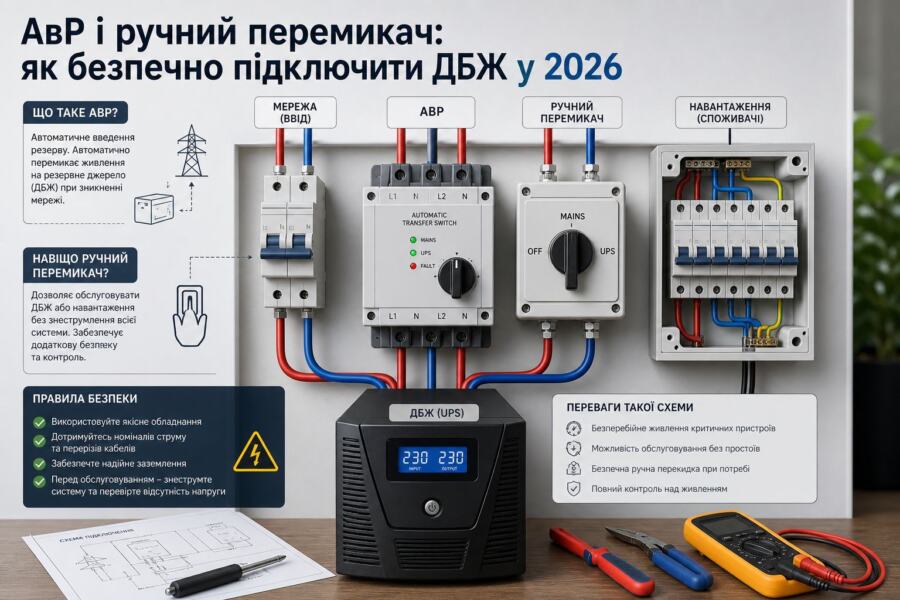
Any backup system has three parts: the input from the grid, the backup source and the output to the load. The most dangerous situation occurs when these parts are not separated physically or logically. If the inverter is left connected to the same line as the input to the house, then when the grid appears, it may start to work in conflict with it. The result is counter voltage inverter, damage to relays, circuit breakers, stabilizers and even the meter.
For apartments and houses, three options are most often used: a manual switch, an automatic backup input or a separate line for critical consumers. The first option is cheaper and more reliable, the second is more convenient, and the third is the most correct for equipment that should not stop. If there is UPS for a boiler, router, server or cash register node, you need to determine in advance whether only the load is switched, or also the battery charging source.
Practical example: in a private house on 220V The boiler, pump and internet are connected through a separate panel, while the refrigerator and lighting are connected through another group. This allows you to not transfer the entire building to standby, but only the critical lines. This approach saves the budget and simplifies installation.
If the backup source is a generator, then the scheme is even simpler: first the city grid is disconnected, then the generator is connected via a manual or automatic switch. If the backup is an inverter with a battery, it is especially important to prevent parallel operation with the grid without appropriate synchronization and protection.
Manual switch, ATS and three-position device: what is the difference?
Manual reserve input switch — is a mechanical device that has clear positions «network», «0», «reserve». Its main advantage is simplicity and lack of control logic errors. The user visually sees which source is connected. For private homes, this is often the best option if outages occur infrequently.
Automatic input of reserve, or AVR automation for the generator, independently starts the generator, controls the voltage and transfers the load to the reserve. This is convenient for offices, boiler rooms, server rooms, shops. But the ATS requires precise settings: delay time, phase control, voltage, frequency, as well as correct interaction with a specific generator model.
A three-position mechanical switch like hager three-position switch appreciated for their compactness, resource and clear logic. In real panels, such devices are installed as a safe reserve when it is necessary to switch a single-phase or three-phase load without complex automation. It is only important to choose the correct current rating and number of poles.
| Decision | Advantage | Drawback |
| Manual switch | Maximum simplicity and control | Human presence required |
| ATS | Auto-switching without user intervention | More complicated setup |
| Three-position device | Clear separation of sources | Correct current selection is required |
For domestic use, a mechanical switch is often more reliable than a «smart» circuit, if there is no need for automatic start. For business, where every minute of downtime costs money, an automatic transfer switch is more often chosen. In both cases, the main thing is to prevent switching under load if the device is not designed for this.
How to safely connect a UPS to your home network
Secure connection UPS starts with allocating a separate outlet for critical consumers. You should not power the entire house through a household UPS if it is designed only for 1–3 kW. First, determine the total power of the boiler, pump, lighting, router, cameras, cash register or computers, and then select the inverter, batteries and cable.
Practical example: boiler 120 W, circulation pump 90 W, router 15 W, two cameras each 8 W. The total load is small, but the starting current of the pump can be 3–5 times higher. If the UPS is weak, it will go into protection even with a nominally «small» load. Therefore, they focus not only on the wattage, but also on the nature of the consumers.
If there is a hybrid inverter, the question is how to connect an inverter to the home network is solved only through a separate AC-IN input and AC-OUT output or through a manufacturer-recommended circuit with a backup shield. It is categorically impossible to connect the inverter output to the home network directly if there is no standard transfer relay or certified switch.
Another critical point is zero and grounding. In some circuits, it is necessary to switch not only the phase, but also the neutral. If this is not done where it is required by the system design, false RCDs, parasitic currents and unstable operation of the equipment are possible. This is no longer a «minor inaccuracy», but the cause of the emergency behavior of the entire node.
Typical installation mistakes and how to avoid them
The most common mistake is using a conventional two-pole circuit breaker instead of a backup switching device. The circuit breaker protects against overload and short circuit, but does not guarantee safe separation of sources. The second wrong decision is to connect the generator, network and inverter through "twists" or untested terminals. In such a scheme, contact heating is inevitable.
Another problem is the wrong choice of rating. If the switch is designed for 25 A, and the actual load of the house during the reserve operation reaches 32 A, the device will overheat even without visible failures. In the private sector, this often happens when the owner adds a fan heater, pump, boiler and refrigerator to one backup group.
It is also mistakenly believed that the ATS is universal for any generator. In fact AVR automation for the generator must take into account the type of start, the voltage of the control circuit, the presence of an electric start, and sometimes the engine warm-up. Without this, the automation can often "hunt" for the network, pull contactors or start the generator at the wrong moment.
In business, a typical mistake is the lack of duplication of critical lines. For example, a cash register and a router sit on the same group as a powerful printer. When the printer starts, the UPS gets a surge and can cut off the entire line. The correct solution is to distribute by priority, not just by rooms.
When do you need a professional shield and what to check before launching?
If the reserve supplies not one boiler, but an entire house or a small office, a separate shield with marking, protection and understandable operating logic is required. It should include: a switching device, group circuit breakers, overvoltage protection, an active source indicator and proper grounding. For three-phase systems, phase and load imbalance control is added.
Before starting, four things are checked: whether there is no parallel connection of sources, whether the power cable is suitable, whether the neutral is organized correctly, whether the device can withstand the real starting mode. It is worth testing the network recovery scenario separately: the switch should not create a short pause, sufficient to reload the boiler or servers if it is critical for them.
When the system is purchased through online electronics store, it is worth looking not only at the price, but also at the passport parameters: rated current, number of poles, type of installation, permissible voltage 220V/380V, as well as compatibility with inverters and generators. Serious manufacturers indicate permissible connection diagrams, and this is not a formality, but a working instruction for safe installation.
Practical conclusion
For a home, apartment, or small business, a safe backup circuit is built around one principle: sources should not operate in parallel unless the system is designed to do so. A manual switch provides maximum reliability and simplicity, an automatic transfer switch provides automation, and a three-position device provides clear mechanical separation. If you need to decide, how to connect an inverter to the home network, start not with cables, but with a proper backup scheme. This reduces the risk counter voltage inverter, protects equipment and makes secure connection UPS a real, not a declarative requirement.