
Useful tips
Inverter for refrigerator, boiler and pumps: how to choose the right one


Inverter for refrigerator, inverter for pump і UPS for boiler — it is no longer a «back-up option just in case», but a practical necessity for many homes, apartments and offices. When the power goes out, not only the lighting stops: the heating turns off, the refrigerator stops working, the water disappears from the pump, and household appliances risk failure due to voltage drops. That is why backup power for equipment you need to plan ahead, not pick at random.
The most common mistake is to buy «any inverter» based on the principle of «just in case». In practice, this often ends in overheating, noise, emergency shutdown or even breakdown of the refrigerator compressor or boiler electronics. To avoid this, it is important to understand the difference between inverter types, peak loads, output voltage waveform and how a particular consumer behaves during startup.
What is an inverter and why is it important for backup power?
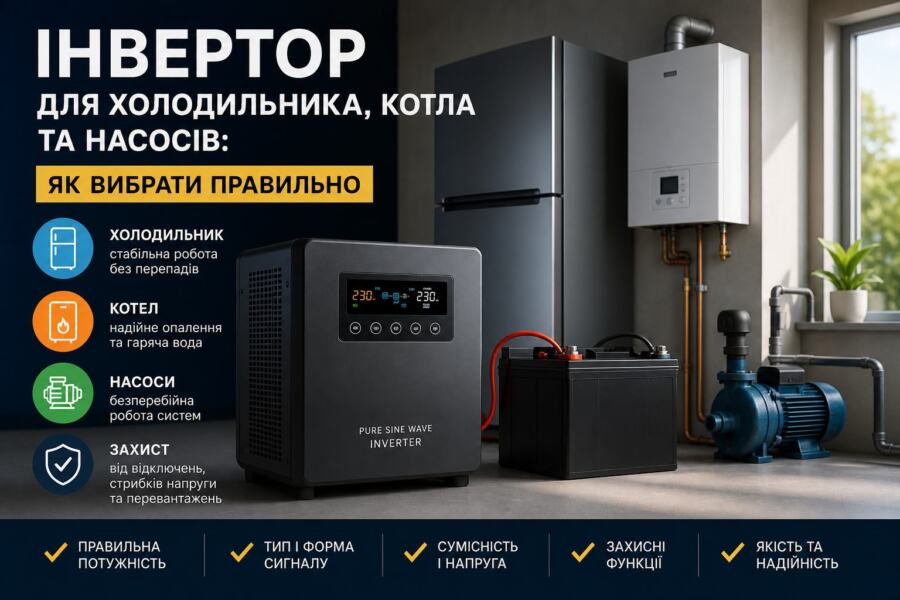
The inverter converts the DC voltage from the battery on alternating voltage 230 V, which is used by household appliances. Simply put, it allows you to power ordinary appliances from the battery when there is no mains. In conjunction with the battery, the inverter can provide short-term or long-term backup power for equipment — depending on the battery capacity and load power.
But not all equipment is equally "friendly" with the inverter. Some devices consume stable power, others have a large starting current, and still others are generally critical to the shape of the sine wave. The most sensitive to this are:
- refrigerators with compressor;
- boilers with electronic board control and pump;
- pumps for water supply, heating or drainage;
- TVs, routers, computers and other electronics.
That is, an inverter is not just a «battery outlet,» but a full-fledged element of the power supply system. And it is its correct choice that determines whether the equipment will work stably or whether it will turn off every second.
What inverter is needed for a refrigerator?
Inverter for refrigerator must take into account two quantities: the operating power of the compressor and the starting current. For example, a refrigerator can consume on average 80–200 W, but at the moment of starting the compressor, require 3–7 times more. This means that a 150 W device does not guarantee the refrigerator will start at all.
For a household refrigerator, the following parameters are usually taken into account:
- pure sine wave at the exit;
- inverter power with a margin of 600 W and above;
- peak power that can withstand a short starting pulse;
- stable operation without significant voltage sag.
If the refrigerator is modern, with an inverter compressor, the requirements may be even higher, because such equipment is more sensitive to the waveform. For older models, the compressor also needs a solid margin for startup, and a cheap modified sine wave often creates problems here: hum, overheating, long start-up or repeated attempts to turn it on.
Practical example: a refrigerator consumes 120 W in operation, but may require a short time during startup 500–900 W. If the inverter is only rated for 300–400 W without any real peak power reserve, it may go into protection mode just as the compressor starts. As a result, it will seem that «the refrigerator is not working», when in fact the problem is a weak inverter.
How to choose an inverter for a pump without mistakes
Inverter for pump — an even more demanding story than for most other household appliances. The pump has a large starting current, especially if it is:
- submersible pump;
- surface pump;
- circulation pump in the heating system;
- pump with capacitor motor;
- pump with complex automation.
The following are important for the pump:
- Power reserve — not less than 2–3 times the nominal value, and sometimes more.
- Peak power — it is she who determines whether the pump starts.
- Pure sine wave — especially for engines and electronic control units.
- Cable connection quality — at startup, the currents are high, and weak contacts are not forgiven here.
For example, a pump on 370 W у reality may require an inverter not at 400–500 W, but at 1000–1500 W with a serious starting margin. If you choose a device "close to" the pump may start more than once, buzz or trip the inverter protection.
Another important detail: pumps do not like long operation from a weak battery with low voltage. When the battery is discharged, the voltage drops, the engine starts to start more difficult, and the inverter may turn off earlier than you expect. Therefore, the inverter for the pump should be selected not only by watts, but also by the quality of the entire power system.
What is the difference between a UPS for a boiler and a regular inverter?
UPS for boiler — this is not always the same as a universal inverter. The boiler is a special load, because inside there is an electronic board, automation, fan, pump, sometimes an ignition module. Here the following are critical:
- pure sine wave;
- stable voltage without jumps;
- quick switch to reserve;
- low noise level;
- compatibility with sensitive electronics.
A conventional offline UPS with a modified sine wave is often not suitable for modern boilers, especially if they have a circulation pump, electronic control or fan. At best, the boiler will operate with errors, at worst, it will not start at all or will show an error.
For domestic gas boilers, a solution is usually required that:
- supports 230 V at the exit;
- has a power reserve of 300–1000 W depending on the boiler model and peripherals;
- does not distort the sine wave;
- works correctly with batteries of the required type.
In some cases it is better to take UPS for boiler, rather than a separate inverter. Why? Because a UPS often has a built-in charger, automatic switching and protection against incorrect modes. If you need a longer autonomy time or powering several consumers, then a system based on a separate inverter, battery and charger is more appropriate.
Table of approximate selection of inverter for household appliances
| Instrument | Typical consumption | Starting load | Recommended inverter power | What is important to consider |
|---|---|---|---|---|
| Refrigerator | 80–200 W | 500–900 W | 600–1200 W | Pure sine wave, peak margin |
| Circulation pump | 25–100 W | 150–400 W | 300–600 W | Signal quality, stable voltage |
| Surface pump | 370–800 W | 1000–2500 W | 1000–3000 W | Large starting margin |
| Gas boiler | 80–150 W | 200–400 W | 300–700 W | UPS for boiler or inverter with sine |
| Boiler + pump | 150–300 W | 300–700 W | 500–1000 W | Output current margin required |
Pure sine wave or modified: which is better?
For backup power for equipment most often chosen pure sine wave inverter. It is closest to the voltage of the household network and is suitable for compressors, motors, boilers and sensitive electronics. Modified sine wave is cheaper, but not suitable for everyone.
What can go wrong with a modified sine wave:
- the refrigerator is buzzing or does not start;
- the pump heats up more than normal;
- the boiler gives an error;
- transformers and power supplies operate noisily;
- Some equipment wears out faster over time.
Yes, for LED lighting, routers, or chargers, a modified sine wave is sometimes suitable. But when it comes to inverter for refrigerator, inverter for pump or UPS for boiler, saving on waveform is almost always a wrong move.
How to correctly calculate power and reserve
Choosing an inverter should not start with "which model is popular", but with calculating the load. The algorithm is simple:
- Find rated power device.
- Find out starting power or starting frequency.
- Add stock 20–30% for stable operation.
- Check whether the inverter can withstand a short-term starting pulse.
- Estimate how many devices will be running simultaneously.
For example, if your boiler consumes 120 W, circulation pump — 60 W, and the refrigerator is still 150 W, then the total operating power may not be high. But the starting currents of these devices can overlap, and then a 500 W inverter will no longer look so reliable. It is better to take a device with a margin, especially if the load is combined.
The guideline for the house is simple:
- only the boiler - from 300–600 W;
- boiler + pump — from 500–1000 W;
- refrigerator — from 600–1200 W;
- pump or several engines - from 1000 W and above.
Which batteries are suitable for an inverter?
Even the best inverter won't save you if the battery doesn't match the load. For a backup power system, it's not just the volts that matter, but also capacity, current output and battery type.
Most often used:
- AGM — a good option for moderate loads;
- GEL — better tolerates deeper discharges, but sensitive to improper charging;
- LiFePO4 — lighter, more efficient and more durable, but more expensive;
- Starter batteries are only a temporary solution, not for permanent operation.
For UPS for boiler and small loads, a battery is often suitable for 12 V. For more powerful inverters it is better to consider 24 V or even 48 V systems, because they have lower currents, less cable heating and higher efficiency. This is especially important if an inverter is planned for a pump or refrigerator with a long battery life.