
Useful tips
Battery for UPS: which 100Ah to choose correctly and reliably


A 100Ah battery for a UPS is not just a «box with energy», but a component that determines whether your equipment will survive a power outage without failures, overheating and deep discharge. In practice, people often buy battery for UPS «"according to the passport", and then wonder why it does not give the expected operating time, ages quickly or does not work with the charger at all. It is important to understand a simple thing here: battery for yup you need to choose not only by capacity 100Ah, but also by type of chemistry, charging parameters, currents, temperature and operating mode.
What does 100Ah mean in practice?
Capacity 100Ah is the reserve charge that a battery can deliver under certain conditions. But in real life UPS or inverter you will not get all 100 ampere-hours «"in the forehead". The reason is simple:
– part of the energy is lost during voltage conversion;
– lead does not like deep discharge;
– a lithium battery has its own BMS limitations;
– the useful capacity increases or decreases depending on the discharge current.
For an ordinary user, it is useful to navigate like this: battery 100Ah under load 300–500 W gives several hours of operation, but the exact time depends on the system voltage — 12 V, 24 V or 48 V. It is the voltage that determines how much current flows, and therefore how quickly the battery discharges.
Rough practical estimate of working time
The formula is simple:
Operating time (h) ≈ Capacity (Ah) × Voltage (V) × Efficiency / Load power (W)
For example, 100Ah × 12V = 1200Wh. But the actual useful energy will be less:
– for lead-acid batteries – often taken 50–70% useful discharge;
– for lithium iron phosphate battery — can be used 80–95% containers;
– Inverter or UPS efficiency — usually 85–95%.
Therefore, two batteries of the same 100Ah can give very different results in work.
Which type of battery to choose: lead or lithium?
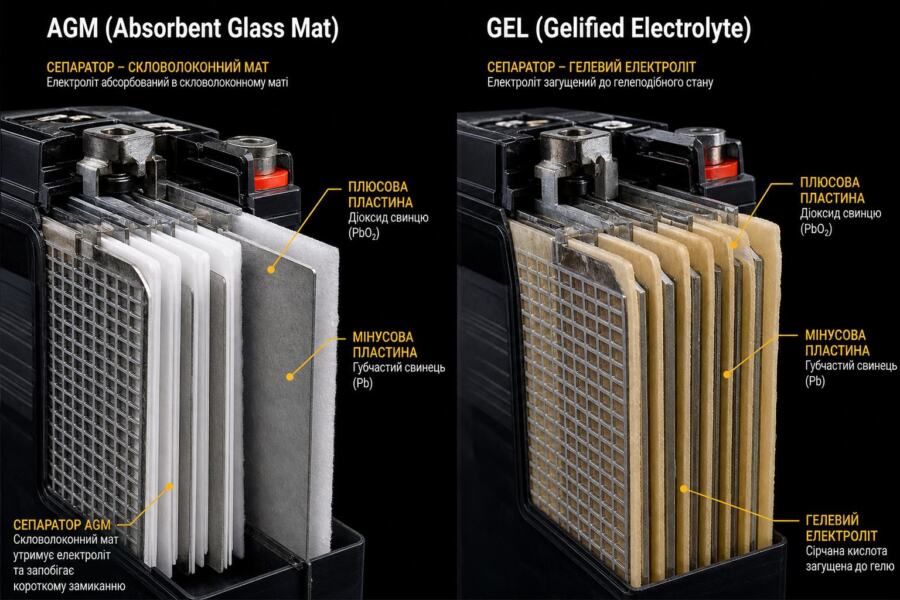
On the market for backup power, AGM is the most common, GEL and lithium iron phosphate battery (LiFePO4). It is the chemistry that determines the resource, weight, safety, and compatibility with UPS.
Comparison of battery types: resource, safety, practical application
Below is a simplified but useful table for selecting a 100Ah battery.
| Battery type | Rated voltage | Cycle life | Permissible depth of discharge | Weight | Pros | Cons |
|---|---|---|---|---|---|---|
| AGM lead-acid | 12 V | 300–600 | 50% | High | Low price, availability | Afraid of deep discharge, shorter life |
| GEL lead | 12 V | 500–900 | 50–70% | High | Better tolerates cycles | More expensive than AGM, sensitive to overcharging |
| LiFePO4 | 12.8 V | 2000–6000 | 80–95% | Low | Long life, lightweight, stable voltage | More expensive, requires charging compatibility |
If you need battery for DBJ for daily outages, frequent cycles and a normal resource for years, then lithium iron phosphate battery usually seems like the smartest solution. If the UPS is rarely used and the budget is limited, then AGM or GEL still makes sense.
Why 100Ah is not always «bigger is better»
Many people think that the bigger the capacity, the better. But for battery for yup there are technical limits.
The main risks of making the wrong choice
1. The UPS charging current is too low.
If the UPS has a weak charging module built into it, the battery 100Ah will take a very long time to charge. After a power outage, you may end up with a system that doesn't have time to recover before the next blackout.
2. The charging voltage does not match the battery type.
Lead and LiFePO4 have different charging profiles. If you put lithium without checking, the UPS may either not charge the battery fully or, conversely, work incorrectly.
3. High starting load current
Some pumps, routers with PoE, servers, refrigerators through the inverter have short peaks. The battery must give not only capacity, but also discharge current without voltage drop.
4. Incorrect system voltage margin
For loads from 500 W and above I often advise against 12 V, and 24 V or 48 V system, because at lower voltages the current becomes too high.
When to get a lithium iron phosphate battery
Lithium iron phosphate battery is my first choice for modern backup power systems, if the budget allows. Why?
– it withstands significantly more cycles;
– almost not afraid of regular discharges;
– keeps voltage more stable than lead;
– weighs less;
– better suited for frequent outages.
But there is an important condition: battery for UPS LiFePO4 must be compatible with the charger. Not every household UPS can charge lithium correctly. This is especially true for older models, where the charging profile is tailored only for lead-acid batteries.
What to look for in LiFePO4 before buying
– availability BMS;
– permissible charge and discharge current;
– operating temperature range;
– guarantee and a passport of real capacity;
– is the mode allowed? buffer work;
– is there protection against low charge temperature.
Importantly: do not charge LiFePO4 at temperatures below 0°C, if the battery does not have heating or special protection. This is not a trifle, but a direct path to cell degradation.
How to understand if a 100Ah battery will fit your UPS
Before buying, you need to check not the brand on the label, but the specific technical parameters.
Minimum compatibility checklist
1. System voltage
Make sure your UPS is working with 12 V, 24 V or 48 V battery pack.
2. Maximum charge voltage
The values are different for lead-acid batteries and LiFePO4. If the charging does not match the battery type, the life drops sharply.
3. Charging current
For battery 100Ah it is desirable that the charging current be at least 10–20A in the appropriate system. Otherwise, the charge will be too slow.
4. Installation location
Extreme heat shortens the life of any battery. Every 10°C above the norm accelerate battery aging very noticeably.
5. Peak load
The power reserve of the inverter or UPS must be at least 20–30%.
Lead or LiFePO4: which is more practical for the home
If you compare without romance, it all depends on the script.
For rare outages
When the light goes out rarely, for a short time, and the system is in buffer almost all year round, you can install a high-quality AGM or GEL. It is cheaper at the entrance.
For frequent and long outages
If the electricity goes out frequently, the battery runs every day or almost every day, then 100Ah LiFePO4 battery pays for itself with its resource and stability. Here you don't have to wait until the lead "gets tired" due to 300–500 cycles.
For critical equipment
For:
– pumps;
– security systems;
– the Internet;
– medical or server equipment;
I would bet on lithium iron phosphate battery or a quality battery pack with the correct BMS and proven compatibility.
Mistakes I advise you to avoid
Here are the typical mistakes I see in practice over and over again:
– buy battery for yup without checking the charging voltage;
– they put cheap lead in and discharge it «to zero» every day;
– they take LiFePO4 and connect it to the old UPS without checking the charge profile;
– underestimate the heating in a closed cabinet installation;
– forget about terminals, cables and fuse;
– they save on wire cross-section, and then have voltage drop and power loss.
Remember: The weak point in a backup power supply is not only the battery, but also all the connections along the current path.
Practical tips for installation and operation
What I recommend doing
– to put fuse as close as possible to the battery;
– use a cable of normal cross-section, without «thin nozzles»;
– ensure ventilation at the installation site;
– do not keep the battery constantly overheated;
– check the resting voltage at least once every few months;
– avoid deep discharges, especially for lead.
For lead-acid batteries
Keep the battery charged, do not store it in a discharged state. Lead loses its resource very quickly if it is left undercharged for a long time. This applies to both AGM and GEL.
For LiFePO4
Follow:
– correct charge;
– BMS protection;
– temperature regime;
– balancing, if provided for by the design.
What to choose for your home: briefly and in an engineering way
If you need a simple, budget-friendly option for 1–3 years and outages are infrequent — you can take a high-quality lead-acid battery battery 100Ah.
If you need a reliable system for the long term, with frequent cycles and minimal maintenance, this is my choice. lithium iron phosphate battery of the appropriate class, but only after checking compatibility with your battery for UPS.
To put it simply:
– lead — cheaper start;
– LiFePO4 — the best long-term investment.
Conclusion from Engineer Gennady
Right choose battery for DBJ — this means not chasing the maximum number 100Ah, and choose a battery for the real operating mode, charger and load. If you want peace of mind and resource for years, take a system with a voltage margin, a normal cable, protection and definitely check compatibility. For frequent shutdowns and daily work I would look towards lithium iron phosphate battery. For a liquid reserve, high-quality lead also has the right to life if used correctly.
Frequently Asked Questions (FAQ)
Can I bet? battery 100Ah in any UPS?
No. Check first system voltage, charging current and battery type support.
Will it work? lithium iron phosphate battery instead of lead?
Not always. It is necessary that UPS worked correctly with the LiFePO4 charge profile.
Why does a 100Ah battery last less than expected?
Because the actual capacity depends on depth of discharge, load current, inverter losses and the condition of the battery itself.
Which is better for frequent outages: AGM or LiFePO4?
For frequent cycles it is better LiFePO4: it has a longer life, better efficiency and is less afraid of regular work.