
Useful tips
UPS for home: selection mistakes that lead to overpayment


UPS for home often bought in a hurry: the power went out, the internet "dropped", the boiler stopped working - and a person takes the first device they come across, focusing only on the price or "so that it has 1000 VA". This is where unnecessary expenses begin. Incorrectly selected UPS for an apartment may not start the boiler, may not pull out the router and cameras, may quickly spoil battery for UPS or even create a risk for the wiring. For a backup power supply to actually work, it is important to understand not only the power on the box, but also the type of load, waveform, switching time, compatibility with equipment and charging conditions.
Why UPS for home are often bought incorrectly
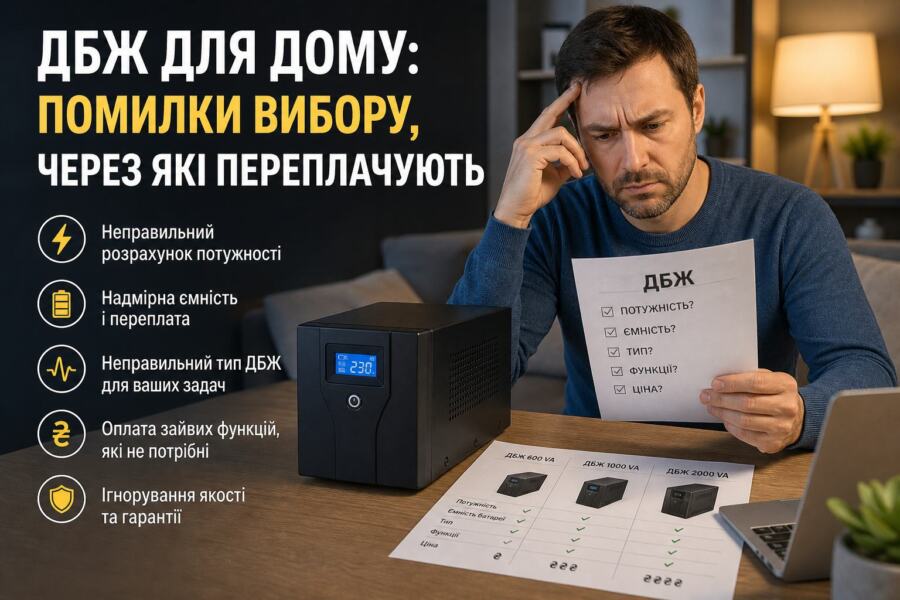
The main mistake is to perceive UPS for home as a universal "outage box". In fact, this is only one element of the backup power system, and its capabilities depend on many parameters. If the device is selected without calculation, it may work unstable or not perform its task at all.
Typical reasons for overpayment:
- take too powerful UPS, although a much more modest solution would suffice for a router, ONT, and a few lights;
- buy a cheap office UPS for a boiler or circulation pump without checking output voltage waveform;
- choose a device without taking into account the capacity and type of battery;
- confused VA і W, which is why they expect more from technology than it actually delivers;
- do not take into account the starting currents of electrical appliances;
- They buy a UPS without a reserve of autonomy time, and then separately purchase batteries, cables, and charging modules.
That is, overpayment occurs not only from an "expensive" device. Sometimes a cheap option turns out to be more expensive because it has to be replaced or supplemented almost immediately.
What tasks should a home backup power supply solve?
Before choosing equipment, you need to clearly determine what exactly should work during a power outage. Home backup power can vary greatly: from a few hours for the Internet and lighting to full power for part of an apartment or private house.
The most common scenarios:
- Minimum reserve — router, ONT, video surveillance, alarm system.
- Comfort reserve — internet, lighting, charging gadgets, sometimes a laptop.
- System reserve — boiler, circulation pump, refrigerator, part of the socket groups.
- Full autonomy — inverter, battery, automatic switching, generator or solar panels.
The more loads, the less the role of a classic office UPS and the more important the correct system architecture. For an apartment, a compact solution is often enough, while for a private house, an inverter-battery complex may be required.
Main mistake #1: confusing VA and W
One of the most common reasons for overpayment is focusing only on the number VA. This is not the same as W. For example, a UPS on 1000VA can only really give 600–700W, and sometimes less. If the load is close to the limit, the device will work at a loss and the battery will drain faster.
What is important to consider:
- VA — full power;
- W — active power that actually powers the equipment;
- a reserve is required for boilers, pumps, compressors and some power supplies;
- better to have 20–30% power reserve than constantly working at the limit.
Practical example: the router consumes 10–15 W, the ONT consumes 8–12 W, and two cameras consume another 10–20 W. The total is about 40–50W. Buying a large UPS of 1500–2000 VA for this is almost always an unnecessary expense. For such a task, a compact one is enough. UPS for an apartment or Mini UPS if only a low voltage 9/12 V line is needed.
Main mistake #2: not looking at the output voltage shape
For many people, all UPSs are the same, but they are not. There are models with approximated sinusoid or "stepped" waveform, but there is pure sine wave. And it is this difference that often decides whether the equipment will work correctly.
What can go wrong with a non-sinusoidal signal:
- the boiler may give an error;
- the pump buzzes, heats up or does not start;
- some power supplies operate unstable;
- motors and transformer assemblies wear out faster;
- Extraneous noise and vibration may appear.
If you need backup power for sensitive equipment, it's better to get it right away. Pure sine wave home UPS. Yes, it is more expensive, but it is often what saves you from having to buy it again. A cheap «pseudo-sine» may seem profitable only until the first start of the boiler.
Main mistake #3: buying a UPS without considering the type of load
Not all equipment is equally "friendly" with backup power. There is active load, there is reactive, there are devices with high starting current. This is especially often mistaken in private houses and apartments with autonomous heating.
You should be careful with:
- boilers with electronics and pump;
- circulation pumps;
- refrigerators and freezers;
- power tools;
- forced ventilation;
- systems with multiple power supplies at the same time.
For such devices, not only the rating is important, but also the UPS's ability to withstand a short-term starting surge. If this margin is not there, the device may turn off even when the power rating seems to be sufficient.
Main mistake #4: Underestimating the battery for the UPS
Many people spend the main budget on the UPS itself, and battery for UPS takes "some inexpensive one." This is a big mistake. It is the battery that determines how long the battery will last, how quickly the charge will be restored, and how many cycles the system will withstand.
What to pay attention to:
- capacity in A·hour;
- battery type — AGM, GEL, LiFePO4;
- permissible charging current from UPS;
- depth of permissible discharge;
- shelf life at room temperature and in heat.
For classic household UPSs, AGM or GEL lead-acid batteries are often used. They are cheaper, but heavier and more sensitive to deep discharge. If you need long autonomy, frequent shutdowns and more cycles, you should look at LiFePO4, but only if the UPS or inverter is compatible with this type of battery.
A common mistake is to put a battery with a large capacity and then be surprised that it charges very slowly. If the UPS charging module is designed for a small current, a large battery will simply take a long time to recover after a power outage.
Main mistake #5: choosing a UPS only based on the operating time in advertising
Phrases like "up to 8 hours of operation" without context mean little. The actual autonomy time depends on the load, efficiency, battery condition, temperature, and even the quality of the cables. What works for 6 hours with a 10 W router may only give 40 minutes with a boiler or pump.
To avoid mistakes, you need to calculate approximately like this:
- add up the total consumption of equipment in W;
- take into account inverter and converter losses;
- take the battery capacity in Wh or convert from A·h;
- leave a reserve, because the battery should not be discharged "to zero";
- evaluate real, not passport, autonomy.
For example, a 12 V 100 Ah battery has approximately 1200Wh, but in real operation the available energy will be less due to losses and discharge limitations. Therefore, an honest calculation is always more important than a nice number in the description.
What parameters to check before buying
To avoid overpaying for unnecessary features and buying a weak solution, check the specific specifications. For UPS for home і UPS for an apartment this is often enough to weed out 80% unsuccessful options.
| Parameter | What does it mean? | What to watch |
|---|---|---|
| Power | How many devices can be connected? | Not only VA, but also W |
| Signal shape | How exactly is the output voltage supplied? | For boilers and pumps it is desirable pure sine wave |
| Switching time | How quickly does the UPS switch to battery? | For sensitive equipment - minimal |
| Charging current | How fast does the battery charge? | Important with large battery capacity |
| Battery compatibility | What battery can be connected? | AGM, GEL, LiFePO4, external batteries |
| Service and protection | Safety and reliability | Protection against overload, short circuit, overheating |
When a Cheap Mini UPS is Better Than a Large UPS
You don't always need a full-fledged large UPS. If you only need to power your internet equipment, camera, media converter or ONU, sometimes it's better to take Mini UPS. It is compact, quiet, often operates directly from 5/9/12 V and does not waste energy on double conversion.
Mini UPS is appropriate if:
- only low-current equipment needs to be powered;
- compactness and easy installation are important;
- there is no need to pull 220 V to individual devices;
- A reserve is needed for several hours for a router or video surveillance.
But for a boiler, pump, refrigerator or part of a home network, a Mini UPS is not suitable. Here you need a full-fledged UPS for home or an inverter system with a battery.
Common installation errors
Even a good device can be "killed" by improper installation. Often the problem is not the model, but how it was connected. Electrical safety is especially important here.
- Connecting via a cheap extension cord with a thin cable.
- Using old sockets with poor contact.
- Placing the battery near the radiators or in a closed niche without ventilation.
- Connecting cables that are too long, due to which the voltage drops.
- Lack of protection from short circuit and overload.
- Trying to connect 220 V yourself without basic knowledge of circuitry and grounding.
Dangerously use a household UPS as an "all-in-one" without checking the load. If a boiler, a pump and several more sockets are connected to one device, power overrun occurs very quickly.
How not to overpay: a practical selection algorithm
To choose UPS for an apartment or a house without unnecessary expenses, it is convenient to follow a simple algorithm.
- <strong (Incomplete: max_output_tokens)