
Useful tips
Battery life for UPS: AGM, Gel and LiFePO4 correctly


The service life of a UPS battery is not marketing or “by eye”, but the specific physics of chemistry, temperature, depth of discharge and charging mode. If a backup power system is needed for a home, boiler, router, server or security alarm system, then a mistake in choosing a battery often costs not only money, but also downtime, broken equipment and nerves. I, Engineer Gennady, always advise in such matters to look not only at the price, but also at the fact that, how long the battery will actually last in your operating mode. That is why today we will analyze how they differ. AGM, Gel and LiFePO4, how is formed battery degradation, and how to choose the right solution if you are planning buy battery for UPS without unnecessary risks.
What really determines the battery life in a UPS
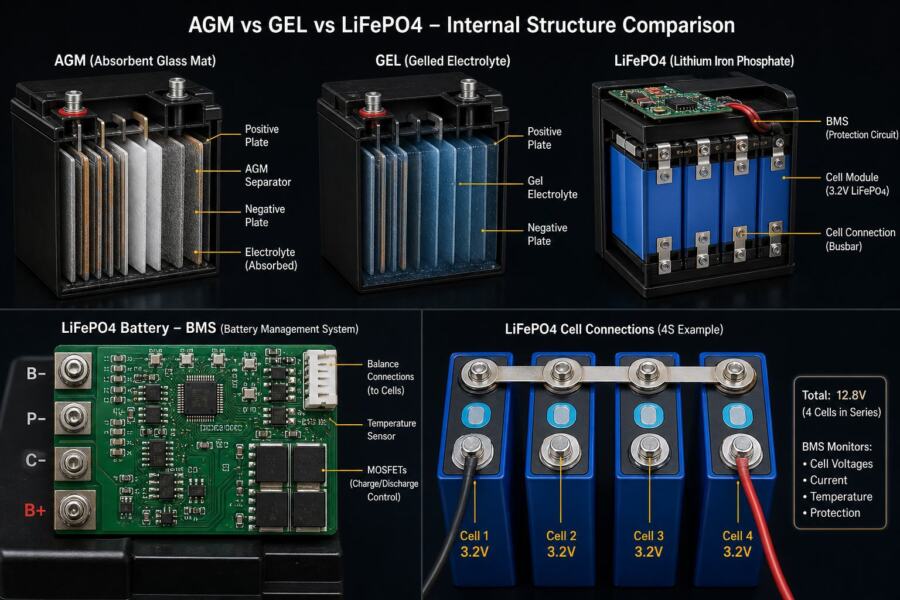
In everyday life, we often say: “The battery is 5 years old.” In fact, this is very conditional. Battery life is determined not only by the manufacturer's passport, but also by how it works.
Main factors of aging
1. Temperature
– For lead-acid batteries, every +10 °C above the norm significantly accelerate aging.
– If the battery is constantly standing near the boiler, in a closet without ventilation, or in the sun, its life will decrease faster.
2. Depth of discharge
– The deeper you discharge the battery, the faster it goes battery degradation.
– For lead types, it is critical to dislike regular discharges “to zero”.
3. UPS charging mode quality
– Too high a charging voltage causes gassing and drying of the electrolyte.
– Undervoltage leads to undercharging and sulfation.
4. Frequency of outages
– If the UPS operates infrequently, the battery ages mainly based on calendar time.
– If shutdowns are frequent, aging also occurs from charge-discharge cycles.
5. Starting load currents
– Pumps, compressors, refrigerators, and some server power supplies provide high starting current.
– This overloads the battery more than a “calm” load of the same power.
AGM, Gel and LiFePO4: what really lasts longer
When people want buy battery for UPS, they often only look at amp-hours. This is a mistake. It is important to understand which type of battery is right for your mode.
Battery type comparison table
| Battery type | Estimated life | Permissible depth of discharge | Pros | Cons |
|—|—:|—:|—|—|
| AGM | 3–5 years in buffer mode | preferred up to 50% | affordable price, good starting current, widespread | afraid of overheating, does not like deep discharges |
| Gel | 4–7 years | often up to 60–70% | better cycle tolerance, stable operation | more expensive, sensitive to improper charging |
| LiFePO4 | 8–15 years or 3000–6000 cycles | 80–90% | long life, light weight, stable voltage | high price, requires compatible BMS and correct UPS |
What do these numbers mean in practice?
AGM — is a good budget option for a UPS that is mostly on charge and only occasionally discharged. Its strong point is its low price and normal operation in short-term failures. But if you constantly “sit down” the battery to 20–30%, the resource drops quickly.
Gel — a better choice where discharges occur more frequently than in the classic reserve. That is why gel battery life usually higher in cyclic operation than AGM. But important: Gel does not like incorrect charging voltage. If the UPS “clamps” the voltage, the gel degrades no worse than AGM.
LiFePO4 — that's another level. If you need a long battery life, high number of cycles and stable operation, then this is the best option. But there is a nuance: not every UPS works normally with lithium. You need to check the charging parameters, cut-off voltage and compatibility with BMS.
Gel battery life: when it is truly justified
Many people think that Gel is always better than AGM. This is not entirely true. It all depends on the task.
In which cases does Gel make sense?
– If there is frequent outages and regular cycles.
– If the battery is in high load mode, but without extreme discharge.
– If it is more important stable cyclic endurance.
When should you not take Gel?
– If you have a cheap UPS with rough charging.
– If there is no temperature control.
– If you just need an inexpensive battery for a rare backup.
The main thing to understand here is: gel battery life does not mean “eternal”. It simply tolerates cyclic loads better if charged correctly. Violate the regime and the advantage quickly disappears.
Why LiFePO4 often wins in the long run
LiFePO4 is not just a “fashionable lithium battery”. It has a different aging logic and better cycle resistance. This is very important for backup power.
Advantages of LiFePO4 for UPS
– High resource — often in 3–5 times longer than lead solutions.
– Deeper discharge without critical loss of resource.
– Low self-discharge.
– Stable voltage during work.
– Light weight and smaller dimensions with the same usable capacity.
But there are also important caveats.
– Needed BMS — battery management system.
– Not every UPS adequately charges lithium.
– It is necessary to check the permissible charging and cut-off voltage.
– Cheap no-name LiFePO4s may have weak cells or a bad BMS.
I always say simply: if the system needs to work long, often and without surprises, LiFePO4 is profitable. But if it is an old UPS without compatibility testing, the purchase can turn into problems.
How to calculate what is right for you
Before buy battery for UPS, you need to answer three questions:
1. How many watts does the load consume?
2. How many minutes or hours of reserve do I need?
3. How often do discharges occur?
Practical approach
– For router, boiler, security guard often enough AGM or Gel, if outages are rare.
– For home network, servers, cash register systems it is better to look at the increased resource.
– For frequent outages and deeper discharges LiFePO4 is more appropriate.
Useful rule
If the battery in your system is running low only on 10–30%, even a good AGM will last a long time.
If the discharge is stable to 50% and below, you need to either take a high-quality Gel, or switch to LiFePO4.
The main mistakes that cause the battery to die earlier
This is what I see most often in practice.
1. Overheating
– The battery is in a closed cabinet without ventilation.
– The temperature rises, and with it the rate of chemical aging.
2. Incorrect charge
– This is especially dangerous for lead-acid batteries.
– Overvoltage = drying, undervoltage = sulfation.
3. Continuous deep discharge
– This is especially harmful to AGM.
– A strong discharge sharply reduces battery life.
4. Storage in a discharged state
– If the battery is left uncharged for a long time, deep degradation of the plates begins.
– In lithium, there is a risk of protection tripping or irreversible damage.
5. Discrepancy UPS and battery
– The UPS is designed for lead, and you install lithium without checking the modes.
– Or vice versa: you take an expensive Gel, but the charging unit works like a cheap universal battery.
How to extend battery life: practical tips
For AGM and Gel
– Keep the battery at a temperature +20…+25 °C.
– Do not allow regular discharge below 50%.
– Check the charging voltage of the UPS.
– Check the real battery life every few months.
– Do not place the battery near heat sources.
For LiFePO4
– Check compatibility with your UPS.
– Make sure the BMS is of good quality and has protection against overcharge, overdischarge and overheating.
– Don’t use cheap “just in case” charging schemes.
– Make sure that the battery does not operate at critically low temperatures without heating, if this is provided by the manufacturer.
When it's time to change the battery
There are several signs that indicate that an old battery has reached the end of its life:
– The UPS shows a normal charge, but the autonomy has become shorter in 2 times and more.
– The battery is getting hotter than before.
– Charging time has increased noticeably.
– After the load is disconnected, the voltage drops too quickly.
– The housing is swollen, shows signs of leakage, or has a strong odor.
If you see these symptoms, don't pull the trigger. A weak battery can not only stop the UPS, but also pose a risk to the system itself.
What to choose: a brief practical guide
If you have rare outages
– Take a quality one AGM.
– This is the smartest balance of price and simplicity.
If outages occur more frequently
– Look at Gel.
– Especially if better cyclic endurance is needed.
If you need a long resource and regular work
– Choose LiFePO4.
– But only after checking compatibility with the UPS.
Conclusion from Engineer Gennady
Simply put, correct battery life is determined not by the brand on the sticker, but by the operating mode. For a short reserve in most household cases, AGM is sufficient. For more frequent cycles, Gel is more profitable, and for long and more intensive work, LiFePO4 shows itself best. Most often, batteries die not from “old age”, but from overheating, improper charging and deep discharges. Therefore, before buy battery for UPS, always evaluate not only the capacity, but also the compatibility with your UPS, the installation temperature and the real load mode. This is what gives reliability, not the pretty numbers on the box.
Frequently Asked Questions (FAQ)
How long does an AGM battery last in a UPS?
Usually 3–5 years, if it operates in buffer mode, without overheating and deep discharges.
Is the life of a gel battery really longer than an AGM?
Yes, in cyclic mode it is often higher. But only under the condition of the correct charging profile and normal temperature.
Can I put LiFePO4 in any UPS?
No. You need to check the compatibility of the charging voltage, cutoff and the presence of the correct BMS.
Why does the battery degrade quickly even though it is hardly used?
Most often the reason is high temperature, permanent undercharge or incorrect charge maintenance mode.