
Useful tips
LiFePO4 Battery Cycles: Life and Comparison of Battery Types


LiFePO4 battery cycles are one of the main reasons why these batteries are increasingly being used in backup power, solar systems, and even UPSs for the home and office. In short: LiFePO4 takes not only capacity, but above all cyclic battery life, stable operation with regular charge-discharge and predictable behavior in the long term. But in order not to make a mistake with the choice, you need to understand what «resource» means, what it depends on and why in real conditions one battery lives 2 years, and the other one is 10+ years.
What are battery cycles and how are they calculated?
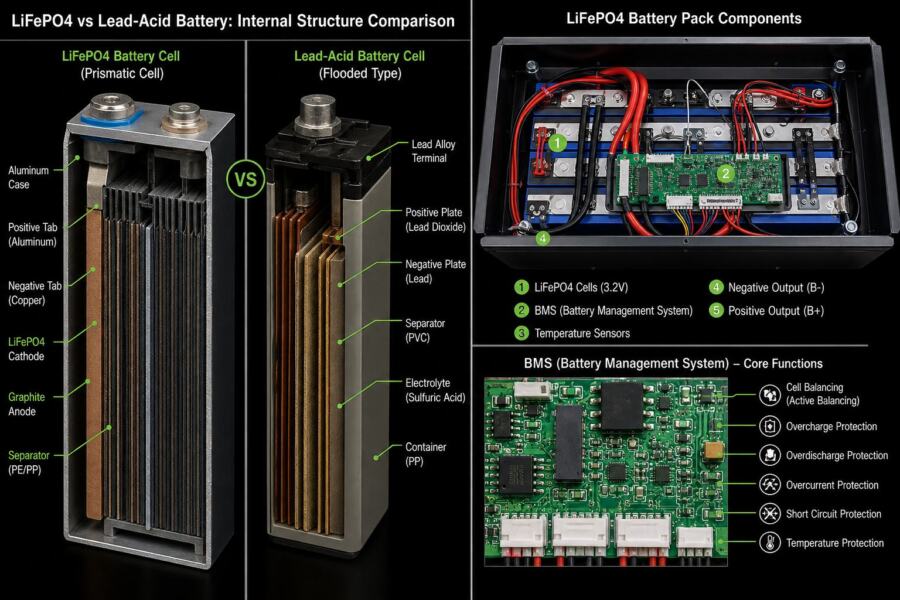
Under cycle understand one full charge-discharge, but in practice everything is a little more complicated. If you discharged the battery not to zero, but only half, this does not mean that the "cycle was not taken into account". The resource accounting system works on the principle equivalent full cycles.
For example:
– discharge on 50% + charge up to 100% = 0.5 cycle;
– two such discharges = 1 full cycle;
– ten small sub-charges per 10% also gradually combine into one conditional cycle.
That is why comparing batteries only by the figure «5000 cycles» without specifying the conditions is a mistake. One manufacturer counts resource at 100% DoD (depth of discharge), the other - at 80% DoD, the third - in general, in a mild mode with a good temperature. In everyday life, this means one thing: battery cycle life always have to be viewed in conjunction with the test conditions.
What does the resource really depend on?
In practice, the resource is affected not only by chemistry, but also by the operating mode:
1. Depth of Discharge (DoD)
The deeper the discharge, the fewer cycles any battery will withstand.
For LiFePO4 the difference between 80% і 100% DoD can be very noticeable.
2. Temperature
High temperature accelerates the aging of the electrolyte and electrode materials.
Low temperature reduces available capacitance and increases internal resistance.
3. Charge and discharge currents
Too high a current heats the battery, and heat is the enemy of the battery's lifespan.
4. Charging algorithm accuracy
Overcharging, undercharging, incorrect buffer mode voltage — all this "eats" the service life.
5. BMS quality
For LiFePO4 without normal BMS It's not serious to talk about a reliable resource. Balancing, protection against overvoltage, overheating, and deep discharge are not options, but mandatory.
Why LiFePO4 lives longer than lead
When comparing batteries, they often only talk about capacity. A·hour. But for practice, something else is more important: how many times the battery will survive the load cycle without noticeable degradation.
In LiFePO4:
– the active mass of the electrodes degrades less;
– lower internal resistance;
– regular deep discharge is better tolerated;
– higher energy efficiency — usually 95–98% versus lower values in lead-acid batteries.
In gel and AGM batteries, the main problem is sulfation of the plates, limitations on the depth of discharge and a strong dependence on the charging mode. If they are regularly put "to zero", the resource drops very quickly. That is why gel battery life in real life, it often turns out to be less than what is written in advertising brochures.
Comparison of battery types: resource, safety, practical application
Below is a simplified but useful table for selection.
| Battery type | Typical life, cycles | Safe depth of discharge | Efficiency, % | Practical service life | Comment |
|—|—:|—:|—:|—:|—|
| LiFePO4 | 3000–6000+ | 80–90% | 95–98% | 7–15 years | Best option for frequent cycles |
| GEL | 500–1200 | 50–70% | 80–85% | 3–7 years | Good for buffer mode, afraid of deep discharges |
| AGM | 300–800 | 50–60% | 80–85% | 2–5 years | Cheaper start, but weaker cyclical resource |
| Li-ion NMC | 1000–3000 | 80–90% | 90–95% | 5–10 years | High energy density, but demanding on safety |
This table shows the main point: if the system is operated daily, LiFePO4 almost always wins. If the battery is in buffer almost all the time and rarely discharges, then you need to consider economy, compatibility and charging mode.
What does «long-life UPS battery» mean in practice?
Phrase lasting battery for UPS It sounds nice, but there is one important nuance here: not every long-lasting battery is compatible with every UPS.
Three parameters are important for a UPS
– Charge voltage in the buffer
Most standard UPSs are designed for lead-acid batteries with a backup voltage of approximately 13.5–13.8 V for a 12 volt system. For LiFePO4 this is sometimes suitable, but not always ideal.
– Charge detection thresholds
Some UPSs "think" the battery is charged or faulty if they see an unusual LiFePO4 voltage curve.
– Test pulses and self-diagnosis
During short tests, the UPS may not read the voltage as it expects and issue an error.
When LiFePO4 in a UPS is a good choice
– when frequent network outages are required;
– when the load is cyclic;
– when there is a high-quality charging profile;
– when the BMS supports the required current and protection.
When is it better to take your time?
– if the UPS is of an old design;
– if the charging algorithm cannot be configured;
– if the manufacturer explicitly prohibits LiFePO4;
– if the system operates without temperature control.
I will practically say this: lasting battery for UPS — it's not just a battery "with more cycles." It's also compatibility with the UPS electronics, the correct charging voltage, and the correct operation of the protection.
Gel battery life: why it is often shorter than expected
Gel battery life depends on how carefully it is handled. Gel is not an «eternal» technology, but a lead-acid system with a thickened electrolyte that likes stable modes and does not like extreme discharges.
What kills GEL the fastest?
– regular discharge below 50%;
– long-term storage in a discharged state;
– undercharge;
– recharge;
– high temperature in the room;
– incorrect float mode.
In practice, gel batteries work well in reserve, where discharges are rare, short and shallow. But if the battery has to power an inverter, refrigerator, pump or communications with a large number of cycles every day, the resource drops much faster than in LiFePO4.
Why LiFePO4 has better battery cycle life
LiFePO4 is a chemistry that has a very stable crystalline cathode structure. This is why it tolerates better:
– multiple cycles;
– deeper discharges;
– faster charge;
– higher peak currents.
In everyday life, this means a simple thing: battery cycle life it doesn't "collapse" after a few hundred deep discharges, like in lead systems. But there are still limits.
What reduces the life of LiFePO4
1. Permanent storage at 100% charge
For a long life, it is better to store the battery not fully charged.
2. Working in the heat
Temperature is higher 40°C accelerates aging.
3. Charge below zero
Charging LiFePO4 at sub-zero temperatures without heating is a bad idea. You can damage the cells.
4. Lack of balancing
If individual cells "dissociate" in voltage, the actual resource drops.
5. Savings on BMS
A cheap protection board may not work on time.
Practical guidelines: how to estimate how long a battery will last
To understand a resource not in theory, but in life, look at three things:
1. Usage mode
If the battery is used every day, it is important battery cycle life.
If it is in reserve and discharged several times a year, calendar aging is more important.
2. Real depth of discharge
Battery on 100 Ah and the battery on 100 Ah, but one is discharged to 20%, and the second to 80%, are two different stories on the resource.
3. Temperature regime
Stable 20–25°C — that's good.
Permanent 35–45°C — this is already accelerated aging.
A simple rule of thumb
– For daily cyclic work it is better to take LiFePO4.
– For liquid reserves, you can consider GEL, but only without deep discharges.
– For an economical start, budget systems often use AGM, but this is a compromise with the service life.
How to extend battery life: my practical tips
As an engineer, I always advise not to chase the passport maximum, but to configure the system so that the battery operates in a gentle mode.
For LiFePO4
– Do not leave the battery on for a long time. 100% without need.
– Make sure that the charging voltage complies with the manufacturer's specifications.
– Do not charge when sub-zero temperature, if there is no heating.
– Use only normal BMS with balancing.
– Do not exceed the recommended charge and discharge current.
For GEL
– Do not allow frequent discharge below 50%.
– Avoid undercharging — the gel really doesn't like a constantly "half-alive" state.
– Keep the battery in a cool place.
– Check for excessive voltage on the charger.
For UPS
– Check compatibility before purchasing a battery.
– Look at the operating voltage, not just the capacity.
– Make sure that The UPS does not give an error. after switching to a new chemistry.
– If the battery is operating in buffer mode, periodically perform a load test.
When LiFePO4 clearly wins and when it doesn't
LiFePO4 is beneficial if:
– there is frequent cycles;
– needed high battery life cycle;
– fast charging is important;
– the system works every day;
– must serve for a long time without frequent replacements.
GEL or AGM may be appropriate if:
– the system is almost always in reserve;
– the budget is limited;
– simpler compatibility with the old UPS is required;
– there will be no deep discharges.
But if we are talking about long-term operation with load and regular shutdowns, LiFePO4 battery cycles almost always give better economy over distance, even if the starting price is higher.
Conclusion from Engineer Gennady
If we consider not the purchase price, but the price one real cycle, LiFePO4 almost always beats lead. Gel battery life good only if you don't torture it with deep discharges. For daily use, backup power, and systems with frequent outages, I think LiFePO4 the smartest choice, but only if the charging mode is correctly selected, high-quality BMS and compatibility with your UPS or inverter. (Incomplete: max_output_tokens)