
Useful tips
LiFePO4 battery: how to operate it properly and avoid 5 mistakes


A LiFePO4 battery is not just «another battery», but an element of the power system that, when properly operated, operates stably, is safer than lead-acid analogues and retains its capacity much longer. In practice, the life of a lithium iron phosphate battery is determined not only by the quality of the cells, but also by how the charge, discharge, temperature and overload protection are organized.
In home backup power systems, solar stations, UPS for boilers, routers and servers, the main problems arise due to incorrect inverter settings, attempts to charge the battery in the cold, deep discharge of LiFePO4 and the use of incompatible chargers. These are the mistakes that most often shorten the service life, although the battery itself is capable of thousands of cycles.
For the home or business owner, it is important to understand simple logic: LiFePO4 likes controlled voltage, moderate currents, adequate temperature and no constant «pressing» to 100%. If these conditions are met, the battery operates predictably even in systems with frequent grid outages and high peak loads.
Below are practical rules that will help you avoid common mistakes when using a UPS, correctly configure the charge, and maintain the energy reserve without risk to the cells and electronics.
How LiFePO4 works and how it differs from other batteries
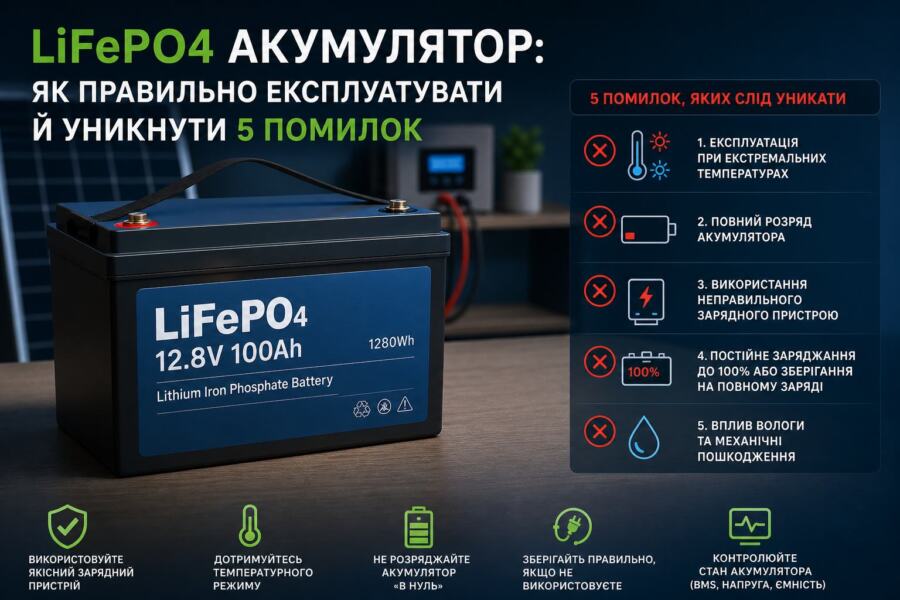
LiFePO4 is a lithium iron phosphate chemistry with high thermal stability. Unlike AGM or GEL, this battery holds voltage better under load, charges faster and degrades less with regular cycling. That is why it is often installed in backup power systems for boilers, pumps, video surveillance and telecommunications equipment.
Typical module 12V has an internal BMS control system that protects against overcharging, overdischarging, overcurrent and short circuit. But the BMS is not a "magic shield": if you constantly work at the limit or grossly violate the modes, the protection will be triggered often, which means stress for the entire system.
Another important advantage for domestic installations: LiFePO4 does not like long-term storage in a fully charged state, but it tolerates daily cycles much better than lead batteries. Therefore, in autonomous homes and offices, it becomes advantageous where there are frequent outages and regular charging from the network or the sun.
In practice, this can be seen as follows: the same LiFePO4 backup power unit after several years of use often retains a noticeably higher usable capacity than AGM, if both were operated under similar conditions. But only on condition that the user understands how to properly charge LiFePO4 and does not exceed temperature limits.
Mistake #1: Improper charging and high voltage
The most common problem is connecting LiFePO4 to a charger without checking the charge profile. This chemistry requires voltage-limited charging; typically for 12V systems use charge in the range of about 14.2–14.6V depending on the manufacturer's recommendations. If the charger is set to AGM or "universal", it may either undercharge the battery or, conversely, keep it at the upper limit for too long.
How to properly charge LiFePO4 in a real system: first check the battery passport, then match the voltage charging with inverter or a charging module, and complete the cycle without a long float mode, unless the manufacturer requires it. For many LiFePO4, float is either not needed at all, or should be reduced to a safe minimum.
The error often occurs in UPSs where the user puts a lithium battery instead of a lead-acid battery without reprogramming the device. This is how UPS usage errors appear: the device may undercharge battery, incorrectly determine the charge level or fail to turn off the load in time.
| Parameter | LiFePO4 | AGM/GEL |
| Typical charge for 12V | 14.2–14.6V | 13.8–14.7V |
| Deep Cycle Reaction | Better tolerated | Wears out faster |
| Sensitivity to frost during charging | High | Medium |
If the power system is powered by solar panels, it is advisable to configure the charge controller separately. An incorrect MPPT/PWM algorithm can «hang» at the upper voltage and reduce the service life, although this is not noticeable from the outside.
Mistake #2: Charging a lithium battery in cold weather
Lithium battery charging battery in the cold is one of the most dangerous conditions for LiFePO4. Himself battery can give off energy at low temperatures, but it cannot be charged below zero without special heating. The movement of ions inside the cells deteriorates, the risk of irreversible degradation of the anode structure increases, and in some cases a sharp drop in resource is possible.
Practical example: the battery is in an unheated cell, at night the temperature drops to -5°C, and in the morning the inverter starts charging. Everything works on the outside, but after a few months the user notices a drop in capacity and an uneven balance of cells. The problem accumulates imperceptibly.
What to do correctly: either place the battery in a warm room, or use models with built-in heating, or turn off the charge below a set temperature via the BMS/controller. For facilities with critical importance - boiler rooms, server rooms, communications - this is not an option, but a mandatory safety requirement.
Low temperatures alone do not «kill» a battery instantly, but regular charging in the cold dramatically reduces Lithium iron phosphate battery life. If the system is mounted in a garage, warehouse or technical cabinet outdoors, temperature control should be as important as short circuit protection.
Mistake #3: Deep discharge of LiFePO4 and work "to zero"«
Deep discharge of LiFePO4 is not as critical as that of lead batteries, but this does not mean that it can be converted into normal operation. If the charge is regularly reduced to a minimum, the BMS will cut off the battery, and the inverter will turn off the load in an emergency order. As a result, the number of stress cycles increases, and the useful capacity gradually decreases.
In everyday life, it looks like this: the user turns on a powerful pump, boiler and lighting on one battery, and the discharge leads to automatic shutdown. After a year or two, the battery still seems to work, but the time reserve is noticeably reduced. This is a classic example of how UPS usage errors and uncontrolled discharge "eat up" the reliability reserve.
Best practice — do not discharge the charge systematically into the lower zone unnecessarily. For daily operation, it is better to work in the middle range, where the battery experiences less stress. If the system has a reserve for several hours, you should not plan to use this reserve completely every day.
For inverters, it is useful to set a cutoff threshold by voltage and by residual capacity, if supported by the BMS or external monitoring. This way the battery will not «fail» into emergency mode, and the user will have a predictable operating time.
Mistake #4: Incorrect integration with UPS, inverter and load
Many problems arise not because of the battery itself, but because of poor communication between the battery, UPS and inverter. Typical error — connect LiFePO4 to an old office UPS, designed for AGM, and expect normal operation. In such devices, the charging current may be too low, the charge profile may be incorrect, and the discharge control may be inaccurate.
Another common situation is over-loading. If 12V If you connect an inverter with peak consumption exceeding the capabilities of the BMS to the battery, the battery will be disconnected when the compressor, pump or powerful power supply starts. This is not a breakdown, but a consequence of incorrect selection.
To avoid this, it is necessary to consider not only the nominal power, but also the starting currents. For some systems, it is critical that the battery has a current reserve of several times the average consumption. This is especially true for pumps, refrigerators, boilers and server equipment with high pulse loads.
In service practice, we often see another mistake: installing the battery in a cramped cabinet without ventilation, next to the inverter. 220V, and the cables are made too thin. As a result, losses in the wires increase, the terminals heat up, and the system operates unstable. For powerful systems, short lines, the correct cable cross-section and high-quality terminal connections are required.
Mistake #5: Ignoring installation, balance, and storage conditions
LiFePO4 does not require complex maintenance, but requires discipline in installation. The battery should be installed so that it is accessible for inspection, and the wiring is protected from mechanical damage. It is unacceptable to place the battery near heat sources, in direct sunlight or in a place where vibrations and shocks are possible.
In multi-battery systems, cell balance and equal conditions for all modules are important. If one unit is warm and the other is cold, they will age differently and the entire battery group will lose symmetry. This is especially noticeable in systems with a reserve for offices, shops, private homes and service areas.
During long downtime, the battery should not be left either completely discharged or on 100%. It is better to store it in an average state of charge, in a dry room without sudden temperature fluctuations. If the facility is serviced seasonally, it is necessary to check the voltage, BMS status and the absence of self-discharge at least once every few months.
It is also worth mentioning service and purchase. If you need a selection for a specific inverter, boiler, solar station or UPS, it is important to buy equipment from a supplier who understands compatibility, and not just sells a «box with amperes». For residents of Dunaivtsi and neighboring settlements, it is convenient to contact the Dunaivtsi electrical shop, where you can choose not only a battery, but also the appropriate protection, cable and charging solution.
Practical rules that extend the resource and reduce the risk of failures
To maximize the life of a lithium iron phosphate battery, follow a few technical rules. First, do not charge the battery below the permissible temperature. Second, do not keep it constantly at the upper limit unnecessarily. Third, do not exhaust the energy to the point of emergency shutdown every day.
Fourth, configure the inverter and controller specifically for LiFePO4, not for lead. Fifth, check the cable cross-section, contact quality, and the presence of fuses. For systems with powerful consumers, even 220V-equipment can create high inrush currents on the low-voltage bus, and this must be taken into account when designing.
A useful practical scheme for the home: a battery in a warm technical room, a BMS with temperature control, a set charge without "overexposure", an inverter with the correct cutoff threshold, and the load is distributed so that there is no simultaneous start-up of heavy consumers. These are simple measures, but they are the ones that give a stable result.
If you follow these rules, LiFePO4 becomes not a consumable item, but a tool for energy independence. It works quietly for years, does not require daily intervention and, when used correctly, justifies its cost in a house, apartment, shop or office.
Practical conclusion
A LiFePO4 battery only lasts a long time when it is charged in the correct temperature regime, regular deep discharge of LiFePO4 is not allowed, and it is not connected to a UPS without checking compatibility. The most common mistakes are charging a lithium battery in the cold, overvoltage, incorrect inverter settings, and weak cabling. If the system is assembled correctly, the resource of the lithium iron phosphate battery is fully revealed, and the backup power supply works predictably and safely. (Incomplete: max_output_tokens)