
Useful tips
Solar panel lifespan: how to avoid panel degradation

The service life of solar panels depends not only on the brand, but also on how they are installed, operated and protected from overloads, moisture and overheating. Nominally, most modern modules work 25–30 years old, but in real conditions, degradation can begin much earlier if there are design errors, incorrect installation angle, or a weak electrical protection circuit.
It is important for a home or business owner to understand one simple thing: a solar panel does not «break» instantly, it gradually loses its performance. If the annual drop in energy output is 0,3–0,8%, this is normal technical wear and tear. If the system loses a noticeable part of its generation over 3–5 years, the reason should be sought in the installation conditions, the cable part, the inverter, or the modules themselves.
That is why when choosing equipment, not only the passport specifications are important, but also the warranty. solar stations, manufacturer's reputation, quality of fasteners, surge protection and correct maintenance. For those who plan reliable solar panels When buying, it is advisable to evaluate not only the price per watt, but also the predicted degradation, type of cells, the presence of anti-PID technologies and service conditions.
In the electro shop catalog, it is worth focusing on solutions where the technical parameters are transparently specified: power, permissible system voltage, temperature coefficient, mechanical strength, warranty limits for degradation. This allows you to predict the payback without unpleasant surprises in the 5th or 10th year of operation.
What really determines the service life of solar panels
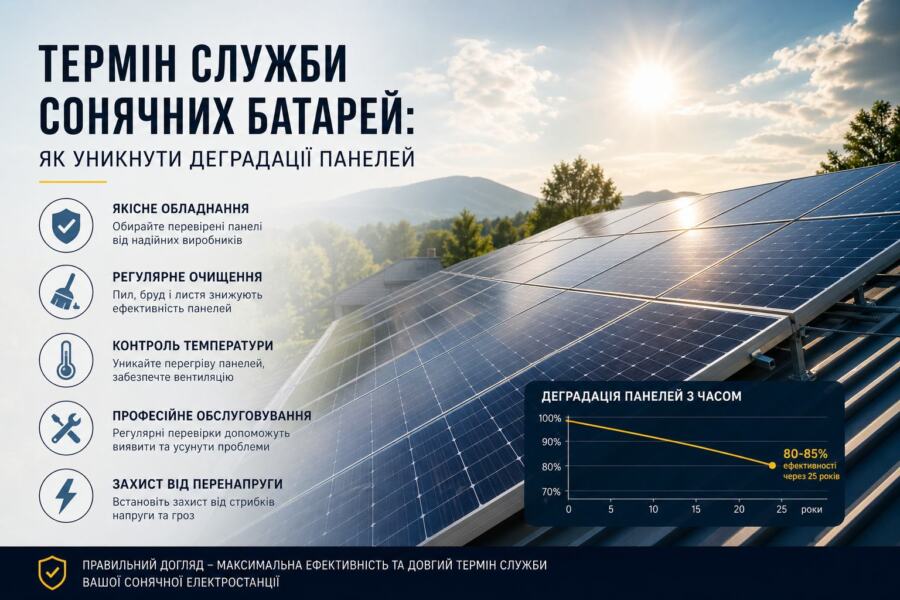
In practice, the service life solar batteries is determined not by one factor, but by a combination of loads. The most harmful of them are high temperature, constant moisture, ultraviolet light, mechanical stresses from wind and snow, as well as electrical surges. The panel may be of high quality, but if it is installed too close to the roof without a ventilation gap, its operating temperature in the summer increases by 10–20°C, and this directly reduces generation and accelerates the aging of materials.
The second critical factor is the electrical mode. When modules operate in a string with an incorrectly selected number of panels, losses occur due to voltage mismatch. If the inverter or controller operates at the limit, the risk of overheating of the contacts increases, which is the path to local damage, hot spots and a drop in efficiency. For private stations, this is a typical hidden problem: everything looks normal on the outside, but the generation is lower by 8–15%.
The third group of reasons is manufacturing defects and improper storage before installation. Microcracks in the cells, weak soldering of tires, lamination violations are often not visible immediately. After a few seasons, they manifest themselves as local overheating zones, the appearance of stains, unstable operation at high humidity. That is why it is worth buying equipment from suppliers who control the origin and transportation conditions.
| Parameter | Normal | Risk of degradation |
| Module temperature | To 45–60°C | Over 70°C |
| Annual power drop | 0,3–0,8% | Over 1,5% |
| String tension | Within the inverter | Exceeding the limit |
PID solar panel degradation: how it occurs
Degradation should be considered separately. solar PID panels — Potential Induced Degradation. This is electrical degradation that occurs due to the potential difference between the photovoltaic module, frame, ground and the high operating voltage of the system. Simply put: under certain conditions, charge «flows» through the insulating layers, which changes the characteristics of the cells and reduces the output power.
PID is especially common in large strings where the voltage reaches 600–1500 V, as well as in humid climates, on dirty surfaces and in systems with poor grounding. Symptoms include voltage and current drops, uneven circuit operation, reduced generation after night or during periods of high humidity. In some cases, losses can reach 10–30%, if the problem is ignored for years.
PID protection is based on several layers: the right choice of modules with PID-resistant certification, high-quality grounding, correct string polarity, use of inverters with anti-PID or night charge recovery functions. For facilities with high humidity and high voltage, this is not an option, but a mandatory technical requirement.
In the practice of private houses, PID is often underestimated because the system is small. But if the modules are installed on a metal roof, there is a weak PE contact or the connection is made "at the limit" in terms of voltage, degradation can begin after the first season. The worst thing is that it is noticed not by visual defects, but only by the generation sag in the bills or in monitoring.
Installation that saves resources: what needs to be done correctly
High-quality installation directly affects the durability of the system. The first rule is not to clamp the panels without taking into account the thermal expansion of the frame and roofing elements. The second is to provide a ventilation gap under the module so that it is cooled by natural convection. The third is to avoid shading even part of the cell: a shadow from a pipe, antenna or parapet can trigger local overheating and accelerate aging.
The cable part is no less important than the modules themselves. For solar lines, UV-resistant cables with the correct cross-section, which are designed for long-term operation outdoors. Poor contact in connectors, weak crimping, incorrect polarity or "twisting" instead of certified connections are a typical cause of accidents and hidden losses. In systems on 12V, 24V and above, such errors are also dangerous, because the currents can be significant even at low voltage.
It is important to provide protection against lightning and surges. To do this, install surge arresters, circuit breakers, string fuses, and also consider high-quality grounding. If the station supplies house via inverter and network 220V, a protection error can damage not only the panels, but also household appliances, batteries, and control electronics.
A common mistake is ignoring service access. If the roof is mounted in a way that makes access to the modules difficult, users rarely inspect, do not clean the panels from dust, and do not check the fastenings after storms. As a result, not only generation is lost, but also mechanical reliability.
What factors accelerate the aging of panels in real use?
In private homes and commercial facilities, aging is most often accelerated by the same mistakes. The first is installation on a hot base without a gap from the roof. The second is placement in places with partial shading at different times of the year. The third is the lack of regular cleaning from dust, leaves, bird droppings, which create local overheated spots. The fourth is the operation of the inverter in conditions of constant overload or poor ventilation.
Another important factor is the wrong choice of panel type for the conditions of the object. For example, for complex roofs, modules with better performance in partial shading and increased resistance to microcracks are advisable. For ground stations, frame rigidity, resistance to wind load, and high-quality anti-corrosion coating are more important. If the system is located near industrial zones, chemical aerosols and dirt can reduce the service life of the coating.
On some objects, degradation is accelerated due to excess current loads on cable and connectors. When a minimum margin is included in the calculation, heating increases in hot weather, insulation ages faster, and losses appear at the junctions. That is why the engineering margin for current, voltage, and temperature should not be symbolic, but practical.
To assess the real state of the system, it is useful to check the IV characteristics, thermography of the modules, the condition of the contact groups and the level of insulation once a year. This allows you to find the problem before it turns into an expensive repair. For business facilities, such diagnostics should be part of scheduled maintenance.
How to choose modules to buy reliable solar panels without unnecessary risk
When it comes to buying reliable solar panels, you should look beyond the peak power in watts. It is more important to compare the temperature coefficient, warranty terms, permissible mechanical load, cell type and the level of degradation in the first year. A quality module usually has a clearly stated guarantee: for the product - separately, for power saving - separately.
It is good practice to choose panels that are designed to have low degradation in the first year and a gradual decline thereafter. This means that after 10 years the plant will still retain a significant portion of the declared generation. If the manufacturer does not specify the degradation rate or the warranty is vague, this is a risk for the long-term project.
For home stations, it is also useful to check compatibility with your inverter, especially if the system operates at high DC voltage. Properly selected string configuration reduces electrical losses, and therefore extends the life of the equipment. It is equally important that the components — mounts, connectors, cables, protection — are from the same technical level, and not randomly assembled from different series.
When selling through an electrical shop, it is worth choosing a solution that includes not only the product, but also technical support: installation recommendations, a connection diagram, voltage calculation, and warnings about operating conditions. This reduces the risk of errors and increases the actual service life of the station.
Warranty, service and technical control: what cannot be ignored
The warranty for solar stations is only meaningful if the user complies with the manufacturer's installation and operation requirements. If the station is connected with a violation of the permissible voltage, without grounding or with uncertified components, the warranty may be lost. Therefore, before starting, it is necessary to record the system parameters: number of modules in the string, open circuit voltage, operating current, type of protection and connection diagram.
Service control includes checking fasteners, inspecting connector tightness, measuring insulation, cleaning surfaces, evaluating temperature maps, and analyzing generation for each string. If one string is producing less energy than the others, this is often a sign of a local defect, not general «bad weather.».
For owners who want to work without technical surprises, it is important to have not only a supply contract, but also an understanding that the cost of service is part of the price of a long resource. A good station does not require constant intervention, but it does need regular diagnostics, especially after strong winds, hail or prolonged rain.
The most practical approach is to plan the system right away with a margin for power, cooling, and protection. Then the service life of the solar panels approaches the nominal one, and is not reduced due to minor errors at the start.
Practical conclusion
For a solar station to last for decades, you need to monitor three things: proper installation, PID protection, and regular technical inspection. If you don't skimp on cables, mounting, grounding, and inverter protection, degradation occurs slowly and predictably. This is how the service life of solar panels reaches the real passport level, and not the average statistics with operating errors.