
Useful tips
Battery storage temperature: AGM and Gel in cold and heat


The storage temperature of a battery directly determines how long it will live and whether it will be able to properly deliver current at the right time. This is especially important for AGM and Gel, because both types belong to lead-acid, but they work differently from conventional «wet» batteries. In practice, I have seen dozens of cases when the battery was «almost new», but after a winter in an unheated room or after a hot summer, it lost a significant part of its capacity. The reason is simple: The chemistry inside the battery is very sensitive to temperature, charge level, and charging mode..
Why does temperature affect AGM and Gel so much?
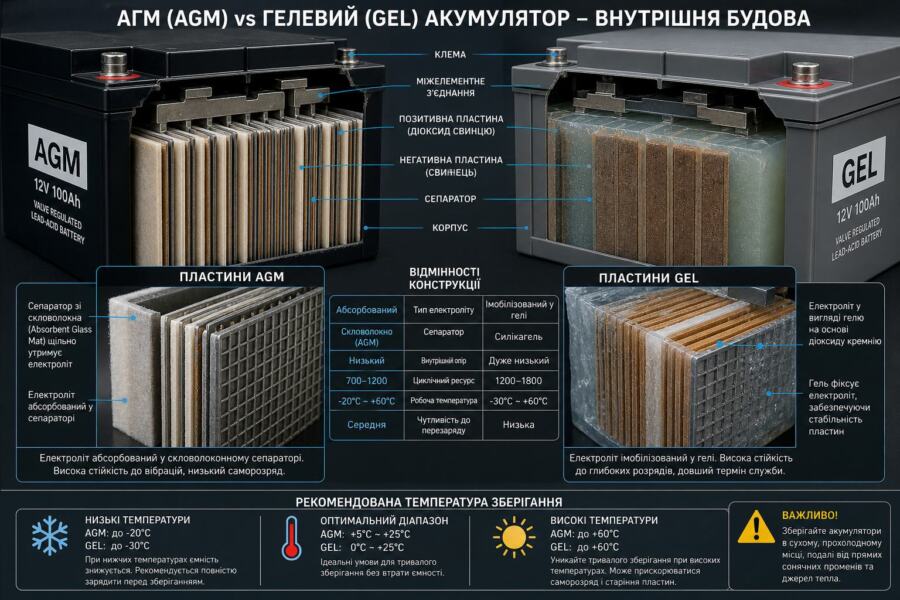
In AGM and Gel, the electrolyte does not freely slosh inside, but is bound in a fiberglass or gel mass. This gives advantages: less leakage, less evaporation, better safety, convenience for UPS, solar systems and backup power. But there is also a disadvantage: such batteries are less tolerant of improper charging and temperature extremes.
When the temperature drops, the rate of electrochemical reactions decreases. Relatively speaking, ions move more slowly, internal resistance increases, and available capacity decreases. In severe frost, the battery may still be «whole,» but it can deliver significantly less current. When it gets hot, the reactions accelerate, but this is not a plus, but a problem: plate corrosion, electrolyte drying, accelerated aging.
What is especially important for storage
For lead-acid batteries, the best condition is — full charge і moderate temperature. If you leave the battery discharged in the cold, the plates sulfation occurs quickly. If you keep it in the heat, the self-discharge increases and the resource decreases.
Battery storage temperature: practical ranges
Below are guidelines that I consider safe for household and backup systems.
| Parameter | AGM | Gel | Comment |
|—|—:|—:|—|
| Optimal storage temperature | +10…+20 °C | +10…+20 °C | The best compromise between self-discharge and resource |
| Short-term storage allowed | 0…+30 °C | 0…+30 °C | Under full charge condition |
| It is undesirable to keep it for a long time | below 0 °C | below 0 °C | Especially if the charge is lower than 100% |
| Critical heat | above +35 °C | above +35 °C | Sharply accelerates aging |
| Charging operating mode | +20…+25 °C | +20…+25 °C | Here the charging parameters are the most stable |
Important nuance: battery storage temperature — is not the same as charging temperature. The battery can be stored in a cooler room, but it must be charged according to the manufacturer's instructions. For most 12-volt AGM/Gel batteries, the charging voltage at 25 °C usually lies within 13.6–13.8 V in buffer mode and 14.1–14.4 V in a cyclical manner, but always refer to the passport of the specific model.
Gel battery: frost resistance without myths
Request for gel battery frost resistance I hear it often. There is a common misconception here: people think that Gel "loves frost" better than all other batteries. In fact, a gel battery simply keeps the electrolyte in a bound state better and is less sensitive to vibration and microleakage. But frost resistance does not mean that the battery can be left in a discharged state in the cold.
What happens in winter:
– if the battery fully charged, the electrolyte in Gel and AGM has a lower risk of freezing;
– if the charge has dropped to 50% or below, frost becomes much more dangerous;
– during deep discharge and low temperature, sulfate crystals may form, which are not always recoverable.
In practice, I advise you to remember a simple rule: It's not the battery that's afraid of frost, it's the discharged battery that's afraid of frost.. This applies to both AGM and Gel.
Battery operation in winter: why capacity «disappears»
Battery operation in winter is always worse than in the heat, and this is normal from a physics point of view. The capacity of a lead-acid battery can drop noticeably even at 0 °C, and at -20 °C the available energy is even lower. For backup power, this is critical: the inverter may shut down earlier than you expect, although the battery is «supposedly sufficient» according to the passport.
The main reasons for the drop in efficiency:
1. Increase in internal resistance — the battery delivers less current.
2. Slower chemistry — reactions on the plates do not proceed so quickly.
3. Reduction of real capacity — especially at high discharge currents.
4. Incorrect charge — a charger without temperature compensation may undercharge or overcharge the battery.
A separate problem is charging in the cold. Many users put the battery in an unheated garage or shed, and then wonder why it does not hold a load in the winter. If the charger does not have temperature compensation, the battery may remain undercharged in the cold, and receive too much charge in the heat.
A practical guide to temperature compensation
For a 12-volt lead-acid battery, typical compensation is approximately -18 mV/°C for the entire block relative 25 °C. This is not a "one size fits all" number, but a good engineering guideline. If the charger does not take this into account, the battery life will decrease faster in unstable conditions.
Heat is no less dangerous than frost
Many people only fear winter, but the heat is sometimes even worse for AGM and Gel. At temperatures above +30…+35 °C Aging processes are dramatically accelerated. For sealed batteries this means:
– pressure increase inside the housing;
– accelerated corrosion of positive plates;
– drying of the gel electrolyte;
– reduction of buffer operation resource in the UPS.
There is a simple engineering law: every +10 °C above the comfort temperature can significantly reduce the service life. In real life, this is seen in poorly ventilated cabinets, near boilers, in attics, and in automotive installations without heat dissipation.
UPS in the garage: how to install the system without unnecessary risk
When people ask about UPS in the garage, I always clarify: is the garage insulated or not, does it get below zero temperatures, is there dust, moisture, condensation, and sudden changes. For UPS with AGM or Gel This is very important.
What to consider in the garage
– Do not place the battery directly on a concrete floor. It is better to raise it onto a shelf or stand.
– Avoid direct sunlight. and places near stoves, heaters, boilers.
– Provide ventilation, even if the battery is sealed.
– Prevent condensation: after a sharp cooling, moisture settles on the terminals, contacts and UPS board.
– Monitor the charge: The battery should not be left in a partially discharged state for months in a cold garage.
What to do if the garage is not heated
1. Keep the battery fully charged.
2. Check the voltage at least once a 1–2 months.
3. If the backup power system is not used, perform a test charge.
4. Do not allow temperatures below -10 °C for long downtime without condition monitoring.
In an unheated room, I especially do not recommend installing a battery «and forgetting about it for half a year.» For battery operation in winter this approach almost always ends in premature degradation.
How to properly store AGM and Gel
To make your battery last longer, follow a simple scheme.
Storage procedure
1. Fully charge battery before storage.
2. Disconnect it from the load and unnecessary consumers.
3. Place in a place with temperature +10…+20 °C.
4. Do not allow deep discharge.
5. Once a 3–6 months Check the voltage and recharge if necessary.
6. Make sure the terminals are clean and dry.
What not to do
– Leaving the battery discharged in the cold.
– Charge without voltage control.
– Keep it near heat sources.
– Transport without securing if it is a large battery.
– Using a charger that is not specifically designed for AGM/Gel.
Comparison of AGM and Gel in cold and heat
| Criterion | AGM | Gel |
|—|—|—|
| Reaction to cold | Good, but capacity drops | Good, but also drops |
| Deep cycle resistance | Average/good | Higher, if the charge is correct |
| Overcharge Sensitivity | High | Very high |
| Behavior in the heat | Aging quickly | Particularly sensitive to overheating |
| Recommended mode | UPS, reserve, starting tasks for individual models | Reserve, cyclic operation, stable charge |
From practice: if the system operates in a room with unstable temperature, AGM often forgives mistakes a little better. But if the charge is set up correctly, Gel can last longer in cyclic mode. It is not important "which type is better in general", but which type is best for your temperature, mode and charger.
A short checklist before winter and summer
– Check the actual open circuit voltage.
– Assess the temperature of the installation location.
– Make sure the charger has a mode for AGM/Gel.
– Check for corrosion on the terminals.
– Do not place the battery in the coldest corner of the garage or close to a heater.
– If there is an inverter or UPS, test operation under load.
Practical conclusion from Engineer Gennady
In short, then battery storage temperature for AGM and Gel should be moderate, and the battery itself should always be charged. Frost is not dangerous by itself, but in combination with discharge. Heat is dangerous because it quietly and quickly "eats up" the resource. If you have DBJ in the garage, think not only about the power supply itself, but also about the microclimate, ventilation and voltage control. For a reliable system, I always say one thing: It is better to correctly adjust the charge and installation location once than to change an expensive battery after the first winter..
Frequently Asked Questions (FAQ)
Can AGM or Gel be stored in a cold garage?
Yes, but only fully charged and without prolonged deep discharge. If the temperature frequently drops below 0 °C, state control is required (Incomplete: max_output_tokens)