
Useful tips
Gasoline generator for home: why you can't run it in the garage


Gasoline generator for home can save from darkness, keep the refrigerator, boiler, Internet and pump working, but only if installed and operated correctly. The most dangerous mistake that private homeowners make is running the generator in a garage, under a canopy without ventilation or even in a semi-closed room. This is not just a violation of the instructions, but a real risk of poisoning, fire and electric shock.
When the power goes out, it seems like the most convenient thing to do is to place the unit closer to the house so you don't have to drag long cables and get wet in the rain. This is where the problems start. Carbon monoxide generator emits constantly, even if the engine is running smoothly, without smoke or foreign odors. Carbon monoxide is colorless, odorless, does not irritate the eyes, and accumulates quickly. Therefore, a generator standing in a garage can become deadly in a matter of minutes.
Why a gasoline generator cannot be run in a garage
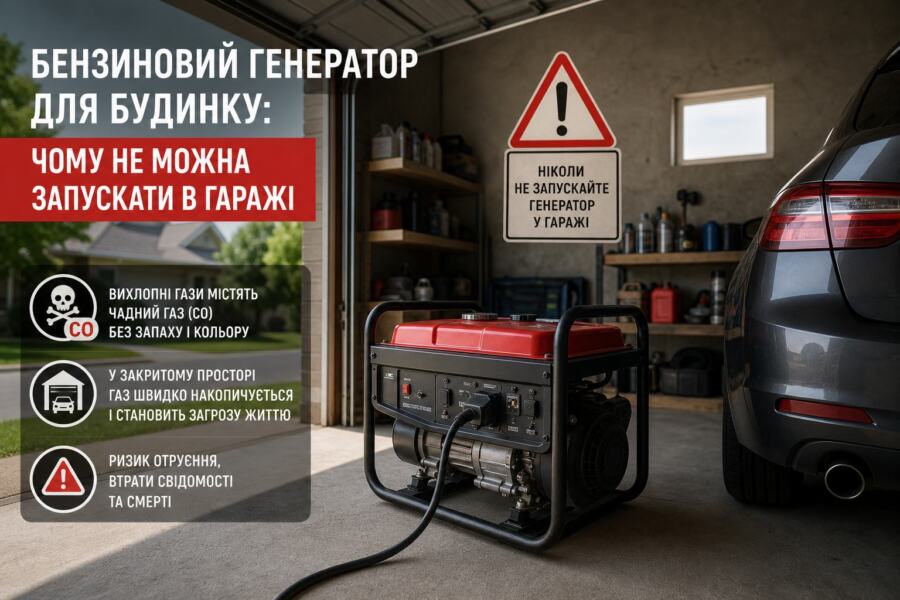
The main reason is simple: during operation, the internal combustion engine produces exhaust gases, among which are carbon monoxide — CO. This is a toxic substance that blocks the transport of oxygen in the blood. A person may not immediately feel the danger because the symptoms initially resemble fatigue or mild malaise.
In the garage, the situation is even worse due to several factors:
- limited air volume — gas accumulates quickly;
- poor ventilation — the exhaust is not dispersed;
- heat reflection from the walls and ceiling - the engine overheats;
- gasoline fumes — additional risk of ignition;
- people often go into the garage for a few minutes and underestimate the danger.
It is especially dangerous when the garage is connected to the house by an internal door. In this case, carbon monoxide can enter the living rooms through cracks, ventilation ducts or simply when the door is opened. That is why gasoline generator for home should only be operated outdoors or in a specially prepared outdoor location.
How carbon monoxide works and why it is so dangerous
Carbon monoxide generator is formed due to incomplete combustion of fuel. It is not felt by the senses, so a person cannot "understand" that he has already entered the danger zone. The most insidious thing is that at low concentrations, the following initially appear:
- headache;
- drowsiness;
- dizziness;
- nausea;
- weakness;
- confusion of thoughts.
Then the condition can worsen dramatically. A person loses the ability to adequately assess the situation, which is very dangerous when working with electricity, fuel and heavy equipment. If a generator is running in the garage, and someone from the family goes there for a minute, the consequences can be tragic.
You need to remember: high exhaust temperature and toxic gases are not the only problem. Even if the exhaust pipe is directed “to the side”, in a closed space the gases still return inside. Any garage has invisible air circulation paths, and carbon monoxide can fill them much faster than it seems.
How dangerous is it to start a generator indoors?
The problem is not only poisoning. A closed garage creates several risks at once:
- Carbon monoxide poisoning due to exhaust buildup.
- Fire due to sparks, a hot muffler or spilled fuel.
- Engine overheating due to lack of normal air exchange.
- Damage to electrical equipment, if the cables are routed incorrectly.
- Condensation and moisture, that worsen the safety and service life of the equipment.
A common mistake is to put the generator in the garage “for just an hour,” open the gate halfway, and think that’s enough. In fact, a partial opening does not guarantee a safe operation. generator ventilation. The wind can change direction, exhaust gases can be drawn back, and at night people often do not notice that the concentration of hazardous substances already exceeds the norm.
Another common mistake is to run the equipment near a basement entrance or ventilation shaft. Exhaust can be drawn into the house even without obvious contact with the room, especially if there is a temperature difference or strong wind.
Where is it safe to install a generator near the house?
Gasoline generator for home should be operated outdoors, on a dry and flat surface, away from windows, doors and air vents. Ideally, under a canopy with side ventilation or in a special protected area where air can move freely from all sides.
Practical guidelines:
- minimum 3–5 meters from the house, windows and doors;
- do not place under a closed roof without side ventilation;
- do not place near ventilation outlets, boiler rooms, or basements;
- do not place on wooden floors, carpet, leaves or dry grass;
- Do not use in a place where fuel vapors may accumulate.
If you need to install the generator permanently, it is worth considering a separate outdoor area with a non-flammable base and free air access. It is good if there is protection from rain, but without a hermetic closure. The generator does not need a “warm garage”, but controlled access of fresh air.
What is generator ventilation and why is it critical?
Generator ventilation — it’s not just “opening the door.” It’s organizing such air exchange that the engine receives enough oxygen, and exhaust gases don’t accumulate near a person and don’t get into the house. For a household gasoline generator, it’s a matter of life and death, not comfort.
Proper ventilation should provide:
- constant flow of fresh air;
- hot air and exhaust to the outside;
- absence of “pockets” where gases can be trapped;
- safety for people passing by;
- stable engine cooling.
If the generator is operating under a canopy, make sure that the air does not rest against a blank wall. The space should be open on several sides. It is also important that the exhaust is directed to a side where there are no windows, doors and places where people are. In no case should you lead the exhaust pipe “into a corner” or “under a wall” in the hope that the gases will go to the side by themselves.
How to safely connect a generator
Safe generator connection to the house is not just about plugging in a socket. Improper connection can burn out household appliances, create a backflow of voltage into the network, and endanger electricians, neighbors, and the owners themselves.
Basic rules:
- Do not plug the generator “through the socket into the socket” without a proper scheme.
- Use mains/generator switch or other certified method of introducing backup power.
- Be sure to consider power generator and total load.
- Check if there is overload protection and short circuit.
- For a fixed connection, it is better to hire a qualified electrician.
A separate danger is the so-called “reverse current” into the home network. If the generator is turned on incorrectly, voltage can flow into the external line. This is dangerous for repair crews who may work on the line, considering it to be de-energized. That is why safe generator connection should only be performed through the correct backup power input circuit.
Comparison of generator placement options
To better understand the difference between safe and unsafe solutions, it is useful to compare the main installation options.
| Installation location | Security level | Main risks | Comment |
|---|---|---|---|
| Garage with closed doors | Very low | Carbon monoxide, fire, overheating | Strongly not recommended |
| Garage with fully open doors | Low | Exhaust backdraft, accidental access by people | Still dangerous, especially when the wind changes |
| Under the open sky | High | Precipitation, humidity, noise | Rain protection and proper placement are required |
| Under a canopy with side ventilation | High | High temperature, humidity | One of the best household options |
Common mistakes made by homeowners
Most often, problems arise not from the generator itself, but from improper handling of it. Here are the most common mistakes:
- Starting in the garage or sheds without proper ventilation.
- Storing a gasoline can next to a hot engine.
- Connecting equipment without checking the total load.
- Using an extension cord that is too thin or damaged.
- Placing the generator under the window of the kitchen, bedroom or boiler room.
- Running in the rain without protection against moisture.
- Lack of grounding where it is required according to the diagram and instructions.
Another common mistake is to assume that if the generator is small, for example, 1–3 kW, it is supposedly less dangerous. In fact, even a compact unit emits enough exhaust to create a deadly concentration of carbon monoxide in a small room. Size is no help here.
How to choose a location and work plan for a private house
For domestic use, it is important not only to buy a reliable gasoline generator for home, but also to think over the scenario of its operation in advance. It is best if, even before the first start, there is a ready installation location, a cable of the required cross-section, a protected output and a clear load switching scheme.
What to pay attention to:
- real power household consumers;
- will the boiler, pump, refrigerator, and lighting be started at the same time;
- Will it last? generator starting currents;
- sufficient length and quality of cables;
- accessibility for maintenance and refueling;
- distance to the house and windows.
For most homes, it is better to reserve in order of priority: first the boiler and circulation pump, then the refrigerator and some lighting, and only then secondary consumers. This approach allows you to reduce the load on the generator and extend the battery life.
What to do when starting and stopping a generator
Proper starting is part of safety. Before starting the generator, you must:
- Check oil and fuel levels.
- Inspect cables, plugs, sockets, extension cords.
- Install the unit on a flat, non-flammable surface.
- Make sure there are no children, animals, or flammable materials nearby.
- Turn on the load only after the engine operation has stabilized.
During a stop, the load is first turned off, and then the engine is turned off (Incomplete: max_output_tokens)