
Useful tips
BMS lithium board: how to protect LiFePO4 battery correctly


The lithium BMS board is not an «additional trifle» to the battery, but the main safety element for the LiFePO4 system. It is it that prevents the banks from overcharging, going into deep discharge, overheating or operating with a dangerous voltage imbalance. In real installations, I have seen dozens of cases when LiFePO4 battery with BMS served for years without problems, and just as many cases when savings on protection ended in loss of capacity, shutdown under load, or even damage to one element in the entire package. In short: battery protection — this is not an option, but a mandatory part of a proper energy system.
What is a lithium BMS board and why is it critical?
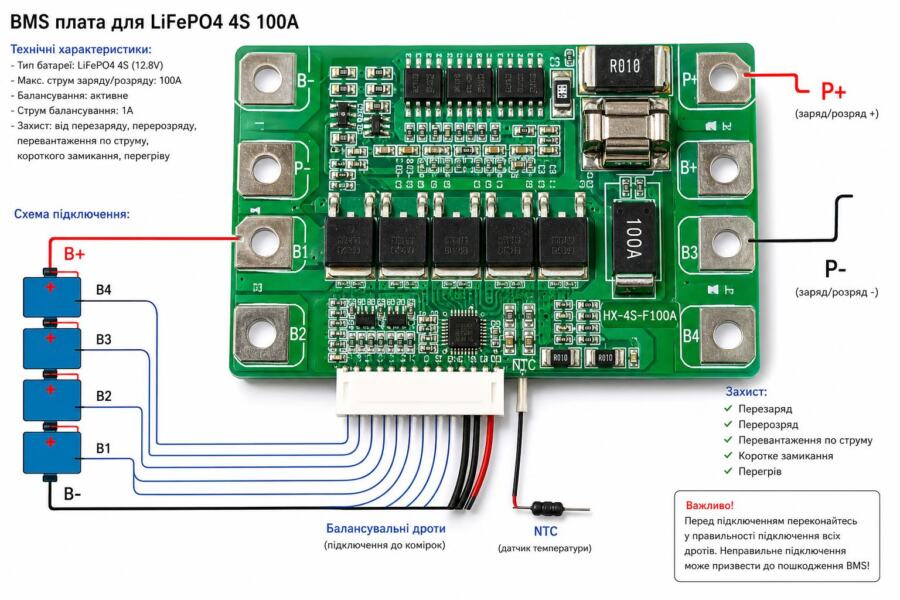
BMS (Battery Management System) — is an electronic battery management board. For LiFePO4, it performs several tasks at once:
– controls voltage of each cell;
– cuts off the charge when overvoltage;
– turns off the discharge when deep discharge;
– limits the current when overload;
– protects against short circuit;
– often controls temperature through sensors.
LiFePO4 chemistry is indeed safer than that of conventional lithium-ion batteries, but this does not mean that the battery is «all-rounder». On the contrary: it tolerates cycles well, but does not like system errors - overcharging, undercharging of individual cells, prolonged exposure to limiting voltages. That is why bms lithium board — this is the basis of longevity.
What is the working principle of battery protection?
The BMS constantly measures battery parameters and compares them with acceptable limits. If everything is normal, the system works. If one parameter goes beyond the limits, the board either limits the current or completely disconnects the circuit.
The most important thing to understand here is: BMS does not «cure» the battery, but prevents damage. It doesn't add capacity, doesn't increase energy reserve, doesn't make weak banks stronger. Its task is to prevent you from ruining the battery with your own system.
Why does a LiFePO4 battery with BMS last longer?
In LiFePO4, the nominal voltage of one cell is 3.2 V, and a full charge is about 3.55–3.65 V per cell. If there are 4 such cells in the package, we have a classic 12.8 V battery. The problem is that even new cells never have perfectly equal capacity and internal resistance. Because of this, without balancing, one cell can charge earlier than the others, while the other may remain undercharged.
What happens without normal protection
When BMS is missing or incorrectly selected, the following situations arise:
1. One can recharges earlier than others.
2. The charger is still supplying voltage, but the weak bank is already working at the limit.
3. During discharge, one bank falls below the safe limit before the others.
4. The imbalance in the package grows, and the useful capacity decreases.
5. Over time, the battery loses its life, although it is still physically "alive".
That's why battery protection should work not only on the total voltage, but also on each cell separately. This is fundamental.
How to choose a lithium BMS board for LiFePO4
Selecting a BMS does not boil down to the phrase «I have a 100 A load, so I take it at 100 A.» In practice, it is important to take into account the operating current, peak loads, number of cells, and balancing method.
Basic selection parameters
– Number of cans in a series: 4S, 8S, 16S, etc.
– Rated continuous current: for example, 20 A, 60 A, 100 A.
– Peak current: short-term reserve for starting the engine, inverter or compressor.
– Balancing type: passive or active.
– Cutoff thresholds: overvoltage, underdischarge, temperature.
– Availability of temperature sensors.
– Quality of power switches and conductors.
BMS comparison table for LiFePO4
| Parameter | Basic BMS | Quality BMS | What does it give in practice |
|—|—:|—:|—|
| Continuous current | 20–40 A | 60–120 A | Real load endurance |
| Peak current | Small margin | Significant margin | Fewer shutdowns at startup |
| Balancing | Passive 30–80 mA | Passive or active 0.5–5 A | Better alignment of cans |
| Temperature protection | Often absent | There are sensors | Safe charge and discharge |
| Control accuracy | Average | Higher | Fewer false cutoffs |
| System resource | Lower | Higher | Longer battery life |
If you are assembling a stand-alone power supply for a home, pumps, refrigerator, or inverter, do not take the BMS «close to you.» The correct rule is this: BMS rating should be with a margin of 20–30% from the real continuous current of the system. This reduces heating and increases the life of the keys.
Battery balancer: why is it needed even if there is a BMS
Often people think that battery balancer and BMS are the same thing. Actually not always. Many budget boards only have passive balancing: when one can is a little "higher", the excess energy from it is burned on the resistor. This works, but slowly.
Passive and active balancer: what's the difference?
Passive balancer:
– simple and cheap;
– removes the excess from the upper jar;
– usually has a balancing current 30–100 mA;
– suitable for small batteries or stable modes.
Active balancer:
– transfers energy from a more charged bank to a less charged one;
– more efficient for large assemblies;
– can operate on currents 0.5–5 A;
– useful in systems where the battery often operates unevenly.
For household LiFePO4 pack active balancer — not always mandatory, but it is highly desirable if the battery is large, works daily, or is assembled from new cells from different batches.
What battery protection settings are considered normal?
For LiFePO4, I focus on practical limits that provide resource and safety, not «maximum energy squeezer.».
Working guidelines for LiFePO4
– Charge voltage per cell: 3.55–3.65 V.
– Safe lower discharge limit: 2.8 V on the cell.
– Emergency discharge limit: 2.5–2.7 V.
– Charging temperature: typically from 0 °C and higher, if there is no special heating.
– Discharge operating temperature: depends on the manufacturer, but it is advisable not to allow overheating above 45–50°C.
What not to do
– Do not set the charging voltage too high. «"to get more capacity." This accelerates degradation.
– Do not discharge the package "to zero"«. LiFePO4 doesn't like this.
– Do not take BMS without temperature protection for a system that sits in a garage, closet, or in the sun.
– Do not connect the inverter without checking the starting currents..
Typical errors when installing a lithium BMS board
Here are the errors I see most often on objects:
1. BMS is not selected by current, but "by eye".
As a result, the board heats up and turns off.
2. No normal cooling.
Even a good board at high currents requires thermal management.
3. Confusion with balancing wires.
One wrong contact can ruin the board or cell.
4. Weak busbar and cable connections.
Contact resistance causes heating, voltage drops and false alarms.
5. No fuse.
BMS is not a replacement for a fuse. Fuse is mandatory as the last level of protection.
Practical installation: how to make battery protection correctly
If you are assembling the battery yourself, follow a simple algorithm.
Step-by-step procedure
1. Align the cells first by voltage before assembly.
2. Assemble the package and check that all the jars have similar readings.
3. Connect the balancing wires strictly according to the BMS manufacturer's scheme.
4. Check polarity twice, or better three times.
5. Install power wires of the required cross-section.
6. Add fuse near the battery.
7. Perform the first start-up under control of voltage, temperature and current.
8. Check if they are heating up MOSFETs, terminals, busbars and connectors.
What I advise from practice
– Do not hide the BMS in a sealed box without heat dissipation.
– Do not use random Chinese boards without clear specifications.
– If the system is powerful, install a BMS with temperature sensors and normal current reserve.
– For home and reserve it is better to have a simple, clear and proven scheme, than a "smart" but unstable one.
Table: what is more important in different scenarios
| Scenario | What is a priority | Which BMS to choose |
|—|—|—|
| Lighting, router, small autonomous | Simplicity and stability | 4S, 20–40 A, passive balancing |
| Inverter for Home | Reliability and current reserve | 4S or 8S, 60–120 A, temperature sensors |
| Daily cycle solar system | Balance and resource | High-quality BMS + active balancer |
| Mobile power supply | Compactness and control | Lightweight BMS with adequate current |
When BMS board lithium won't save
This is an important point. Even the best BMS does not compensate for:
– bad banks with different capacities;
– incorrect charger;
– lack of a fuse;
– weak power contacts;
– overheating in a closed space;
– an attempt to draw current from the battery above its design potential level.
That is battery protection — it's a system, not a single board. BMS, charging, wires, terminals, ventilation, and proper settings must work together.
Conclusion
To put it simply in engineering terms, BMS lithium board — this is insurance against the main errors in the operation of LiFePO4. For a home or backup system, I always advise taking LiFePO4 battery with BMS immediately, do not save on current reserve and do not ignore battery balancer. In a good assembly, not only capacity is important, but also how calmly the battery goes through daily cycles. My practical advice from Engineer Gennady is simple: it is better to install a slightly more expensive, but correct BMS than to later change banks that have suffered from incorrect operating conditions.
Frequently Asked Questions (FAQ)
Can LiFePO4 be used without BMS?
Only possible under very controlled laboratory conditions. For everyday use, solar systems and backup power BMS is mandatory.
Is a separate balancer needed if there is already a BMS?
Yes, if the package is large or the banks are often unbalanced. Most built-in balancers in BMS — passive and work slowly.
What current reserve should I take for the BMS?
Practically — 20–30% stock from the maximum continuous current of the system. This reduces heating and failures.
Can LiFePO4 be charged with a regular lead acid battery charger?
No, no verification (Incomplete: max_output_tokens)