
Useful tips
The inverter lies about the charge: how to determine the real battery level


The inverter often shows the battery charge «by eye», and not by fact. The reason is simple: it assesses the battery condition by voltage, and the voltage under load varies depending on the current, temperature, battery chemistry and the settings of the device itself. Because of this, the user sees 70–80%, and after 10 minutes already 30%, although the real capacity is still there.
That is why the phrase «"the inverter is lying about the charge"» in the practice of power systems it sounds not as an emotion, but as a technical fact. Most often the error occurs on AGM, GEL and even on LiFePO4, if the inverter does not have the correct charge profile or if the battery is old, unbalanced, or operating at low temperatures.
For a house, apartment, office or small business, this is no small matter. Incorrect indication leads to premature shutdown of the reserve, deep discharge, reduced battery life and errors in autonomy planning. To understand, how to find out real battery charge, you need to look not at one parameter, but at a system of features.
Below is a practical analysis, Why does the charge on the inverter drop?, how to test a battery without a laboratory, when you need a coulometer, and how to choose an online electronics store where you can buy the right measuring equipment without unnecessary overpayments.
Why does the inverter show the wrong charge?
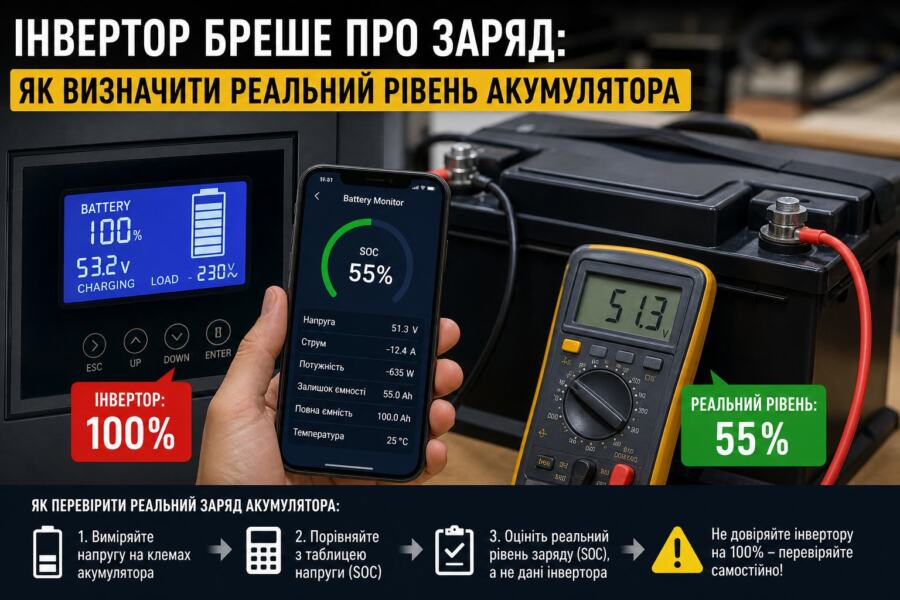
Most household inverters determines the charge by the voltage at the terminals. This is convenient, but inaccurate. The battery voltage is not a direct copy of its capacity: it sags under load, and recovers after the load is removed. If inverter takes readings at the moment the refrigerator, pump or boiler is started, the indication immediately "falls".
The second reason is internal resistance. battery. In old AGM and GEL it increases, so even with a still decent capacity the voltage sags more than in a new battery. In LiFePO4 the problem is different: the discharge curve is almost flat, and in the area of 20–80% the voltage changes little. It is difficult for the inverter to understand whether the battery is filled to 60% or 35%.
The third factor is incorrect settings. If the profile selected in the inverter 12V AGM instead of LiFePO4, the cut-off, absorption and float thresholds will be incorrect. The same applies to systems 24V і 48V: the voltage error of one section is multiplied by the entire circuit and distorts the SOC estimate.
Another common cause is low and high currents at the same time. For example, a solar inverter may show "charge is present", but in the evening, when consumption has increased to 1.5–2 kW, the battery sags so much that the controller considers it almost empty. This is not a lie in the literal sense, but a limitation of the measurement method.
How to find out the real battery charge without errors
The most accurate approach is not to estimate the charge by a single number, but to check three parameters at once: the quiescent voltage, the behavior under load, and the number of ampere-hours actually delivered. If these data match, the estimate will be close to reality.
The first step is to turn off the load and charging current, then let the battery «settle» for 20–40 minutes. It is the open-circuit voltage that best indicates the state of charge for lead-acid batteries. For lithium it is less informative, but still useful as a reference point.
The second step is to perform a test under a stable load. If the battery is 100 Ah keeps the inverter without a sharp drop, but after starting the pumps the voltage drops to 0.7–1.0 V, the problem may not be in the capacity, but in worn or weak terminals, cables, and circuit breakers.
The third step is to use a coulometer. That is coulometer for battery buy is useful for those who want to see the real charge/discharge balance in ampere-hours. Such a device counts how much energy went into the battery and how much came out, and not just looks at the voltage.
AGM, GEL and LiFePO4 voltage table
Useful for quick orientation AGM GEL LiFePO4 voltage table. It does not replace measurement, but helps to understand whether the battery is already at the limit.
| Battery type | Resting voltage | Approximate charge |
| AGM 12V | 12.7–12.8 V | 100% |
| AGM 12V | 12.2–12.3 V | 50–60% |
| GEL 12V | 12.7 V | 100% |
| GEL 12V | 12.1–12.2 V | approximately 40–50% |
| LiFePO4 12.8V | 13.3–13.4 V | almost fully charged |
| LiFePO4 12.8V | 12.8–13.0 V | intermediate level |
For lead-acid batteries, it is critical not to discharge below 11.8–12.0 V under a quiet load. For LiFePO4, you cannot focus only on voltage: it is more useful to look at the BMS or coulometer data.
Typical mistakes of owners of inverter systems
The most common mistake is to assume that a new battery will always show the correct charge. In practice, even a new battery can be uncorrected after long storage or installation with thin cables. If there is a weak connection between the battery and the inverter, the inverter sees less voltage than is present on the battery.
The second mistake is to measure the charge immediately after the operation of powerful consumers. In systems with a pump, microwave, compressor or air conditioner, the voltage drops briefly, and then recovers. You need to wait for stabilization, otherwise the conclusion will be incorrect.
The third mistake is to ignore temperature. When 0°C and below, lead-acid batteries give less capacity, and lithium batteries are often limited by BMS. The inverter perceives this as a rapid discharge, although physically the battery simply operates in more difficult conditions.
The fourth mistake is to charge «until the green indicator» and consider the system ready. In many inverters, the green status only means the completion of the charging algorithm, but not a complete balance of the cells. For LiFePO4, this is especially critical: without balancing, the SOC will be displayed with an error.
When is a coulometer needed and how is it better than an inverter?
A coulometer is useful in systems where precise autonomy is important: backup power for a boiler, server cabinet, cash register, security, video surveillance, lighting, or an autonomous home. If the load changes during the day, and you need to get a forecast from the battery in hours, it is difficult to do without such a device.
Unlike an inverter, a coulometer measures the actual charge flow. It is useful after installing a new battery pack, after replacing one battery in a battery chain, and after switching from AGM to LiFePO4. It is in these situations that an inverter often lies about the charge the most.
Practical scenario: system 48V, load 800 W, battery on 100 Ah. The inverter may show 45% for another hour, and the coulometer will already show what is actually spent. 38–42 Ah. For reserve planning, this is the difference between normal operation and emergency shutdown.
If necessary coulometer for battery buy, it is better to take a model with the correct current range, support for your system voltage and the ability to calibrate the capacitance. For domestic and commercial installations, this is one of the most useful devices, not an "additional toy".
Installation practice: what to check before concluding about the charge
Before you trust the inverter's numbers, check the terminals, crimping of the terminals, cable cross-section and line length. On short systems 12V even additional 0.2–0.3 V Wire losses greatly distort the picture. Powerful inverters require thick cables, otherwise the sag will be taken as a battery discharge.
Check the battery type settings separately. AGM and GEL require different charging voltages and different recovery thresholds. LiFePO4 requires a correct charging profile and ideally an inverter with a BMS. If this is not the case, the percentage on the screen will only be approximate.
Another nuance is the balance of the batteries in the assembly. In systems with several batteries, one weak bank pulls down the entire chain. In this case, the inverter does not «lie», but simply sees the weakest link. Therefore, timely diagnostics, contact stretching and periodic capacity monitoring are more important than beautiful numbers on the display.
For home installations, it is useful to perform a control cycle once a month: full charge, battery rest, load test, recording voltage and delivered ampere-hours. This way, degradation can be seen quickly, and you don't have to guess., Why does the charge on the inverter drop?.
Practical conclusion
If the inverter shows an inaccurate charge, check the system comprehensively: open-circuit voltage, sag under load, profile settings, temperature and cable condition. For AGM and GEL, the voltage is the reference point, for LiFePO4 - also the BMS or coulometer. In real installations, it is the coulometer that gives the closest picture to the truth, and the correct selection of equipment in an online electronics store helps to avoid mistakes even at the installation stage.