
Useful tips
Battery balancer: how to choose and extend the life of 24V/48V batteries


A battery balancer is needed where the battery does not work equally well across all cells. In real 24V and 48V systems, the voltage difference between the banks accumulates due to aging, different temperatures, uneven charge and discharge, and poor-quality connections. If this imbalance is not removed, one part of the battery is constantly overcharged, the other is undercharged. As a result, the capacity drops, heating increases, and the resource is reduced.
For home solar power plants, inverters, backup power, telecom cabinets and UPS, this is not a theory, but a typical reason for premature battery replacement. Especially critical imbalance UPS batteries, when the system operates in a constant charge and short cycle mode. Here, even a few tens of millivolts of difference between the cells turns into a system problem over time.
Correctly selected equalizer for lithium batteries or for lead-acid assemblies helps equalize the charge between cells, reduces battery stress and extends its life. For the user, this means fewer emergency shutdowns, more stable inverter operation and less cost to replace the battery pack.
When needed active balancer 24V, and when is a passive solution enough, how to execute battery balancer connection without errors, and why microart balancer often installed in household and semi-industrial systems - these questions are important for those who want to buy not a "box with wires", but a real tool for protecting the battery park.
What is a balancer and how does it remove imbalance?
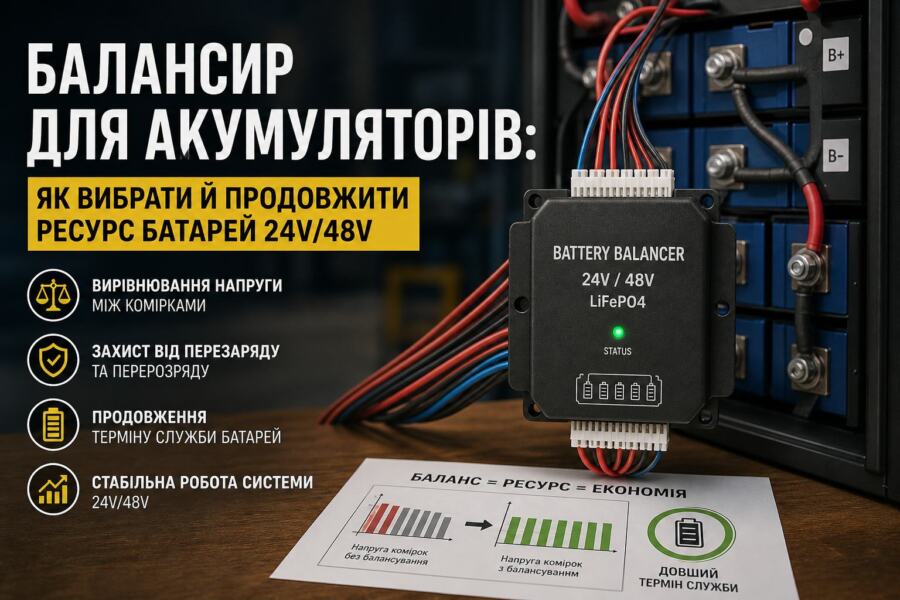
A balancer is a device that equalizes the voltage between series-connected battery cells. For 48V from 12V batteries, you need 4 12V batteries in a series circuit (detailed 24V and 48V battery installation algorithm see our new instructions).. One heats up more, the other has higher internal resistance, the third ages faster. Without balancing, the system starts working "at its weakest". That is why buy battery balancer It is worth it before obvious problems appear, not after an emergency drop in capacity.
There are two main principles of operation. A passive balancer discharges excess energy from more charged elements in the form of heat. An active one transfers energy from stronger cells to weaker ones, i.e. it works more efficiently and hardly heats up. For systems with high current and frequent cycles, an active circuit works better.
In practice, this is easy to see: one bank in a 48V assembly reaches the upper limit earlier than the others, the BMS or charger reduces the current, and the entire battery charges more slowly. If this happens constantly, the capacity seems to «disappear» earlier than the passport resource. The balancer reduces this deviation and equalizes the operation of all cells.
It is important for the user to understand: the balancer does not restore a damaged battery, but maintains uniformity its work. If the element already has deep degradation, the balancer will only postpone the problem, but will not replace repair or replacement.
When a balancer is absolutely necessary
There are several typical cases where a battery degrades quickly without balancing. The first is sequential builds on 24V and 48V, especially if they are assembled from individual cells or batteries from different batches. The second is backup power systems with frequent network outages, when the battery regularly switches from charge to discharge and back.
The third is UPS, inverters, solar stations and telecom equipment, where the charging algorithm keeps the battery on standby for months. In this mode, even a small imbalance in the UPS batteries gradually accumulates. The fourth is cold or overheated rooms: the temperature directly changes the internal resistance of the elements, and therefore their charge/discharge.
A separate risk group is lithium assemblies with a large number of consecutive cells. For them equalizer for lithium batteries is practically mandatory, because the difference in voltage between the cells there very quickly puts the battery into emergency mode.
| Solution type | When appropriate | Pros |
| Passive balancer | Small currents, simple system | Cheaper, easier installation |
| Active balancer | 24V/48V, inverters, solar power plants, UPS | Levels faster, heats up less |
For home with inverter at 48V, the active option often gives a significantly better result: the battery holds its capacity longer, and the charge becomes more uniform. For a small office With a UPS, there is an additional advantage - less downtime due to battery errors.
How to choose a balancer for 24V and 48V systems
The first thing they look at is compliance with the system voltage. Active balancer 24V cannot be put into a 48-volt assembly without checking the operating range. The operating voltage, number of series elements, maximum balancing current, connection method, and presence of protections are important in the technical specifications.
For lead batteries, compensation for differences between blocks is more important, for lithium - precise work on each cell. If the batteries are collected from different batches or have different ages, it is better to take a device with a higher energy transfer current. For small home systems, a compact model is enough, but for large battery cabinets, a power reserve is needed.
The practical selection criterion is simple: if the system regularly operates at the limit, the balancer should not be «minimally compatible», but with a margin. Otherwise, it will not have time to equalize the cells during a real charge/discharge cycle.
To navigate between models, compare the following parameters:
System voltage: 24V or 48V.
Battery type: LiFePO4, Li-ion, AGM, GEL, lead-acid.
Balancing current: the larger it is, the faster the alignment.
Work scheme: active or passive.
Assembling: in the housing, on the DIN rail, in the cabinet, next to the battery.
If you are looking for where buy battery balancer with proven compatibility and adequate selection for the system, it is worth focusing not only on the price, but also on the characteristics of the power supply, charger and type of battery pack. For electrical systems, it is not "universalism" that is important, but accurate fit into the operating mode.
Connecting a battery balancer without errors
Connecting the battery balancer begins with a complete de-energizing of the system. It is impossible to work under load or during charging. Next, the polarity of each tap is checked, because an error in one wire can disable the device or create a short circuit.
The wires must be of sufficient cross-section, and the connections must be short and reliable. Poor contact at the connection point is sometimes more dangerous than the imbalance itself, as it heats up, oxidizes, and further breaks the voltages between the elements. In lithium assemblies, it is advisable to place the balancer as close to the battery as possible.
A typical mistake of users is to connect the device «by eye», without measuring each cell with a multimeter. Another mistake is to install a balancer after long-term use of the battery with different levels of wear. In this case, it works, but the full effect will not be there, because one element is physically weaker.
For installation in domestic systems, it is useful to follow simple rules: ensure ventilation, do not pinch cables between metal edges, do not lay wiring near power buses without protection, check the case temperature after a few hours of operation. If the balancer is actively heating up, it means either it is overloaded or the system has a serious imbalance.
Microart balancer: where it is used and what to consider
Request microart balancer often associated with the search for compact solutions for inverter and backup systems. Such devices are valued for their simple installation, clear operating logic and suitability for daily use in domestic and commercial installations. For an electrician, it is important that the balancer does not require complex maintenance and does not introduce unnecessary losses in the charging circuit.
In inverter or UPS systems, Microart modules are often installed where there is already a problem of uneven battery aging. When properly selected, they help extend the life of the battery pack, reduce voltage errors, and stabilize the charging circuit. This is especially useful when the battery pack is not new but is still serviceable.
At the same time, you should not expect miracles. If the batteries have different capacities, different internal resistances and different service lives, the balancer will only reduce the asymmetry. For maximum efficiency, it is advisable to select identical elements, the same cable path and the same cooling conditions.
Operating practices: what extends battery life
Most often, the resource is lost not because of one major failure, but because of small repeated errors. Constant recharging of one bank, storage of the battery in the heat, operation without checking the contacts, inappropriate charging profile - all this accelerates aging. The balancer reduces the consequences, but the correct operating mode remains the basis.
For 24V and 48V systems, it is useful to check the voltage on each cell every few months, especially after emergency shutdowns. If the difference between banks increases, the cause should be sought: cell degradation, poor contact, overheating or incorrect charger. The balancer should not work as a «cure for all diseases».
One of the real scenarios: in a private house on 48V the battery of four modules began to lose capacity after 1.5 years. After installing an active balancer and replacing a weak connection, the autonomy time stabilized, and the difference between the banks decreased several times. The savings were not in the "magic recovery", but in the fact that the system stopped working with constant skew.
Another example is an office UPS with frequent network failures. After switching to proper balancing, false low voltage trips decreased, and the batteries stopped heating up at the end of the charge. For the business, this means fewer failures and predictable maintenance.
Conclusion: what to choose in practice
For systems 24V і 48V The balancer is needed where the stability of the battery pack is important, and not just the availability of batteries. If the system works with lithium, an inverter or a UPS, it is advisable to take an active solution with a current reserve and compatibility with a specific type of battery. For domestic and commercial applications, it is better to choose the right device once than to regularly change degraded modules.
Before buying, check the voltage, number of cells, type of chemistry, installation conditions and the availability of real technical support. That's right balancer for lithium batteries or for lead assemblies works as a resource extension tool rather than a formal accessory. For those planning buy battery balancer в electrical shop, priority is given to the quality of selection, compatibility and clarity battery balancer connection.