
Useful tips
How to clean solar panels: engineering rules for safe care

Solar panels do not require complex service, but they are sensitive to dirt, ice, dust, bird droppings and mineral deposits after rain. Any layer on the glass changes the angle of light transmission, and the module quickly loses some of its generation. In practice, the drop may be imperceptible to the user in one day, but in a month it gives a noticeable shortage of kilowatt-hours.
It is important for the owner not only to know, how to wash solar panels, but to understand the line between safe care and actions that damage photovoltaic cells, cables, sealant or fasteners. Improper cleaning often creates more problems than the dirt itself: cracks from thermal shock, scratches from a hard brush, leaks through a broken seal.
The most common reason for contacting the service is Why is the power dropping? solar panel even without visible damage. The answer is usually simple: contamination, shading, overheating, poor contact, aging of the inverter or degradation of the modules. Some of the causes can be eliminated by the owner himself, but only if he works according to safety rules.
Correct service solar power plants includes not only washing, but also inspection of fasteners, cable routes, MC4 connectors, sealing condition and performance control. In a private house, warehouse or office, the principle is the same: a clean panel and working electricity should work as a single system.
When to wash panels and why you shouldn't do it haphazardly
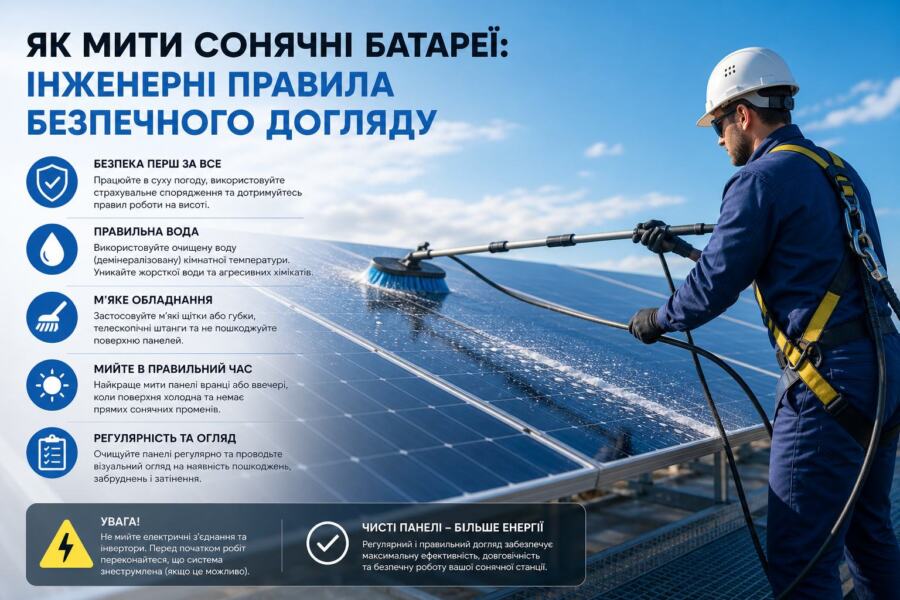
The frequency depends on the installation location. On a roof near a road, field, construction site or industrial zone, the panels get dirty faster. In such conditions, cleaning may be required once every 1–3 months. For a roof in a clean area, 2–4 times a year is often sufficient. If the system has online monitoring, focus not on the calendar, but on the actual drop in production.
An illustrative practical scenario: a 10 kW station in the suburbs lost about 8–12% of generation after spring dust. The owner noticed this only after comparing it with the same period last year. After cleaning, the output returned almost to normal without repairing the inverter or replacing modules. That is, the problem is not always in the electronics - often it is banal surface contamination.
Do not wash the panels unnecessarily. Every intervention is a risk: you can step on the module, tear the sealant, damage the anodized frame, or work on a slippery roof. If the panels have not lost their performance and there is no dense coating on the glass, frequent «preventive» contact with water is not necessary.
Winter is a special case. Cleaning solar panels in winter makes sense only when the snow does not melt on its own, and the coating gives a long loss of generation. In the cold period, the danger is that hot water or sharp mechanical impact can create thermal shock and microcracks. It is better to remove snow with a soft tool, without touching the glass with metal.
Before washing, assess whether the modules are shaded by trees, antennas, nearby buildings, or new construction. Sometimes the owner blames dirt, when the real cause is changed lighting patterns in the morning or evening. This is especially important for string systems, where one shaded panel can pull down the entire row.
Safe cleaning algorithm without damaging the glass and sealing
Start with a complete power outage according to the installation plan. Modules under the sun always generate voltage, even when the inverter is off. Therefore, the first step is to turn off the inverter, DC automation and, if available, the battery circuit. Working on a switched-on system is dangerous: wet connectors, exposed contacts and water near the cables create a risk of electric shock.
The best time to clean is in the morning, evening, or on a cloudy day when the glass is cold. If the surface temperature is significantly different from the water temperature, the risk of micro-damage increases. Do not use ice water on a heated module or pour boiling water on a frozen panel.
Acceptable tools are simple: a soft sponge, a telescopic brush with non-abrasive bristles, a hose with low pressure, clean water. Aggressive chemicals, household powders, solvents and hard scrapers are prohibited. They remove the anti-reflective layer, leave scratches and accelerate the aging of the glass.
| Method | Risk | Result |
| Soft water + sponge | Low | Safe basic cleaning |
| Stiff brush + pressure | High | Scratches, microcracks |
| Hot water on cold glass | High | Thermal shock, risk of damage |
| High pressure washing | Medium/high | May damage the seal |
After washing the panel, it is advisable to let the water drain on its own. If traces of hard water remain, wipe only with a soft, lint-free cloth. On large areas, it is better to use demineralized water: it does not leave salt stains and reduces the need for repeated wiping.
Pay special attention to edges and joints. Water should not accumulate in the area of frames, junction boxes, cable entries and connectors. If after washing you see fogging inside the panel or a suspicious white coating near the gland, this is no longer maintenance, but a reason for diagnostics.
What not to do when caring for photovoltaic modules
The most common mistake is to wash panels with a hose with high pressure, like a facade or tiles. In solar The module has adhesive and polymer layers, and excessive pressure can gradually wash away the seals, especially on older stations. Even worse is high-pressure washing from close range.
The second mistake is to walk on the panels. Glass does not withstand the load as it seems, and local pressure from shoes, tools, or knees can cause microcracks that are initially invisible. After a few months, they cause a drop in generation or failure of some cells.
The third mistake is using solvents, abrasives, glass cleaners with ammonia, and car washes with wax. They leave a film that, on the contrary, impairs the transmission of light and collects dust. For solar panels require neutral clean water or a specialized product compatible with photovoltaics.
A separate danger is ignoring the electrical part. After heavy rain, snow or hail, it is necessary to inspect not only the surface, but also the cable routes. Damaged PoE not relevant here, but the principle is the same for any low-voltage network: if the insulation is damaged, a humid environment increases the risk of an accident. For stations, it is critical to check the integrity of the wiring on 12V auxiliary circuits, as well as the inverter power lines on 220V.
Do not clean the panels in severe frost unnecessarily. If it is necessary, remove only dry, loose snow with a soft brush. Ice, frost and solid crust should not be scraped off with a metal, shovel or hard scraper. Damage to the glass in such cases is often more expensive than the lost day of generation.
Why power drops and how to distinguish dirt from a technical problem
The decrease in production is not always visible to the eye. If why is it falling solar panel power — your key question, start with a simple one: check the generation schedule, module cleanliness, and shadow areas. A uniform drop across the entire array more often indicates dirt, low insolation, or overheating. A sharp drop in one row indicates a problem with the cable, connector, or one panel.
For string systems, a situation is typical when one dirty or shaded module reduces the current of the entire chain. In this case, cleaning gives a noticeable effect even without repair. For systems with optimizers or microinverters, the impact of dirt is more local, but the principle is the same: less light on the cell - less power.
It is useful to compare the indicators in the same weather. For example, on a clear April day, the station should give values close to previous years at a similar temperature. If the difference is 10–15%, and the panels look dirty, this is a practical signal to wash them. If the modules are clean, you need to look at the inverter, MPPT configuration, shading and contact quality.
Don't forget that overheating also reduces generation. A dirty panel dissipates heat worse, and dust on the frame and back of the module impairs ventilation. For rooftop solar power plants, this is especially critical in the summer, when every extra degree reduces useful output.
If the system is large, it is effective to keep a simple log: cleaning date, weather, visible surface condition, daily generation before and after. Such records help to understand what exactly is causing losses and avoid wasting time on unnecessary maintenance.
Solar power plant maintenance: what to check besides washing
Full-fledged maintenance of solar power plants is not limited to cleaning the glass. Together with the modular part, the fasteners, the tightness of the bolts, the condition of the roof under the structures, metal corrosion, the tightness of the passages through the roof are inspected. Even a clean panel will not help if moisture accumulates under it or the frame has lost its rigidity.
In practice, it is useful to check once a season: whether the terminals have loosened, whether the connectors have oxidized, whether the cable has rubbed against the metal, whether the position of the panels has changed after the wind. For rooftop installations, snow loads and deformation of the load-bearing elements are also checked after winter.
For a private home, farm, or small business, it is worth having a minimum set: dielectric gloves, goggles, a soft brush, access to monitoring, and a clear emergency shutdown scheme. This reduces the risk of error during any work, even if it seems simple.
In the store electrical shop It is advisable to select not only the panels themselves, but also related equipment for safe operation: protection automation, cable, connectors, fasteners, generation control devices. It is high-quality components that often determine how problem-free the entire operation cycle will be.
Practical conclusion
Solar panels should only be cleaned safely, at the right time and without aggressive agents. Regular inspection, clean water, soft tools and control of the electrical part give more effect than frequent but chaotic interventions. If the system has stopped producing the expected generation, first check for dirt, shadow and contacts, and only then look for a complex malfunction. It is this approach that makes a solar power plant stable, durable and cost-effective.