
Useful tips
UPS battery capacity: checking at home


The capacity of the UPS battery cannot be determined “by eye” and cannot be read only from the label. In real operation, the battery may look good, show normal voltage without load, but when the mains is turned off, the UPS will not work. 20–30 minutes, but barely 2–3 minutes. That is why checking the battery at home is not a whim, but a normal practical procedure if you want to understand whether your power reserve is still suitable for work.
I, Engineer Gennady, will say it bluntly: for a UPS, the most important thing is not the “beautiful” number on the case, but real battery capacity, its internal resistance and behavior under load. And here a simple multimeter for checking, a little patience and a basic understanding of physics.
What is battery capacity and why does it drop?
Capacity battery is the amount of electricity, which the battery can deliver before reaching the discharge limit voltage. For most lead-acid batteries that are installed in UPSs, the capacity is indicated in ampere-hours (Ah).
For example, 12 V battery 7 Ah theoretically can give 7 A for 1 hour or 1 A for 7 hours. But this is ideal. In reality, the result is influenced by:
– battery age;
– depth of previous discharges;
– temperature;
– load current;
– plate sulfation;
– high internal resistance.
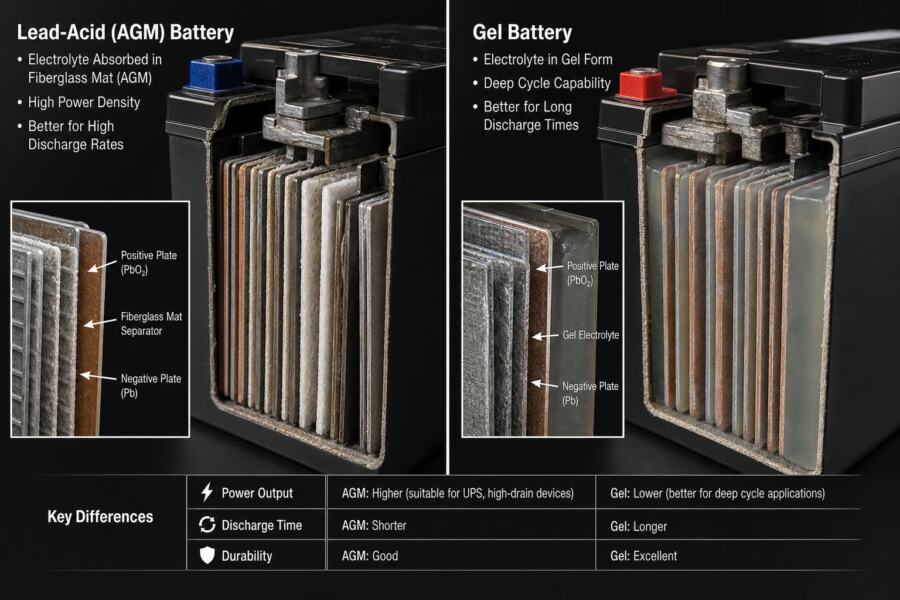
For UPS most commonly used AGM or GEL batteries. They are sealed, do not require electrolyte topping up, but they really do not like overheating and deep discharges. If the battery has been discharged for a long time, its actual capacity can drop by half or more.
When to check the battery
Homemade battery check is needed not only when the UPS is already “whistling” and turns off after a minute. There are several typical signs that it is time to take out a multimeter and test:
– UPS is powered by battery much less, than before.
– After charging, the battery “sinks” quickly.
– Battery case pouting, there is an odor, leakage, or corrosion of the terminals.
– UPS shows an error battery or frequently goes into emergency mode.
– The battery is already 3–5 years and more, and he works in a warm room.
If the battery has reached this state, a simple voltage measurement no longer gives the full picture. At least a basic load test is needed.
What you need for a home inspection
For normal home diagnostics, a minimum set is enough:
1. Multimeter for checking voltage.
2. Load with known current — for example, 12-volt lamp, car lamp or resistive load.
3. Stopwatch or phone.
4. Notebook for recording indicators.
5. Optionally — ammeter or a multimeter with current measurement.
The most important rule: test the battery after full charge and after standing. Let the batteries stand 1–2 hours after charging to remove the surface charge. Otherwise, the voltage will be slightly overestimated and the conclusion will be incorrect.
What multimeter is needed and what will it show?
A regular digital multimeter is sufficient. Its function here is simple: to show open circuit voltage and voltage under load.
No-load voltage rating
For a good one 12V lead-acid battery After settling, focus on the following values:
– 12.7–12.9 V — the battery is charged;
– 12.4–12.6 V — the charge is normal, but not maximum;
– 12.2–12.3 V — noticeable undercharge;
– below 12.0 V — the battery is discharged or worn out.
But remember: no-load voltage is not equal to capacitance. The battery may show 12.6 V, and under real UPS operation, it can “fail” to the emergency voltage in a matter of seconds.
Battery test under load
This is the most useful home method. Its essence is simple: apply a stable, known load to the battery and see how long it can maintain the voltage within the operating range.
How to do the test without special equipment
1. Fully charge the battery.
2. Disconnect it from the UPS.
3. Connect a load with a known current.
4. Measure the current with a multimeter or according to the load certificate.
5. Record the time until the limit voltage is reached.
For most 12-volt lead-acid batteries, the critical limit under discharge is considered to be approximately 10.5 V. But for home evaluation it is better not to discharge “to zero”. If the voltage under load quickly drops below 11.0 V, this is already a bad sign.
Calculation formula
The approximate capacity is calculated as follows:
Capacity (Ah) = load current (A) × discharge time (h)
For example, if you connected a load 1 A and the battery lasted 4 hours, then its real capacity is approximately 4 Ah. If it says on the case 7 Ah, and in fact it turned out 4 Ah, the battery lost about 40% resource.
An important nuance: lead-acid batteries have an effect that is seen in practice as a decrease in available capacity at higher discharge current. This is normal and is associated with internal processes in the plates and electrolyte. Therefore, the test should be carried out as close as possible to the real operating conditions of the UPS.
Comparison of home inspection methods
| Verification method | What it shows | Accuracy | Pros | Cons |
|—|—|—:|—|—|
| Voltage measurement without load | Degree of charge | Low | Very simple, fast | Does not show real capacity |
| Load test | Real battery behavior | Medium/high | Closest to UPS operation | Requires time and control |
| Built-in UPS self-test | Overall battery health | Average | Convenient, indiscriminate | Not always accurate |
| Professional tester/analyzer | Capacitance and internal resistance | High | Maximum informativeness | More expensive and not always available at home |
How to understand that the battery is already “dead”
There are several practical signs that you should not deceive yourself:
– voltage drops quickly from 12.6 V to 11.0 V or below;
– The UPS only holds a few minutes even without a heavy load;
– the battery heats up during discharge or charging;
– the body is deformed;
– after full charging, the voltage drops almost immediately;
– more battery 4–5 years, and he has already experienced several deep discharges.
In such cases, home diagnostics usually only confirm the obvious: the battery needs to be replaced.
Common mistakes when doing a home inspection
To avoid getting an incorrect result, avoid the following mistakes:
– Check immediately after charging without defending.
– Lamp test without knowing the actual current.
– Using too much load, which “kills” the battery in minutes.
– Ignoring temperature: capacity is lower in cold weather.
– Confusion between “voltage is normal” and “battery is good.”.
– Deep discharge “to the last” — this reduces the resource.
It is especially important: do not short the terminals and do not operate a damaged battery in a closed room without ventilation. A lead-acid battery can emit hydrogen, and this is a fire risk.
When is it better to buy a new battery?
Sometimes people are looking for what battery for UPS price will be the “cheapest”, but this is the wrong approach. First, you need to understand whether it makes sense to reanimate the old battery at all.
A new battery is needed if:
– the actual capacity has fallen below 60–70% from the nominal value;
– the battery has lost its tightness;
– there is swelling or signs of overheating;
– internal resistance has increased noticeably;
– The UPS with it does not pass the basic stand-alone operation test.
A cheap battery that degrades quickly ends up costing more than a normal mid-range product. So look beyond the battery for UPS price, but also on the date of manufacture, type AGM/GEL, warranty and storage conditions.
Practical home inspection algorithm
Here is a short diagram that I use in household inspections:
1. Fully charge the battery.
2. Leave it on 1–2 hours without load.
3. Measure the voltage with a multimeter.
4. Connect a known load.
5. Check the voltage every 10–15 minutes.
6. Record the time until it falls below the operating limit.
7. Compare the result with the passport capacity.
If the battery shows sudden voltage drop or works half as much as expected — this is no longer a “minor defect,” but a loss of resource.
A brief practical conclusion from Engineer Gennady
Battery capacity for UPS at home, it is best to check not only with a multimeter, but also with a load. The voltage without discharge gives only a general picture, and the true state of the battery is visible during operation. If you care about the reliability of backup power, do not wait for a complete failure. Check the battery once a 6–12 months, and after 3–4 years operation - especially carefully. It is cheaper than losing equipment due to a sudden shutdown.
Frequently Asked Questions (FAQ)
Can I test a battery with just a multimeter?
Yes, but it will only show the voltage. For evaluation real capacity another load test is needed.
What is the normal voltage for a 12 volt UPS battery?
After settling, a charged battery usually has 12.7–12.9 V.
Can the battery be discharged to 0% during the test?
No. This is harmful to lead-acid batteries. It is best to complete the test at approximately 10.5–11.0 V under load.
If the battery is old but still holds voltage, can it be left?
It is possible, but only after testing with loads. An old battery often “cheats” at idle, and quickly fails during an accident.