
Useful tips
Battery-powered alarm for a summer residence - reliable autonomous security without electricity


Alarm systems for summer cottages often have to work in places where there is no stable network, and sometimes even electricity itself for several days. That is why autonomous security is not an «additional option», but a basic requirement for a country house, outbuilding, workshop or summer cottage, which is visited only on weekends. If the system stops working during a power outage, it does not protect the property at the most critical moment.
The most reliable solution in such conditions is alarms on battery, preferably with the possibility of backup power from a solar panel. Such a scheme allows the security system to operate autonomously for hours, days or even weeks, depending on the battery capacity, number of sensors and mode of use. This is especially important for summer cottages, because attackers often choose objects without constant supervision and without a clear energy reserve.
Practice shows: most problems with country security systems arise not because of a weak siren or bad sensors, but because of poor power supply. The battery was chosen "by eye", the GSM module was not taken into account, the solar battery was installed too small - and after a few days the security system is discharged. Therefore, autonomous security should be designed as an energy-balanced system.
Below we will look at how a GSM alarm system for a summer residence works, which batteries are best suited, how to properly organize power from a solar battery, and what mistakes should be avoided so that the system truly protects, and not creates the illusion of security.
How does an autonomous battery-powered alarm work?
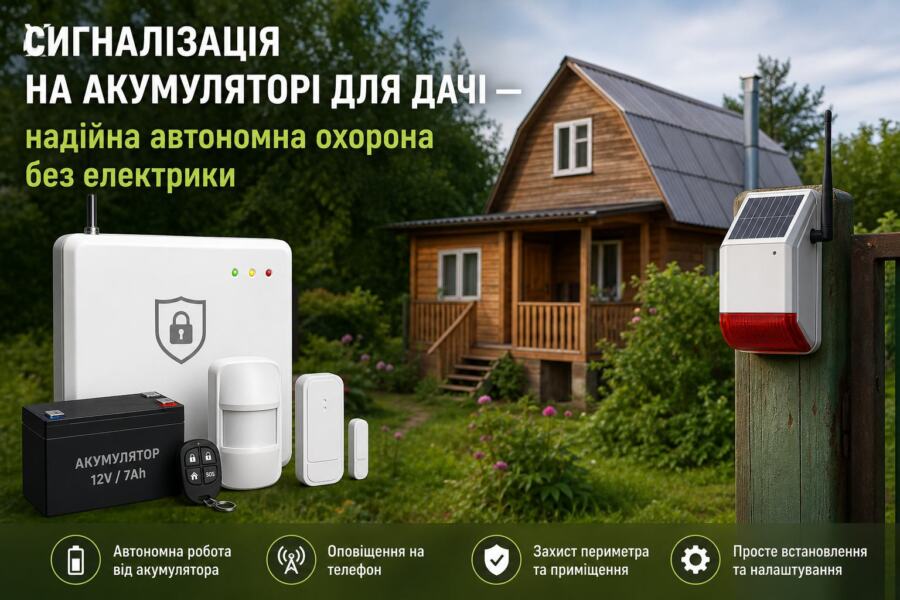
The basis of such a system is simple: a central unit, motion, opening, smoke or vibration sensors, a GSM module for sending messages and a backup power source. When the mains power disappears, the system automatically switches to the battery. In high-quality models, this transition occurs without rebooting and without losing communication.
For giving most often used 12 V systems, as they are compatible with most security units, sirens, relays and communication modules. It is important to understand: autonomy determines not only the battery capacity, but also the average consumption of the entire system. For example, a base unit with several sensors can consume 100–200 mA in standby mode, and with active GSM exchange, consumption temporarily increases.
If a powerful siren is installed on 12 V, it can briefly take 0.5–1.5 A and more. This is not a problem if the battery is designed correctly. But if the battery is weak or old, the voltage quickly drops and the system starts to falsely signal a malfunction or turns off altogether.
A stable battery-powered alarm system has three essential components: a power-hungry battery, charge control, and deep discharge protection. Without these, autonomous security loses its reliability after the first prolonged outage.
Which battery is suitable for a country alarm system?
For security systems, sealed lead-acid batteries of the type are most often used. AGM or GEL. They are maintenance-free, safer for the premises and better tolerate long-term backup power. For small country systems, tanks are practical 7 A·h, 9 A·h, 12 Ah or 18 A·h. For more complex objects, they often put 26–40 Ah.
An AGM battery is a good choice when compactness and a reasonable price are required. GEL tolerates deeper cycles better, but is usually more expensive and requires more accurate charging. If the cottage is used seasonally and the system is in reserve most of the time, AGM is often the most rational choice.
You should not take a battery «with a reserve just in case» without checking the charging unit. If the power board or controller is not able to charge a larger battery correctly, it will constantly be undercharged, sulfated and lose capacity. In real practice, this is one of the most common mistakes: the customer puts 40 Ah, and the standard charging current of the central unit is designed only for a small backup battery.
Another important point is temperature. In the cold, lead-acid batteries give off less energy, and at negative temperatures the effective capacity can drop noticeably. Therefore, if the security unit is located in an unheated room, the autonomy calculation should be more generous, and it is advisable to place the battery itself in a relatively warm place.
GSM alarm for a summer residence: why this is the most convenient option
For summer cottages, GSM security has become the de facto standard, because it does not require the Internet or the constant presence of the owner. When the sensor is triggered, the system sends a call or SMS to the phone, and some models support push notifications via the application. This is convenient when the object is far away and it is physically impossible to check it.
The main advantage of a GSM alarm for a summer residence is that it can be configured to work even in weak mobile networks. For this, a high-quality antenna, stable power supply to the module, and correct placement of the central unit are important. If the GSM module is discharged along with the main system, the user loses both the notification and the security itself.
In real conditions, a system with two levels of notification is often installed: the first is an immediate call to the phone, the second is sending an SMS with a low battery charge or a network problem. This allows the owner to understand in time that the object needs to recharge the backup power or check the status of the solar panel.
If there is a risk of periodic power outages, it is better to abandon models that work only from an outlet. Reliable autonomous security should have a built-in or external battery with charge control, rather than relying on a random power supply.
| Parameter | Alarm only from the network | Battery alarm | Autonomous security with solar battery |
| Work during power outages | No | Yes, limited by battery life | Yes, with a long reserve |
| Installation complexity | Low | Medium | Medium or higher |
| Autonomy | 0 hours | From a few hours to days | From days to weeks |
| Reliability for the summer cottage | Low | High | Highest |
Solar power: when it really works
Solar power is especially useful for summer cottages that are left unattended for a long time and have an unstable power grid. The solar panel should not directly power the entire system - its task is to correctly charge the battery through the controller. It is the battery that evens out night hours, cloudiness and peak loads.
For a compact battery-powered alarm system, a panel is usually sufficient. 20–50 W, if the system consumes little and does not have too powerful loads. For objects with frequent messages, relay modules, a video camera or several sirens, solutions are needed already on 50–100 W and more. The exact choice depends on the daily consumption and the number of hours of sunshine in your area.
In practice, a common mistake is to install a panel without a charge controller. In this case, the battery may overcharge on sunny days or undercharge due to incorrect mode. This is dangerous for a security system: the battery degrades quickly, and autonomy decreases significantly.
Another common problem is improper installation location. If the solar panel is shaded by trees, a chimney, or a neighboring roof, the actual generation drops to 30–70%. For a summer cottage, this is critical, because in cloudy weather the system is already working on reserve. It is important to place the panel in the most open area, with the correct angle of inclination and without seasonal shading.
What to look for when choosing a system
The first is the total consumption. It is easy to calculate it: you need to add up the consumption of the central unit, GSM module, sensors, siren and additional devices. The second important figure is the desired battery life. If the system is to last at least 24–48 hours without a network, a battery is needed that is much larger than for a short backup.
The second is the quality of the connection. A GSM alarm system for a summer residence must work reliably in a specific location, and not just "according to the passport." Before final installation, it is worth checking the signal level at different points in the house. If the connection is weak, sometimes it is better to move the antenna higher or use an external GSM module.
Third — protection against discharge. A good system should disconnect secondary loads when the battery voltage drops to a critical level. For lead-acid batteries, it is undesirable to bring the voltage to very low values, because deep discharge reduces the resource. In practice, it is worth focusing on schemes where control occurs automatically, without user intervention.
Fourth, serviceability. For a summer cottage, it is useful when the battery can be quickly replaced, and the controller and power supply are available for diagnostics. If the system is «hidden» in such a way that it is difficult to get to the battery, maintenance becomes a problem.
Common user errors that reduce reliability
Most often, owners underestimate the real energy consumption. They install several sensors, put a powerful siren, add GSM alerts, and leave the battery small. Then they wonder why the autonomous security system lasts not a week, but a few hours.
The second mistake is using old or «reclaimed» batteries. The battery may look good, but lose capacity after the previous cycle of operation. This is especially dangerous for security systems, because the failure is noticed only after it has already occurred.
The third mistake is installation without testing in real mode. After installation, the system must be checked not only for sensor activation, but also for long-term battery operation, for sending messages, and for correct power recovery. It is better to detect a weak point immediately than to lose security during the first shutdown.
The fourth mistake is ignoring the climate. If the cottage is located in a cold area or in an unheated room, you should choose a more spare configuration. For winter backup, it is sometimes useful to separate the power source: separately for the alarm system, separately for other consumers, so as not to overload one battery.
Practical safety and installation tips
Place the central unit so that it is not easily accessible from the outside. An attacker often starts by finding the power box and disconnecting the entire system. If possible, place the battery and controller in a closed technical area, and place the sensors at vulnerable entry and perimeter points.
For a summer residence, it is advisable to choose not one, but several control zones: doors, first-floor windows, a vestibule, a pantry, a garage or a utility room. This way, the autonomous security system will not react chaotically, but will show exactly where the event occurred.
If you plan to use solar power, install a controller with a current reserve and high-quality surge protection. This is especially important with long cables between the panel and the unit, as losses and surges can occur on the line.
Check the battery voltage and test notifications monthly. This doesn't require sophisticated equipment: just make sure the system is making calls or sending messages and the battery doesn't drop below acceptable levels in standby mode.
Brief practical conclusion
Battery alarm — this is the best base for a summer cottage where electricity can go out unexpectedly and for a long time. If you choose the right battery, take into account the consumption of the GSM module, add charge control and connect it if necessary solar powered, the system becomes truly reliable autonomous security. For a summer residence, this means not just convenience, but a real chance to save property at a time when (Incomplete: max_output_tokens)