
Useful tips
Inverter Malfunctions: Why Does It Beep or Shut Down Under Load?


Inverter faults often start with little things: the device emits a short beep, flashes the indicators, and then turns off just when the most important equipment is connected to it. For the owner, this looks like a “breakdown”, but in practice the reason often lies not in the inverter itself, but in overload, incorrect connection, weak battery or overheating. This is especially true for systems where backup power works in real household conditions: boiler, router, pump, lighting, computer, refrigerator.
When inverter for home starts to beep or turn off under load, this is a protection signal. That is, the electronics are trying to protect themselves, the battery and connected devices from damage. In most cases, the problem can be found without service, if you understand the logic of the system. Below we will analyze why such symptoms occur, how to distinguish UPS overload from a real breakdown, and what to do to make the inverter work stably.
What does the squeak of an inverter or UPS mean?
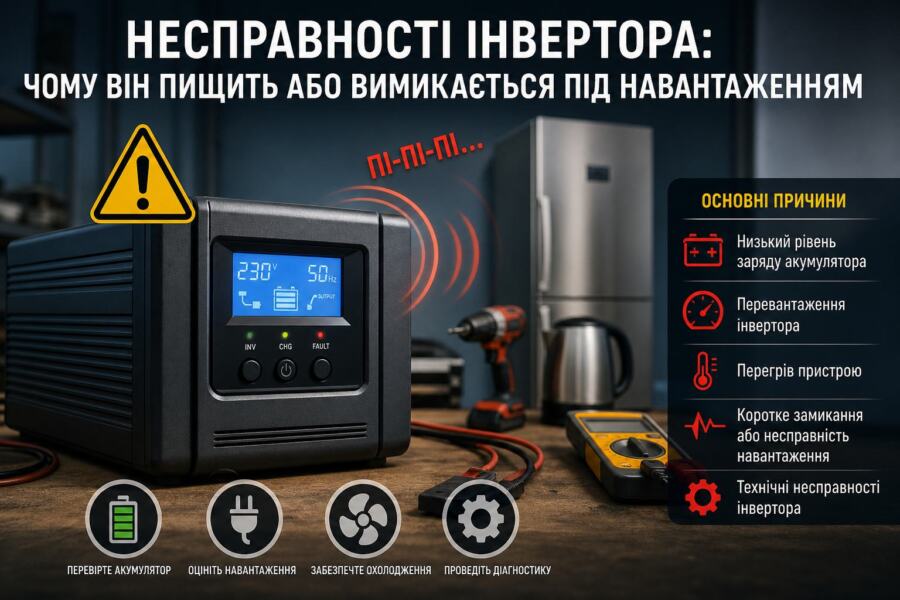
A beep is not always a malfunction. In different models, the signal means different modes:
- switching to battery;
- low battery;
- overload;
- overheating;
- connection error or internal failure.
If the inverter beeps briefly when the mains fails, this is normal. However, if the signal becomes continuous or repeats in series during load operation, you should look for the cause. This is most often the case inverter malfunctions, related not to electronics, but to the operating mode.
For domestic systems, it is especially important to understand the difference between:
- rated power inverter;
- peak power at the start;
- real consumption your devices;
- battery capabilities to deliver current without voltage drop.
Why does the inverter turn off under load?
The most common reason is UPS overload or inverter. This means that the total consumption of connected devices exceeds what the device can deliver stably. But there is a nuance: the problem is not always visible from the watts on the label. Some household devices have a large starting current.
For example, 200–300 W pump during start-up may briefly require 3–5 times more. A refrigerator, compressor, boiler, vacuum cleaner, circulation pump - all of them can create a pulse load. If the inverter does not have a reserve for peak power, it perceives this as an accident and turns off.
Other common reasons for shutdown:
- Weak battery or a battery with high internal resistance.
- Cables that are too thin or long, due to which the voltage drops.
- Bad terminals, oxidation, weak tightening of contacts.
- Overheating due to poor ventilation or dust.
- Inappropriate load type, for example, engines or compressors without starting reserve.
- Malfunction of the inverter itself: worn capacitors, fan, power switches, control board.
How to distinguish overload from breakdown
Not every shutdown means that the inverter is burned out or needs repair. Before drawing conclusions, it is worth looking at the behavior of the system.
| Symptom | Probable cause | What to check |
|---|---|---|
| Short beep when the network is disconnected | Normal transition to battery | Is the load powered by the battery? |
| Continuous beeping and turning off after a few seconds | UPS overload or low battery voltage | Total power, battery condition, starting current |
| Shutdown immediately after starting a powerful appliance | Insufficient peak power | Appliance consumption during startup |
| Housing heating, then accident | Overheating or excessive prolonged load | Ventilation, temperature, dust in the fan |
| Periodic shutdown even at low load | Problem with battery, cables or electronics | Load voltage, contacts, inverter status |
If the inverter only shuts down when a specific appliance is connected, it is almost always due to inrush current or exceeding the allowable power. If the shutdown occurs even at low load, it is worth suspecting a battery, wiring or internal fault.
UPS overload: how it occurs in practice
UPS overload — one of the most common reasons why a backup system works unstable. The error occurs not only because of connecting “too much equipment”. Sometimes people do not exceed the total power, but forget about the starting pulses or about the voltage drop on the battery.
Typical situation: inverter on 1000 W, a boiler, a router, a couple of LED lamps and a pump are connected to it. In normal mode, everything looks normal. But when the pump starts, a short surge of current knocks the system down. The inverter trips on protection, and it seems as if it is “breaking”. In fact, there is simply not enough reserve.
Another example - inverter for home works with cheap old battery. Even if the battery is formally charged, under load the voltage drops below the threshold. The inverter perceives this as a discharge and turns off the output so as not to drain the battery “to zero”.
The main reasons for overload:
- connected devices without calculating the total power;
- starting currents were not taken into account;
- they took an inverter without a power reserve;
- used a weak battery;
- long wires create voltage drops;
- The contacts heat up and lose some energy.
How to correctly calculate the load
To prevent backup power from turning into constant outages, the load must be calculated with a margin. For household systems, it is best to focus not only on the wattage of the devices, but also on the nature of their operation.
The simple algorithm is as follows:
- Make a list of all the devices that should be powered by the inverter.
- Look at their passport power in watts.
- Separately mark devices with a motor, compressor or pump.
- Add a margin for starting currents - minimum 20–30%, and even more for engines.
- Compare the resulting figure with the inverter's rating and its peak power.
If you have, for example, a boiler 120 W, router 15 W, lighting 40 W and pump 250 W, then in total it is only 425 W. But the pump at start-up can “pull” the system by a much larger amount. Therefore, the inverter at 500–600 W will already be at the limit, and the model at 1000 W with a normal margin it will work more stably.
The battery as a weak point of the system
Many people look for a fault in the inverter, although the problem is in the battery. For backup power, the battery is no less important than the converter itself. If the battery is old, undercharged or incorrectly selected, the inverter will start to write, turn off and “weld” even at an average load.
Signs of a battery problem:
- after starting from the battery, the voltage drops quickly;
- the inverter turns off after 1–5 minutes;
- the fan is working, but the output disappears;
- the charge shows the norm, but under load everything collapses;
- The battery is hot or has a suspicious odor.
For a backup power system, it is important that the battery has sufficient capacity and can deliver the required current. If the inverter is designed for 12 V, and the battery is small or worn out, the current will be high, the cables and contacts will heat up, and the voltage will drop. For more powerful systems, it is often more appropriate to use 24 V or 48 V, to reduce the current load on the wiring.
Wiring, terminals and connection losses
Even a good one inverter for home can behave unstable due to small electrical losses. The cable is often underestimated, although it is often the cause of voltage drops under load.
What to check:
- cable cross-section between the battery and the inverter;
- cable length — the shorter, the better;
- tip quality and crimping;
- tightening terminals;
- absence of oxide film, rust and overheating.
If the wire is thin, it heats up, the voltage drops, and the inverter sees a “low battery” and shuts down. From the user’s perspective, this looks like a mysterious failure, even though the problem is entirely mechanical. This is especially critical in systems where backup power operates at high current.
Inverter overheating and ventilation
The second major class of problems is overheating. The inverter generates heat under load, and if it is not properly cooled, the protection will trip very quickly. This is especially true for compact models that are installed in cabinets, pantries, near batteries, or directly on the floor without air access.
Signs of overheating:
- the case is hot to the touch;
- the fan operates constantly or with increased noise;
- after some time, the load of the inverter is turned off;
- After cooling down, the device starts again.
What to do:
- Do not place the inverter in a closed niche without air flow.
- Leave a gap around the body.
- Clean the dust regularly.
- Do not cover the device with objects.
- Do not install near heat sources.
If the inverter is operated in a house with frequent power outages, dust or high indoor temperatures, the cooling mode is especially important. Overheating protection is not a defect, but a normal reaction of the electronics to a dangerous mode.
Common mistakes when choosing an inverter
Most problems could have been avoided at the purchase stage. People often choose an inverter based on the formula “to have a margin”, but they misunderstand the margin.
The most common mistakes:
- purchase of a model “close to” the real load;
- ignoring the starting current;
- selecting an inappropriate system voltage — 12 V instead 24 V or 48 V;
- savings on cables and circuit breakers;
- using an old battery;
- connecting a refrigerator, pump or other motor without checking the starting power;
- placing equipment without ventilation.
The right inverter for your home is not just “more powerful”. It is a device that fits your specific scenario: a boiler and router, 24/7 backup for an apartment, autonomy for a private house, or short-term power during a power outage. Each case will have different requirements for power, type of output voltage, and current reserve.