
Useful tips
UPS for a boiler: how to connect it correctly and not burn the board


UPS for boiler — it is not just a “battery in case of a power outage”, but an element of protection of expensive equipment. If the backup power supply is connected incorrectly, the boiler may not start, give errors, heat up idle or even get damage to the control board. Most often, problems arise not because of the UPS itself, but because of a mismatch in the shape of the output voltage, errors in connecting the inverter, weak battery or improper grounding.
A modern gas boiler is no longer a simple “burner + pump”. Inside there are electronics, a fan, a circulation pump, sensors, automatic ignition and flame control. All this requires a stable power supply. If the voltage “jumps”, has a rough shape or disappears under load, the boiler board reacts instantly. That is why boiler backup power You need to choose not based on the principle of “just so it works,” but on technical parameters.
Why is the boiler so sensitive to power?
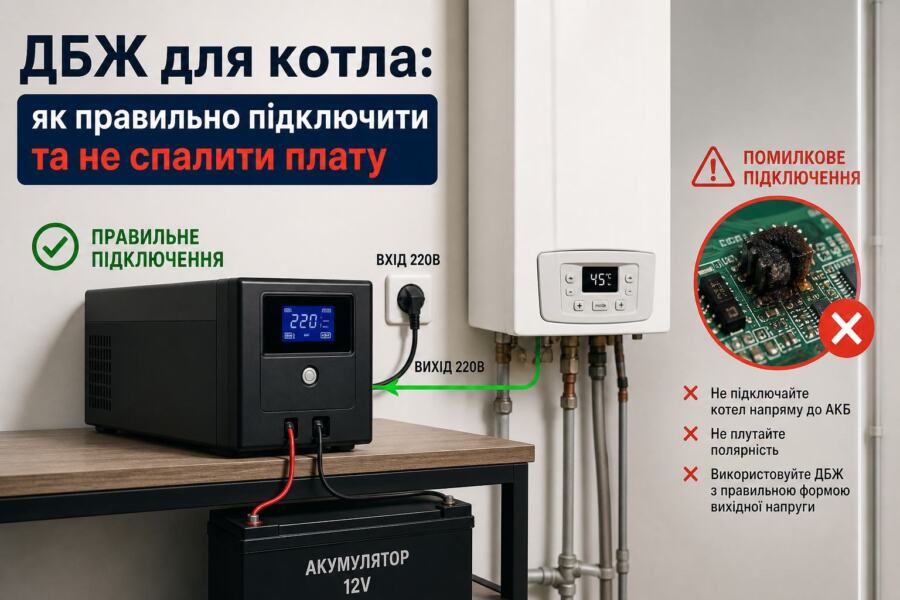
In many household appliances, electronics can survive a short voltage drop. But a boiler is a special piece of equipment. It simultaneously works with gas, ventilation, a pump and a security control system. If the power supply unit gives a poor-quality signal, individual components begin to operate unstable.
The most common problems with poor nutrition:
- the boiler does not start after a power outage;
- errors appear on the board, fan or ignition;
- the pump hums, but does not start correctly;
- automation “sees” an accident where there is none;
- The board degrades over time due to overheating or pulse distortion.
That's why DBJ for boiler should not be “any”, but compatible with sensitive electronics. The most important thing here is pure sine wave.
What is a pure sine wave and why is it critically important?
In everyday life, they often say that “the main thing is that there is 220 V”. In fact, a simple number is not enough. The form of the voltage is important. If at the output UPS or inverter, the signal is similar to a stepped or “approximated” sine wave, the boiler electronics may operate intermittently.
Pure sine wave — is a form of alternating voltage, as close as possible to that coming from the network. For the boiler this means:
- correct operation of the board's power supply;
- stable fan and pump start;
- less heating of electronics;
- lower risk of errors and hangs;
- safer operating mode for sensitive components.
You should be especially careful with cheap “inverter” solutions without a normal sine wave. They can formally give out 220 V, but at the same time create distortions that are imperceptible for a regular lamp, but critical for a boiler.
Which UPS is suitable for the boiler?
For a gas boiler You shouldn't buy the first UPS you come across from the computer segment. It is advisable to choose a model that is designed specifically for backup power supply of sensitive household equipment. There are several basic requirements:
- pure sine wave at the exit;
- sufficient power with a margin;
- correct operation with an external battery if long autonomy is required;
- stable output voltage;
- protection against overload, short circuit and overheating.
If the boiler only has electronics and a small circulation pump, the consumption may be relatively small. But during start-up, the pump and fan draw more current than in normal operation. That is why a power reserve is needed.
Practically, they are guided as follows:
- for a simple wall-mounted boiler it is often enough 300–600 W high-quality UPS;
- if there is an external pump, additional automation or several circuits, the reserve should be larger;
- For a long-term backup, you need not only a UPS, but also a properly selected battery.
Important: do not confuse nominal power and peak power. What is important for a boiler is its real characteristics at start-up and during long-term operation.
How to choose a UPS for a boiler without mistakes
When choosing, you need to look not at the beautiful numbers on the box, but at the real parameters. In everyday life, people most often make three mistakes: they take a weak UPS, ignore the shape of the output signal, or do not take into account autonomy.
What to pay attention to:
- Output voltage type — only a pure sine wave.
- Power — preferably with a margin of 20–30% from the consumption of the boiler and related devices.
- Battery type — built-in or external, depending on the autonomy time.
- Switching time — for the boiler, it is better to have a minimum, without dips.
- External battery compatibility — if the light is turned off for a long time.
- Availability of protections — overload, overheating, deep discharge.
If the house has an unstable network, it makes sense to take the model not only as a backup, but also as a means of improving the quality of power supply. This is especially true for areas where the voltage “walks” within the range of 180 to 250 V.
Connecting an inverter: when is it appropriate and how not to ruin the boiler
Connecting the inverter often used when you need to get more autonomy than a regular UPS gives. In such a scheme, the inverter converts the voltage from the battery into 220 V for boiler. But a connection error can be very expensive.
Basic rules:
- The inverter must have pure sine wave;
- the rated power must cover the starting currents;
- the cross-section of the cables from the battery must correspond to the current;
- the polarity when connecting the battery must be correct;
- All connections must be securely tightened and protected from heat.
A typical mistake is to use a “car” inverter, which formally provides 220 V, but is not designed to power the boiler for a long time. A car inverter may work fine with a laptop, but may cause malfunctions for the boiler. If there is a separate inverter in the circuit, it is important to understand that boiler backup power — this is not improvisation, but a technical system with coordinated elements.
Another common mistake is to connect the inverter “directly” without protection, without circuit breakers, and without normal backup switching. As a result, in the event of an accident, there is either a failure, or reverse voltage, or incorrect operation of the boiler.
How to properly organize backup power for the boiler
There are three practical options for organizing a reserve:
- Ready-made UPS for boiler — a simple option for most apartments and houses.
- Inverter + battery — a flexible solution for longer autonomy.
- Combined system — when there is a UPS, an external battery, automation and separate power lines.
For many households, a pure sine wave UPS with an external battery works best. This scheme is simple, compact, and does not require complex wiring. If hours of autonomy are needed, then a separate inverter or hybrid system makes sense.
During installation, you must follow simple rules:
- it is advisable to supply the boiler with a separate line;
- all connections should be made through reliable terminals or standard connectors;
- do not use thin extension cords of questionable quality;
- place the battery in a ventilated place;
- Do not place the backup source near a heat source or humid areas.
Typical boiler parameter diagram
Below is a guide to help you understand how to choose a backup power supply. It is not a universal standard, but it is a useful starting point.
| System element | Recommended value | What is important? |
|---|---|---|
| Output voltage | 220 V ± tolerance | Stability without dips and jumps |
| Signal shape | Pure sine wave | Critical for board, pump and fan |
| UPS power | 300–600 W and higher depending on the boiler | A margin for starting currents is required |
| Battery | 12 V or 24 V, depending on model | Affects autonomy and currents |
| Autonomy | From 1–2 hours to a day or more | Depends on battery capacity and load |
The most common connection errors
Problems with the boiler after installing a reserve are very often not related to a lack of equipment, but to the installation. Below are the most common mistakes.
- UPS without pure sine wave — the boiler may hum, not start, or give an error message.
- Insufficient power — the system works close and shuts down during startup.
- Weak battery — the voltage drops under load and the boiler turns off.
- Thin wires — heating, voltage drop, energy loss.
- Wrong polarity — risk failure inverter or battery.
- Lack of protection — short circuit or overload become dangerous.
A separate problem is connecting to the outlet via a “regular” household extension cord. If it is cheap and has weak contact, voltage drops may occur during switching. This is undesirable for the boiler.
How to understand that the boiler is operating normally from reserve
After installation, it is important not to simply “plug and forget”, but to conduct a brief check. A normal backup power system behaves quietly and predictably.
Signs of correct operation:
- the boiler starts from the UPS without any problems;
- no errors in the power supply, board or fan;
- there is no extraneous hum, crackling or overheating;
- when the network disappears, the system does not restart several times;
- autonomy corresponds to the calculation.
If, after switching to reserve, you hear a strange noise in the pump, errors appear, or the boiler behaves unstably, this is a signal that you need to check the quality of the output voltage, correct connection, and power compliance.
Practical safety tips
The boiler is connected to gas, electricity and the heating system, so you can't skimp on safety here. Even if the system seems simple, the consequences of a mistake can be serious.
What to do:
- use only a working one DBJ for boiler or an inverter with verified parameters;
- select the battery based on real consumption, not “by eye”;
- check the temperature of cables and terminals after loading;
- prevent deep discharge of the battery;
- test the system with the network disconnected every few months;
- Do not place the equipment in a damp room without protection.
Importantly: If there are any doubts about the connection diagram, it is better to show it to an electrician or service specialist once than to change the boiler board later.
When is a UPS better and when is an inverter needed?
For short outages — from a few minutes to 1–2 hours — a simple, high-quality UPS is often the most convenient solution. It is compact, (Incomplete: max_output_tokens)