
Useful tips
UPS battery: how to properly install it at home


Battery for UPS in the house is not just an “additional box with energy”, but part of the system on which the operation of the boiler, router, circulation pump, security and sometimes all the comfort in the house depends. In practice, most problems arise not because of the battery itself, but because of the wrong installation location, poor connection, lack of protection and banal ignoring of operating conditions. I, Engineer Gennady, have seen more than once how people bought expensive lithium battery for home, but they put it in a damp basement, next to a boiler, or without a proper fuse. The result is overheating, a drop in service life, inverter errors, or a complete system failure at the worst possible moment.
Which UPS battery to choose for your home?
You need to start not with the installation location, but with understanding what type of battery you are installing. For home battery for UPS can be lead-acid, AGM, GEL or lithium. And each option has its own temperature, ventilation and safety requirements.
Comparison of battery types for the home
| Battery Type | Advantages | Disadvantages | Where applicable |
|—|—|—|—|
| AGM | Inexpensive, does not require electrolyte topping up, easy to install | Sensitive to deep discharge, shorter life | UPS, boiler room, lighting backup |
| GEL | Better cycle tolerance, more stable in reserve | More expensive, does not like high charging currents | Backup power systems |
| Lead-acid | Affordable | Requires good ventilation, heavy, limited life | Small backup systems |
| Lithium home battery | High resource, low weight, deep discharge without significant loss of resource | Higher price, requires a compatible charging algorithm and BMS | Modern energy independence systems |
For most homes, where the battery works as a backup for the boiler or the internet, they most often install AGM or lithium battery for home. If you need a large number of cycles and compactness, lithium wins. If the budget is limited and the system is simple - AGM may be a smart choice.
Where to place the battery in the house
The installation location is not “wherever there is a free corner”, but an area where the battery will operate stably and safely. It is best when battery in the boiler room or in a technical room located in a dry, ventilated place, away from heat sources and open flames.
Installation site requirements
When choosing a location, follow these rules:
1. Dryness of the room. Humidity accelerates contact corrosion, and for electronics, this is a direct path to failure.
2. Stable temperature. Optimally keep the battery in range +15…+25 °C. At low temperatures, capacity drops, at high temperatures, the resource is reduced.
3. Absence of direct sun and heat radiation. Do not place the battery near radiators, a boiler, a chimney or a stove.
4. Convenient access for maintenance. There must be access to terminals, switches, circuit breakers and markings.
5. A solid foundation. The battery must stand level, without vibration and risk of falling.
Is it possible to install a battery in a boiler room?
Yes, battery in the boiler room are often installed, and this is a practical solution if the boiler room is dry, ventilated and meets safety requirements. But there is an important “but”: not every boiler room is suitable.
When is it permissible:
– there is no excessive humidity in the boiler room;
– the battery is not placed close to the boiler;
– there is access for maintenance;
– short circuit protection is installed;
– the temperature does not exceed a comfortable level for the battery.
When you can't do this:
– if the boiler room is small, stuffy and overheats;
– if there is a gas valve nearby without sufficient distance;
– if the battery is placed on a wooden shelf without fixing;
– if flammable liquids, paints, rags are stored there.
For lithium battery for home It is especially important to avoid overheating. Lithium does not like constant high temperatures, and the life of the cells at +35 °C and higher it falls noticeably faster.
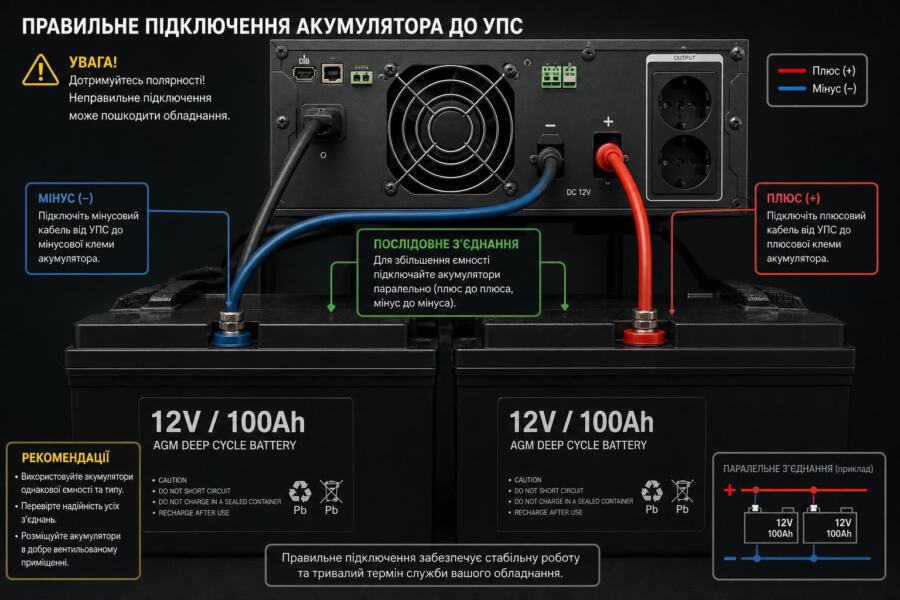
How to safely connect a battery to a UPS
Proper installation is not just about placing the battery on the floor. It also needs to be done correctly. connect it to the inverter or UPS, so as not to burn either the cable, the controller, or the battery itself.
What must be in the chain
– Fuse or circuit breaker near the positive terminal of the battery.
– Cable of the required cross-section.
– Normal crimped terminals.
– Reverse polarity protection.
– Circuit breaker or service disconnect for maintenance.
Why is this important?
The battery is capable of delivering a very high short-circuit current. This is not “12 volts and nothing to worry about.” Even with 12V or 24V the current strength can be so great that the wire starts to heat up in seconds. If the contact is weak, a transition resistance occurs. And the transition resistance = heating, voltage drop, loss of power and the risk of melting.
Practical connection rules
1. The terminals must be clean and tight.
2. The cable should not be “on the limit” in terms of current.
3. The length of the wire should be minimal.
4. The fuse is placed as close to the battery as possible.
5. You cannot mix old and new batteries in the same circuit without calculation.
If you bet battery for UPS on the boiler, remember: not only the battery, but also the UPS must be compatible with the battery type. Normal charging profile for lead is not always suitable for lithium. For lithium battery for home often requires separate BMS control and the correct charging voltage.
Step-by-step installation procedure in the home
To avoid making mistakes, I recommend installing the system in the following sequence:
1. Determine the load. What exactly should work during a power outage: boiler, pump, lights, internet, alarm system.
2. Calculate the required capacity. It is not only important “how many hours”, but also what current the system consumes.
3. Choose the installation location. Dry, accessible, without overheating.
4. Check the UPS or inverter. It should support your battery type.
5. Prepare the cable and protection. Machine, fuse, tips, fixation.
6. Place the battery on a flat surface.
7. Connect the protection first, then the battery, then the load.
8. Check voltage, charge and terminal heating after starting.
9. Perform a test network shutdown. Watch the system go into reserve.
10. Sign the cables and the machine. It's a small thing, but after a year it helps a lot.
Ventilation, temperature and resource physics
Most people underestimate the impact of temperature. And they shouldn’t. Battery chemistry is very sensitive to heat. For lead-acid batteries, excessive heat accelerates plate aging and electrolyte evaporation. For lithium batteries, it accelerates cell degradation and BMS wear.
What happens at the wrong temperature?
– When low temperature the battery gives off less capacity.
– When high temperature self-discharge increases and service life decreases.
– If the terminals are not tightened properly, the heating will increase even more.
– In a closed niche without ventilation, heat accumulates, even if the battery “almost does not heat up”.
Therefore, if you have battery in the boiler room, do not place it in a narrow cabinet compartment without air circulation. An open metal or non-flammable rack is better than a cramped box next to the boiler.
Battery storage: how to avoid losing resource
I will say separately about battery storage, because this is a common topic for summer cottages, seasonal homes, and backup kits. People buy a battery “for later,” and after six months it has already lost some of its capacity.
Storage rules
– Store in a dry place with moderate temperature.
– Do not leave the battery completely discharged.
– Check the voltage periodically.
– Do not place near metal objects that could short the terminals.
– Do not store in a place where frost or overheating is possible.
For lead batteries, it is critical to avoid deep discharge during downtime. For lithium batteries, it is also not worth leaving them at 0% or, conversely, constantly at 100% without need. If this lithium battery for home, it is best to keep it partially charged, not “at zero”.
What you can't do
– Do not store the battery on a wet concrete floor.
– Do not cover it with a dense cloth without ventilation.
– Do not place near sources of sparks.
– Do not short-circuit the terminals.
Typical installation errors
Over the years of practice, I have seen the same mistakes dozens of times. Here are the most dangerous ones:
– There is no fuse near the battery.
– The cable is thinner than necessary.
– Battery in the boiler room standing close to a hot boiler.
– The battery is installed in a damp basement.
– The wrong type of battery was connected to the UPS.
– The terminals are loosely tightened, causing them to heat up.
– The system was not tested after installation.
– The battery is stored in a discharged state.
Each of these errors reduces the resource and increases the risk of an accident. And most importantly, when the light goes out, the system may simply not work.
Practical conclusion from Engineer Gennady
In short: battery for UPS should be installed not "wherever convenient", but where it is safe, dry and with a normal temperature regime. For most homes, a technical room or a neat boiler room is best, but only without overheating, moisture, and chaotic installation. If you choose lithium battery for home, be sure to check compatibility with UPS and the presence of BMS. If you install a lead-acid version, take care of ventilation, protection and regular condition monitoring.
My practical advice is simple: It is better to install the system correctly once than to change the battery, inverter and burnt wires later..
Frequently Asked Questions (FAQ)
Can I put a battery in a boiler room?
Yes, if the room is dry, ventilated and the battery is not near a heat source. Battery in the boiler room cannot be placed close to the boiler or in a damp corner.
Which battery is best for a UPS at home?
Suitable for simple systems AGM or GEL. For longer life and better energy efficiency — lithium battery for home, but only compatible with your UPS.
Do I need a fuse near the battery?
Yes, absolutely. This is a basic safety feature that protects against short circuits and fires.
How to store a spare battery?
In a dry room, without frost and overheating, not in a discharged state, with periodic voltage control. This is correct battery storage.