
Useful tips
Solar Panels for Farms: How to Choose the Best in 2026

Solar Panels for Farms: How to Choose the Best in 2026
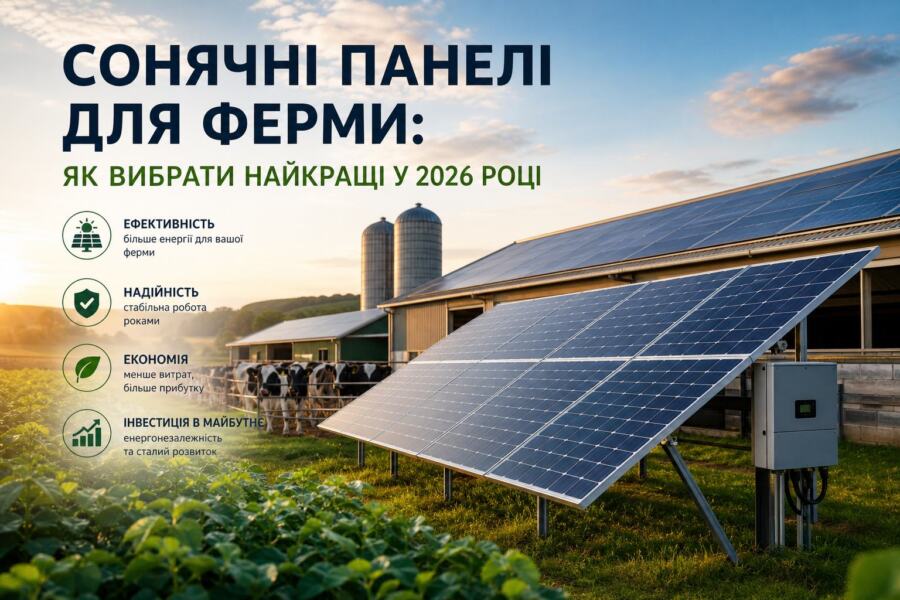
Modern farming is increasingly switching to its own electricity generation, and this is no coincidence. Solar panels for the farm allow you to reduce dependence on the network, stabilize costs and ensure the operation of equipment even in remote locations. In 2026, the choice has become wider, but at the same time the need for a competent approach to system design has increased.
For an agricultural business, not only the price of the equipment is important, but also its reliability, resistance to dust, moisture, wind, and temperature fluctuations. If the system is selected correctly, solar energy in agriculture works to reduce operating costs, automate processes, and increase the energy independence of the economy.
Where exactly do solar panels have the greatest effect on a farm?
On a farm, electricity is needed almost everywhere: for pumps, lighting, ventilation, cooling, battery charging and automation. In many cases, it is the photovoltaic system that allows you to avoid expensive connection to the grid or reduce the load on it. The best effect is given by solutions that cover the most energy-intensive processes.
- Water supply and irrigation — especially for watering fields, gardens and greenhouses.
- Greenhouse complexes — ventilation, pumping stations, climate control.
- Livestock farms — lighting, ventilation, milking equipment, cooling.
- Warehouses and granaries — microclimate control and security systems.
It is worth mentioning separately solar panels for greenhouse. For such facilities, it is critically important to ensure stable operation of ventilation, shading, irrigation systems, and sensors, as temperature and humidity fluctuations directly affect yield.
What characteristics determine the best solar panels for a farm
When choosing, you should not focus only on power in watts. For a farm, a set of parameters that affect the real resource, productivity and payback of the system is important. In 2026, high efficiency, stable operation in partial shade and a long warranty period remain priorities.
- Panel type — monocrystalline modules usually have higher efficiency and are better suited for limited space.
- Efficiency coefficient — the higher the indicator, the more energy from the same area of roof or land.
- Temperature coefficient — important for working in the heat, when the drop in productivity can be significant.
- Resistance to external conditions — dust, moisture, hail, ammonia in livestock facilities, strong wind.
- Warranty and degradation — for a farm, it is advisable to choose modules with a long performance guarantee.
If the farm operates seasonally or has irregular consumption, it is important to provide energy storage and an inverter with a reserve capacity. This is especially true for systems that use refrigeration equipment, automatic power supply and solar panel pump.
Comparison of the main types of solar panels for the agricultural sector
| Panel type | Advantages | Disadvantages | Best use |
|---|---|---|---|
| Monocrystalline | High efficiency, compactness, better performance in limited space | Higher price, sensitivity to installation quality | Farms, greenhouses, hangar roofs, facilities with a shortage of space |
| Polycrystalline | More affordable, easier choice for basic systems | Lower efficiency, larger installation area | Farms with sufficient space and a moderate budget |
| Bifascial | Generation from both sides, higher production potential | Requires proper installation and light reflection | Ground stations, open areas, farm fields |
| Flexible modules | Light weight, easy to install on non-standard surfaces | Typically shorter life and lower efficiency | Temporary solutions, mobile systems, lightweight structures |
How to calculate system capacity for a farm
The most common mistake is buying panels without an accurate energy audit. First, you need to determine the daily consumption: how many kilowatt-hours are used by pumps, lighting, ventilation, refrigerators, automation and additional equipment. After that, a reserve is made for losses in the inverter, cables and cloudy weather.
For practical calculations, it is worth considering not only the average load, but also peak surges. For example, solar panel pump may require significantly more starting power than during normal operation. The same applies to cold rooms, compressors and powerful fans.
- First, determine a list of all electricity consumers.
- Calculate their average daily consumption in kWh.
- Add a margin of 20–30% for losses and seasonal fluctuations.
- Check if batteries are needed for night or emergency operation.
- Select an inverter and controller that match the total load.
Solar panels for a greenhouse: what to pay attention to separately
Greenhouses have specific requirements for the power system. Here, not only daytime consumption peaks are important, but also uninterrupted operation at critical moments: in the heat, during irrigation or during the period of active plant growth. That is why the system must be designed taking into account local shade, roof orientation and the need for automatic microclimate control.
Solar panels for greenhouse It is advisable to combine it with humidity, temperature and light sensors. This allows you to start fans, pumps and other devices only when they are really needed, rather than constantly operating with excess costs.
- Choose panels that perform well in partial shade.
- Provide resistance to moisture and elevated temperatures.
- Use protected cable routes and secure mounting.
- Build a capacity reserve for peak summer loads.
Solar panel pump: when is it the most profitable solution?
For irrigation, animal watering, and water pumping, a solar system is often one of the most efficient solutions. Solar panel pump Especially advantageous where there is no stable access to the electricity grid or where the cost of connection is too high. In such cases, the system operates during the day without significant electricity costs.
It is important to choose the right not only panels, but also the type of pump, controller and power supply scheme. For deep wells and long pipelines, a pressure reserve is required, and for irrigation it is better to take into account the water consumption per hour and the duration of operation. If the system must operate stably, it is advisable to use a pump with a soft start and a compatible inverter.
What is important to check before buying in 2026
The market has become more technological, but at the same time many cheap solutions of dubious quality have appeared. In order not to make a mistake, it is worth evaluating not only technical characteristics, but also service support, availability of components and the supplier's experience in agricultural projects. This is critical for a farm, because a system outage can mean direct financial losses.
- Certification and origin of equipment.
- Warranty on modules, inverter and batteries.
- Compatibility of all system components.
- Scalability when expanding the farm.
- Availability of service and spare parts in your region.
Common mistakes when choosing a solar system for a farm
Most often, farms overpay or receive insufficient productivity due to the lack of competent design. Often, panels are installed without analyzing shadows, orientation, seasonal insolation, and real consumption schedules. As a result, the system formally works, but does not cover the needs of the farm at the right hours.
- Choosing panels without an energy audit.
- Ignoring peak loads and starting currents.
- Savings on fasteners, cables and surge protection.
- Underestimating dust, dirt and regular maintenance.
- Lack of capacity reserve for seasonal changes.
Frequently Asked Questions (FAQ)
Are solar panels suitable for an off-grid farm?
Yes, but for Autonomous operation requires a properly designed system with batteries, inverter and power reserve. It is important to consider nighttime consumption, peak loads and seasonal fluctuations in solar generation.
Which solar panels are best for a greenhouse?
Monocrystalline modules with high efficiency and good heat resistance are often the best choice. For a greenhouse, reliable installation, protection of electricity from moisture, and compatibility with ventilation and irrigation systems are also important.
Can a solar panel pump work without batteries?
Yes, if the pump is used during the day and the system is selected for direct power supply from the panels. However, for more stable operation, especially with variable cloud cover, it is better to provide a controller and backup power or energy storage.
How long do solar panels last on a farm?
Quality modules typically last 25 years or longer, although their performance gradually declines over time. The actual lifespan depends on the quality of installation, operating conditions, and regular maintenance.