
Useful tips
Deep battery discharge: how DoD affects battery life


Deep battery discharge is not just a situation where the battery "dies", but one of the main factors that directly affects resource, battery capacity and speed battery degradation. In practice, I have seen dozens of cases where people bought good traction batteries, but due to the incorrect discharge mode, they lost part of their life in the first year. The reason is simple: each battery chemistry has its own allowable DoD (Depth of Discharge), that is, the depth of discharge, and if it is regularly exceeded, internal processes destroy the active material, internal resistance increases and the battery ages quickly.
What is DoD and why is it important?
DoD is the percentage of battery capacity used. However, users often encounter the fact that The inverter shows the charge incorrectly., so it is important to know the actual capacity of your system. If the battery is 100 Ah gave 50 Ah, then DoD is 50%. If you gave 80 Ah, this is already 80% DoD. This indicator more accurately describes the load on the battery than simply "discharged/not discharged.".
For understanding, it is important not to confuse DoD with voltage. Voltage only roughly indicates the state of charge, and under load it also sags. Therefore, the battery may look "alive" in terms of voltage without load, but in fact be very deeply discharged.
Why deep discharge is harmful
When the battery is discharged too deeply, unwanted processes are triggered:
– in lead-acid in batteries, lead sulfate becomes coarser and is less likely to return to working condition;
– in lithium batteries, internal resistance increases and cell balance deteriorates;
– when the battery is low on charge, it takes a worse charge, heats up more and loses capacity faster;
– after several such cycles real battery capacity no longer matches the passport.
That is, the main mechanism here is not a «one-time blow», but a cumulative one. battery degradation after many deep discharge cycles.
How DoD affects battery life
Battery life is usually measured in terms of the number of cycles. However, the same battery can last a very different number of cycles depending on how deeply it has been discharged. That is why technical data sheets always indicate not only the cycles, but also DoD.
Typical dependency: less discharge, longer service life
Below is a simplified practical table. The values are averaged, as the exact numbers depend on the brand, temperature, currents, and charging conditions.
| Battery Type | DoD | Estimated Cycle Life | Comment |
|—|—:|—:|—|
| Lead-acid AGM/gel | 30% | 800–1500 | The most gentle mode for this type |
| Lead-acid AGM/gel | 50% | 500–800 | Balanced household routine |
| Lead-acid AGM/gel | 80% | 200–400 | Already noticeable battery degradation |
| LiFePO4 | 80% | 2000–4000 | Normal operating mode |
| LiFePO4 | 90–100% | 1500–3000 | You can, but not every day without need |
| Lithium-ion | 80% | 1000–2500 | Sensitive to overheating and overcharging |
The table shows the main pattern: the deeper the battery discharge, the fewer cycles it will withstand. But the degree of loss of resource depends on the chemistry. That is why traction batteries and more expensive lithium batteries behave differently.
Which batteries are most sensitive to deep discharge?
Lead-acid batteries
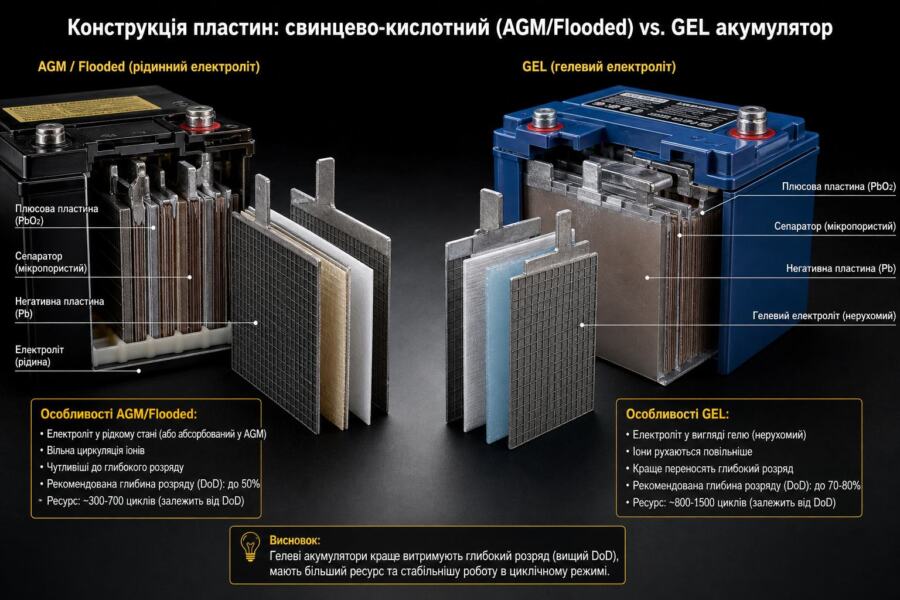
For classic AGM, GEL and liquid lead-acid batteries deep battery discharge especially harmful. If they are kept at a low charge for a long time, dense sulfate forms on the plates, which is difficult to dissolve during charging. This is one of the main reasons for the loss of capacity.
Practically it looks like this:
– the battery takes longer to charge;
– voltage drops faster under load;
– available decreases battery capacity;
– in advanced cases, the battery no longer holds even half of its nominal capacity.
For lead-acid batteries, I advise against regular deep discharge 50%. If it's a backup power supply, even less is better.
LiFePO4 and other lithium batteries
Lithium iron phosphate batteries are much better at withstanding deep cycles. That's why they're often used in solar systems, boats, campers, and backup power. But there's an important caveat: the battery maybe to work for 80–100% DoD, does not mean that you have to do this every day unnecessarily.
Why? Because the resource is affected by:
– temperature;
– discharge current;
– BMS quality;
– duration of low charge;
– correct charging profile.
In lithium batteries, deep discharge does not cause sulfation, as in lead batteries, but accelerates cell aging and unbalancing. Therefore, even for good LiFePO4, it is advisable to operate in the range 20–80% in daily operation, if the system allows.
Practical signs that the battery is already «tired»
There are several symptoms by which I quickly see the effects of regular deep discharge on objects:
1. Rapid voltage drop even under light load.
2. The battery charges "almost to the end", but in reality it holds much less.
3. The inverter shuts down earlier than expected.
4. The battery heats up more than before while charging.
5. After rest, the voltage rises, but it does not return the lost battery capacity.
Pay special attention to backup power systems where the battery operates in buffer or cyclic mode. If it often goes into deep discharge, battery degradation accelerates many times.
Which DoD to choose in real operation
There is no one universal number. You need to look at the type of battery, your budget, and the purpose of the system.
For household backup power
If the battery is for the house, boiler, router, lighting:
– for lead batteries it is advisable to keep DoD no more than 30–50%;
– for LiFePO4 you can plan 60–80%, but it is better to leave a margin;
– if outages are rare, you should not «squeeze» the battery to zero.
For solar stations
In solar systems, the mode is different: daily cycles, charge from PV, discharge in the evening. Resource economy is important here. If the battery is constantly operating on 90–100% DoD, you will get more useful energy today, but you will be buying a new battery sooner tomorrow.
For traction loads
Traction batteries designed for regular cycles, but they also do not like mindless exhaustion. When loading electric cars, boats, carts, and vans, the following principle should be followed:
– do not discharge the battery «to zero»;
– do not leave in a discharged state;
– charge immediately after use;
– prevent overheating during operation and charging.
What to do to reduce battery degradation
Here are some practical rules that I almost always recommend:
– Do not discharge the battery unnecessarily.
– Use an inverter, charge controller or BMS with the correct shutdown thresholds.
– Do not store the battery in a discharged state.
– Charge immediately after a cycle, especially if it is lead.
– Monitor the temperature: high temperature accelerates aging many times over.
– Periodically check the actual capacity, not just the voltage.
– For lead-acid batteries, avoid «chronic undercharging» — it is just as harmful as deep discharge.
What to look for in technical specifications
When buying a battery, check:
– permissible DoD;
– the number of cycles with this DoD;
– operating temperature;
– availability of BMS;
– maximum charge and discharge current;
– guarantee for resource and capacity conservation.
If the battery passport states that the resource is given at 80% DoD, and in reality you will push her to 100% daily, then the predicted service life should be reduced. This is normal engineering logic, not a "salesman's horror story.".
When deep discharge is still permissible
It is not always possible to completely avoid deep discharge. Sometimes it is necessary:
– in an emergency situation;
– during a short-term complete absence of a charge source;
– when the system was designed specifically for this mode.
But it is important to distinguish here one-time deep discharge from regular operation on the edge. One emergency won't kill a good battery. But repeated use with frequent discharge to low values is almost guaranteed to accelerate battery degradation.
Practical conclusion from Engineer Gennady
Simply put, deep battery discharge — it is always a compromise between available energy today and resource tomorrow. For lead batteries, stick closer to 30–50% DoD, for LiFePO4 - in the operating range 20–80%, and don't force the battery to live "at the bottom." It is the moderate discharge regime that gives the best balance between savings now and durability in the future.
Frequently Asked Questions (FAQ)
Can the battery be discharged to 0%?
Only possible in emergency mode and not for all types. Regularly discharge to 0% not worth it - it accelerates wear and reduces battery capacity.
What is more harmful: deep discharge or overcharge?
Both modes are harmful. For lead-acid batteries, deep discharge is often more dangerous in everyday life, while for lithium batteries, both overcharging and overheating can be critical.
Is it true that traction batteries tolerate deep discharge better?
Yes, but not infinitely. Traction batteries designed for cyclic operation, however, frequent discharge to zero still leads to faster battery degradation.
How do I know if the battery has lost capacity?
The easiest way is to compare the system's operating time with the initial state or measure the energy output under load. If the autonomy has noticeably dropped, then the real battery capacity has already decreased.