
Useful tips
Home generator or LiFePO4: which is more profitable in 2026


Generator for home і LiFePO4 for home in 2026 remain the two most popular options when it comes to ensuring backup power during power outages. But the profitability of these solutions depends heavily not only on the purchase price, but also on the frequency of outages, load, noise restrictions, installation conditions and how it is used. energy independence system.
For some, a classic gasoline or diesel generator will be optimal, which is cheaper to integrate into the system and can work for a long time under load. For others, a LiFePO4-based battery system will be a much smarter choice, which operates quietly, without emissions and requires almost no maintenance. In many cases, the best result is not given by one device, but by a properly assembled combination of solutions.
What changed in 2026 and why the choice became more difficult
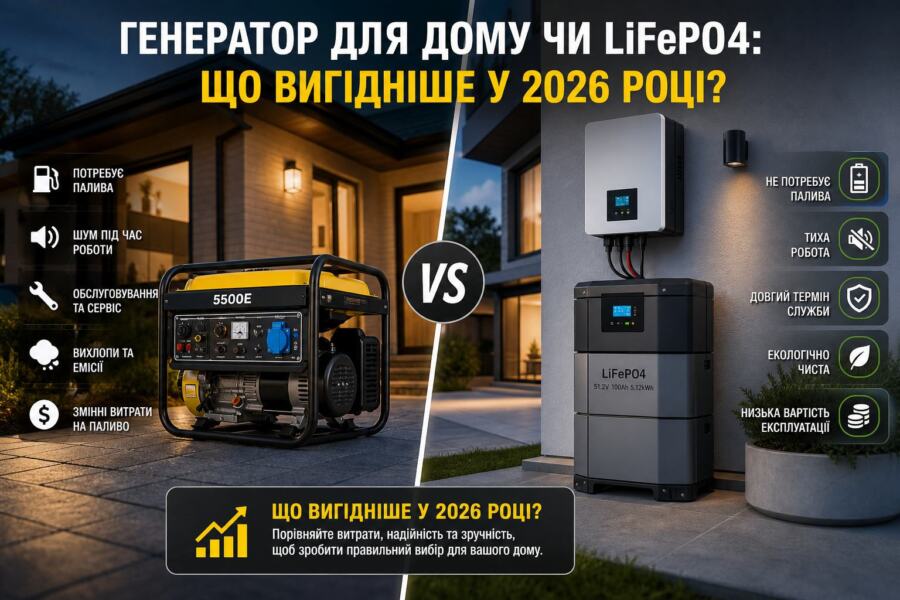
A few years ago, the comparison was simple: a generator is cheaper at the start, a battery is more expensive but more comfortable. In 2026, the situation became more interesting. On the one hand, inverters, battery modules, charge controllers and ready-made solutions have become cheaper LiFePO4 for home. On the other hand, users have become more demanding of silence, autonomy, and safe work in an apartment, house, or office.
The key change is that people are increasingly counting not only the cost of equipment, but cost of 1 kWh of reserve energy. And here the generator and battery system behave differently:
- Generator gives a cheaper start, but requires fuel, service, and proper starting.
- LiFePO4 more expensive at the start, but has low operating costs.
- Backup power Battery-powered is more comfortable for sensitive equipment and night use.
- Energy independence system can be a hybrid, where both options complement each other.
Therefore, the question no longer sounds like "which is better in general", but rather like "which is more profitable for your consumption scenario.".
How a home generator works and where are its strengths?
Generator for home - it is autonomous a source of electricity that generates current by burning fuel. Most often used gasoline, diesel or gas models. They are useful where it is necessary to power consumers for a long time, especially if outages can last for hours or days.
Its main advantages are clear:
- quick start backup power for the home;
- opportunity to work a long time without charging batteries;
- relatively low initial price;
- suitable for powerful consumers - pumps, boilers, refrigerators, tools;
- it is easy to understand the principle of operation even without complex automation.
But there are also disadvantages that are often underestimated. The generator is noisy, emits exhaust gases, requires regular replacement of oil, spark plugs, filters and fuel control. If the model is of poor quality or is selected incorrectly, the voltage can "float", which is harmful to electronics. In addition, it is almost impossible to use it safely in an apartment or in a multi-storey building.
The most common mistake is to buy a generator «with a reserve», but without understanding that it does not like underload. If the device constantly operates at 10–20% of its power, the engine may operate inefficiently, and fuel will be wasted. Another mistake is to try to connect the generator to the home network without correctly entering the reserve and automatic switch.
What is LiFePO4 for the home and why has this technology become so popular?
LiFePO4 for home is a battery system based on lithium iron phosphate batteries. It stores energy and releases it when the grid disappears. In conjunction with an inverter, charger or hybrid inverter, such a system is able to provide comfortable backup power without noise, smell and constant interference.
What attracts her:
- quiet work without engine and exhaust;
- possibility of installation in a house, technical room or even in an apartment, if safety requirements are met;
- very high cycle life - often 3000–6000 and more with proper operation;
- stable voltage, which is useful for boilers, routers, servers, lighting and electronics;
- minimum maintenance compared to a generator.
But LiFePO4 is not a «magic» solution without limitations. It must be correctly calculated by capacity, selected with a compatible inverter, taken into account the starting currents of the equipment, the quality of the cables, overload protection, as well as charging conditions. If the system is assembled haphazardly, it can be more expensive and less reliable than it seems on paper.
Another important point: the battery does not create energy, but only stores it. That is, if the outage lasts a long time, the battery must be charged either from the network, or from solar panels, or from a generator. That is why in 2026 it often wins hybrid energy independence system.
Comparison by main criteria
To understand which is more profitable, you need to look at not one characteristic, but several at once. Below is a practical comparison.
| Criterion | Generator for home | LiFePO4 for home |
|---|---|---|
| Initial cost | Lower | Higher |
| Operating cost | Fuel, oil, service | Low, the main thing is proper charging |
| Noise | High | Almost 0 dB from the battery itself |
| Possibility of installation in a home | Poor or limited | Good for safety. |
| Battery life | Depends on fuel supply | Depends on battery capacity |
| Voltage stability | Average or depends on inverter type | High |
| Service | Regular | Minimum |
| Environmental friendliness | There are exhausts | No local emissions |
If you look at the starting price alone, a generator almost always looks more attractive. But if you consider comfort, quietness, convenience, and long-term operation, LiFePO4 often becomes more profitable over a horizon of several years.
When a generator is more profitable than LiFePO4
There are scenarios where generator for home — this is not a compromise, but the best solution.
- Frequent and long power outage for 6–12 hours or more.
- Need to feed powerful consumers, for example, a pumping station, power tools, a large refrigeration complex.
- There is a separate place for safely placing the generator outside or in a special box.
- The budget is limited at the start, and a reserve is needed now.
- You are ready for regular maintenance and fuel supply.
For example, a private home with electric heating or a powerful pumping system may require hundreds of watts or several kilowatts for many hours. In this case, a battery pack of the required capacity will become very expensive, and a generator will be more practical. Especially if the outages are not daily, but rare but long.
However, it is important to remember: a generator works better not when it is bought "by eye", but when it is properly matched to it. automatic input of reserve, cable part and overload protection.
When is LiFePO4 more profitable and why is it often chosen for the city?
LiFePO4 for home becomes especially advantageous when quiet, clean and predictable is needed backup power. This is the best option for apartments, townhouses, houses in dense development, as well as for those who value comfort and do not want to deal with fuel, starting and service.
A battery system is beneficial if:
- short-circuits - from 15 minutes up to several hours;
- you need to power sensitive equipment: routers, NAS, video surveillance, boiler, lighting, PC;
- important silent operation at night;
- there are solar panels or their installation is planned;
- an automatic, almost invisible energy independence system is needed.
In practice, LiFePO4 often wins where outages are frequent but not too long. For example, if the power goes out for 1–3 hours every day, the battery covers these gaps without stress for the family. There is no smell of fuel, no need to run outside to start the engine, and nothing buzzes under the window at night.
LiFePO4 also protects household electronics better. For boilers, TVs, server equipment and routers, stable voltage is important, and a battery system provides it much more evenly than a cheap generator.
What is important to consider before buying
Mistake number one is to focus only on the power on the nameplate. For generator for home and for LiFePO4 It's not just kilowatts that are crucial, but also the actual usage scenario.
Before buying, you should answer a few questions:
- How many hours How long does the outage last on average?
- Which consumers need to be powered: just the light and the boiler or also the refrigerator, pump, appliances?
- Is it possible to take the generator outside without compromising safety?
- Do you need complete silence at night?
- Is there any plan to expand? energy independence systems in the future?
If you answer honestly, the choice becomes more obvious. For example, for a house with rare but very long outages, it is sometimes better to install a generator and a small LiFePO4 block for critical loads. And for an apartment or office - the opposite: a battery plus an inverter, without a generator at all.
Typical mistakes when choosing and installing
The biggest problems arise not because of the technology itself, but because of improper selection and installation.
- Underestimation of starting currents. A refrigerator, pump or compressor may briefly require 2-5 times more power.
- Too little power reserve. The system works at the limit, heats up, shuts down, and wears out faster.
- Savings on cables and protection. Cheap wire or the lack of circuit breakers is a direct path to overheating and failure.
- Wrong location for the generator. It cannot be used indoors without exhaust ventilation.
- Poorly implemented LiFePO4 charging. The battery requires a compatible charging profile and correct settings.
- Lack of a backup scenario. If the battery runs out and the generator is not provided, the system will stop.
A separate danger is connecting backup power «"through extension cords and tees." This approach is dangerous because it is easy to overload the line, create a bad contact, or miss a grounding error.
How to combine a generator and LiFePO4 in one system
The best energy-independent system (Incomplete: max_output_tokens)