
Useful tips
Solar Panels for Business: How to Reduce Your Bills in 2026


In 2026, businesses in Ukraine continue to look for practical ways to reduce operating costs, and solar panels for business are becoming one of the most effective solutions. Rising tariffs, unstable energy supply and the need for predictable costs make own electricity generation not just a trend, but a tool for financial sustainability. For shops, warehouses, offices, industries and HoReCa, this is a way to reduce the monthly burden on the budget without losing the quality of work.
Why solar generation has become profitable for business
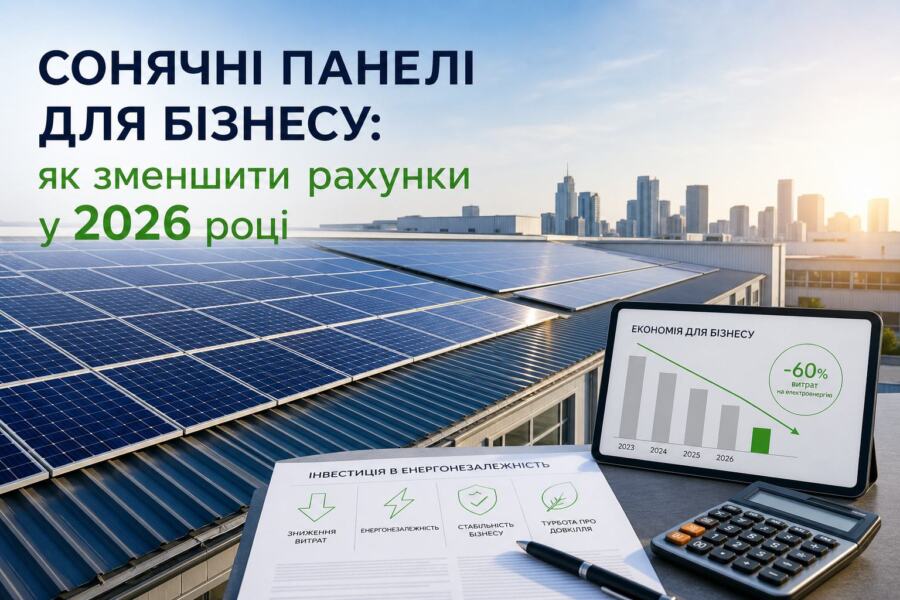
The economics of a commercial facility's own power plant in 2026 is based on a simple principle: the more daytime consumption, the faster the system pays for itself. Most companies operate during daylight hours, when the panels' output is at its peak. This allows them to cover a significant portion of their own needs without purchasing electricity from the grid.
Reducing electricity bills business benefits not only through direct savings, but also through better control over costs. The fixed model of partial self-sufficiency helps to plan the budget, reduce dependence on peak tariffs, and avoid downtime during outages.
- Smaller monthly bills for electricity.
- Stable costs for a long period.
- Protection against tariff increases and market fluctuations.
- Increasing energy autonomy object.
How a solar station for a commercial facility works
Solar station for the store or other business facility consists of panels, an inverter, a mounting system, a cable infrastructure and, if necessary, batteries. During the day, the system covers current consumption, and the surplus can be stored in batteries or used according to the chosen connection scheme.
For businesses, hybrid or grid-connected solutions are most often chosen. Grid-connected stations are suitable for facilities with stable daily loads, while hybrid ones provide more flexibility and protection in case of outages.
- Consumption assessment — analyze daily load, peaks, and seasonality.
- Power calculation — determine the optimal size of the station for business goals.
- Installation and connection — install equipment and integrate it into the engineering system.
- Monitoring — monitor production and consumption in real time.
What format of solar station to choose for business
The choice depends on the type of facility, work schedule and consumption structure. For retail, coffee shops and pharmacies, a small system that covers the daytime loads is often enough. For warehouses, workshops and shopping centers, more powerful solutions with a greater generation margin are required.
Below is a comparison of popular options that are most often considered by companies planning solar panels for business.
| System type | Advantages | Disadvantages | Who is it suitable for? |
|---|---|---|---|
| Network | Lower cost, simple scheme, faster payback | Does not work during network outage | Shops, offices, warehouses with daily consumption |
| Hybrid | Autonomy, backup power, flexible control | Higher price due to batteries and more complex configuration | Business with critical load and risk of disruption |
| Autonomous | Complete independence from the network | The most expensive, requires large batteries and precise calculations | Remote sites, farms, special commercial sites |
What has the greatest impact on payback in 2026?
The payback period of a solar project for a business depends not only on the cost of the equipment. The operating mode of the company, the proportion of daytime consumption, the area of the roof or land plot, as well as the quality of the design are of key importance. An error at the calculation stage can increase the return on investment by years.
That reducing electricity bills business felt from the first months, it is important to consider the following factors:
- Consumption profile — the more work you do during the day, the better the effect.
- The right power — the system should be neither too small nor too large.
- Equipment quality — inverters, panels and cabling system affect reliability.
- Installation location — tilt angle, orientation, and shading are critically important.
- Availability of batteries — they increase autonomy, but increase the project budget.
For which businesses do solar panels work best?
The fastest economic impact is felt by companies that consume electricity mainly during the day. These include retail stores, pharmacies, offices, logistics centers, warehouses, food establishments, car services, and small manufacturing. For such facilities, solar energy can cover a significant part of the base load.
Especially profitable solar station for the store becomes where refrigeration equipment, lighting, cash register systems, ventilation and air conditioning operate. It is these consumers that form a stable daily load that coincides well with the generation schedule.
- Shops and supermarkets — constant daily consumption, refrigeration equipment.
- Offices — work during daylight hours, expected workload.
- Warehouses and logistics — lighting, appliances, security systems.
- Food establishments — kitchen equipment and air conditioning.
- Production — large bills and high savings potential.
What to consider before investing
Before launching a project, it is worth conducting an energy audit. It shows how much electricity the business consumes at different times, which devices create the main load, and which station format will be most efficient. Without this, it is difficult to accurately calculate the economics of the project.
It is also important to assess the technical limitations of the site. Not every roof is suitable for the placement of panels, and in some cases it is more appropriate to install a ground structure. All this affects the budget, installation time and future performance of the system.
- Check the roof's load-bearing capacity or the possibility of ground mounting.
- Assess the condition of the power grid on the object.
- Compare several technical solutions by payback.
- Set up service and maintenance into a financial model.
Frequently Asked Questions (FAQ)
How much can you really save on electricity after installing solar panels?
The level of savings depends on the business schedule and system capacity. For facilities with daytime consumption, savings can be significant from the first months, especially if the station covers base load during business hours.
Is a solar power plant suitable for a small shop?
Yes, especially if the store is open during the day and has constant consumption: lighting, cash registers, refrigerators, air conditioners. In this case solar station for the store helps lower bills and reduce dependence on tariffs.
What is better for business: a network or hybrid system?
If the main goal is quick reducing electricity bills business, often choose a grid-connected system. However, if backup power and higher resilience to outages are required, a hybrid configuration with batteries would be more appropriate.
In 2026, commercial solar is not just about the environment, but also about financial discipline, cost predictability, and protecting your business from energy risks. For companies looking to reduce operating costs and gain greater independence, solar panels for business are becoming one of the most practical tools for long-term savings.