
Useful tips
Solar panels for the home: how to choose in 2026

Correctly selected solar panels for home allow you to reduce electricity costs, increase energy independence and create a reliable autonomous power supply for critical consumers. But the choice of panels should not be made only by price or appearance. It is important to consider the type of photovoltaic cells, actual generation, roof area, seasonality and quality of installation.
Solar power plant for a private house — it’s not just a set of panels. It’s a system where every element affects the result: inverter, controller, batteries, cables, protection and installation method. That’s why before buying, you need to calculate consumption, assess installation conditions and compare different technologies.
The main types of solar panels for a private home
There are three types of modules most commonly used on the market: monocrystalline, polycrystalline, and thin-film. They differ in efficiency, heat resistance, area requirements, and cost. If the goal is to get the most energy from a limited roof, then monocrystalline is the most common choice. monocrystalline solar panels.
In order not to be mistaken, it is important to look not only at the nominal power, but also at the behavior of the panel in real conditions: in heat, cloudiness, winter and partial shading. This is critical for a private house, as the available roof area and consumption mode are often limited.
| Panel type | Efficiency | Advantages | Disadvantages | When to choose |
|---|---|---|---|---|
| Monocrystalline | High, 20–23% | Compactness, better generation per m², durability | Higher solar panels price | Small roof area, high efficiency requirements |
| Polycrystalline | Medium, 16–19% | More affordable, easy choice for basic systems | Requires more space, lower productivity | Budget solutions, large free space |
| Thin-film | Low, 10–13% | Flexibility, good work in diffused light | Low efficiency, large area, shorter life | Special installation conditions, non-standard surfaces |
Monocrystalline solar panels: why they are chosen most often
Such modules are made of monocrystalline silicon, so they have higher efficiency and are better suited for roofs with limited area. For a private house, this is often the most rational solution, especially if you need to ensure not only partial coverage of costs, but also stable autonomous power supply important devices.
In addition to efficiency, pay attention to the temperature coefficient, warranty, and quality of the frame, glass, and sealing. These parameters determine how stable the system will operate after 5–10 years of operation.
How to calculate the power of a solar power plant
You need to start by analyzing your daily consumption. To do this, sum up the power of your main appliances and their operating time. The calculation is made in kilowatt-hours per day, and then make a reserve for losses in the inverter, wiring, and batteries.
If the system is to operate as a backup, focus on critical consumers: lighting, refrigerator, router, pump, boiler, security. If complete energy independence is planned, a more accurate calculation is needed with a margin for seasonal changes.
Calculation algorithm
- Make a list of all electrical appliances that will be connected to the system.
- Determine their average daily work in hours.
- Calculate the total consumption in kWh per day.
- Add 20–30% of margin for losses and unforeseen loads.
- Select the inverter, batteries, and number of panels based on the value obtained.
Example: if a house consumes 8 kWh per day, then taking into account losses, you should aim for 10–11 kWh of generation. Conventionally, one panel with a capacity of 450 W can produce an average of 1.5–2.2 kWh per day, depending on the season and region. So, for such a house You may need about 5–7 panels, and more for extra storage.
What else affects power?
- Installation region — quantity sunshine hours varies significantly across Ukraine.
- Roof pitch and orientation — the southern direction works best.
- Shading — chimneys, trees, and nearby buildings reduce generation.
- Seasonality — in winter, production is noticeably lower than in summer.
- System type — networked, hybrid, or standalone configurations have different requirements.
Autonomous power supply or network system: which is better for the home
The choice between an autonomous and a networked scheme depends on the task. If you only need to reduce bills, a networked station without batteries is enough. If energy independence is important, it is worth assembling a system with energy storage.
Autonomous power supply It is suitable where there are power outages, there is no stable network, or there is a need to backup critical equipment. However, such a system is more expensive due to the batteries and requires more precise design.
- Network system — lower cost, easier installation, no batteries.
- Hybrid system — combines mains operation and battery backup.
- Autonomous system — complete independence, but higher price and more complex calculation.
What to look for when choosing equipment
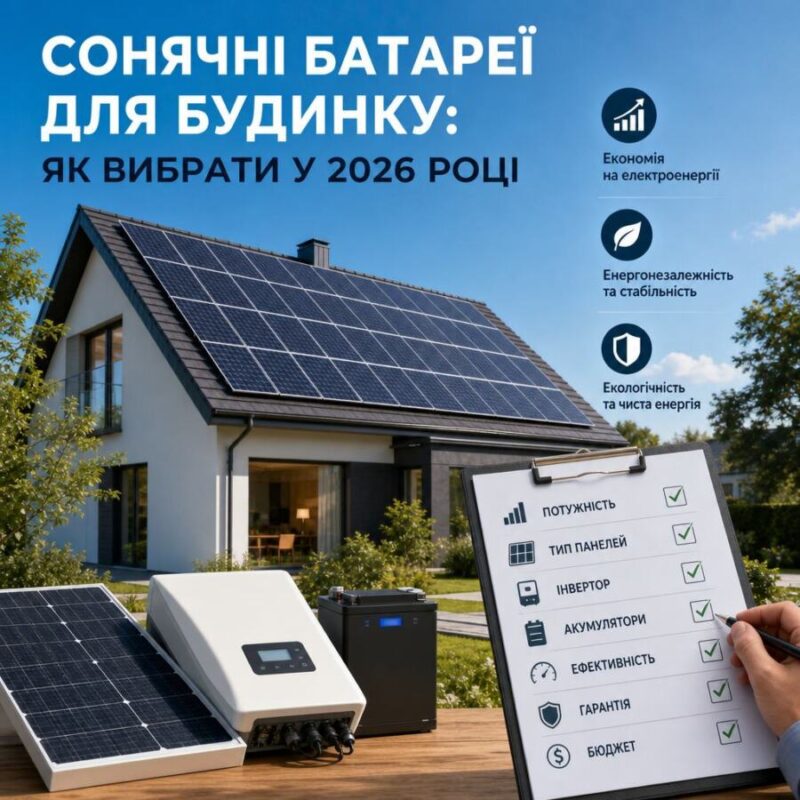
Quality solar power plant is determined not only by the panels. The inverter must be compatible with the future load, and the batteries must be compatible with the charge and discharge regime. If the system is assembled without a reserve, voltage sags or outages may occur at peak times.
When you compare solar panels price, be sure to consider not only the cost of the modules themselves, but also the components, installation, and service. A cheaper solution often ends up being more expensive due to lower efficiency or faster wear.
Practical checklist before buying
- check the nominal power and real efficiency of the panel;
- specify the product warranty and linear power warranty;
- assess whether the roof area is sufficient for the required number of modules;
- choose an inverter with a power reserve of 20–30%;
- make sure that the cables and protection are suitable for the current loads;
- anticipate the possibility of expanding the system in the future.
Solar panel installation rules
Quality installation directly affects production and safety. The panels must be securely fastened, protected from wind loads and installed with an optimal slope. Even expensive solar panels for home will not give the expected result if they are mounted with errors.
Most often, modules are placed on the roof, less often on ground structures. It is important to provide a ventilation gap to avoid overheating, as high temperatures reduce performance.
Basic installation rules
- Avoid shaded areas and do not place panels under trees.
- Follow the recommended tilt angle for your region.
- Ensure reliable attachment to the roof's supporting elements.
- Use cables designed for outdoor use and UV-resistant.
- Install surge protection, circuit breakers, and grounding.
- Do not mix modules with different electrical characteristics in the same circuit without a design solution.
Special attention should be paid to sealing the passages through the roof. Any violation of the waterproofing layer can lead to leaks, so installation should be entrusted to specialists who have experience with rooftop solar systems.
How much does the system cost and how to estimate the price
When users compare solar panels price, they often only see the difference between individual modules. In reality, the budget depends on the power of the entire station, the type of system, the availability of batteries, the complexity of the roof and the cost of the work.
For a small home, a base station may be cheaper, but it won’t provide backup during outages. Hybrid and stand-alone solutions are more expensive, but they offer real control over energy consumption and greater reliability.
- Panels — the main part of the budget, but not the only one.
- Inverter — is critically important for the quality of the system's operation.
- Batteries are the largest expense item for autonomous solutions.
- Installation and protection — affect safety and durability.
Frequently Asked Questions (FAQ)
Which home solar panels are best for limited roof space?
Most often, the optimal choice is monocrystalline solar panels, because they have higher efficiency and allow you to get more energy from a smaller area.
Is it possible to make autonomous power supply only with solar panels without batteries?
Full-fledged autonomous power supply Without batteries, it is impossible to power a house at night or when there is no sun. Without energy storage, the system only works during the day and when there is generation.
How to understand whether the price of solar panels in a specific offer is adequate?
It is necessary to compare not only the cost of one module, but also the characteristics of the entire system: efficiency, warranty, components, installation, inverter and expandability. A cheap offer may turn out to be less profitable due to lower performance or additional operating costs.
Is it necessary to install the panels on the south side of the roof?
South orientation is the most effective, but not the only possible one. East-west solutions also work, especially if you need to stretch the generation over most of the day.