
Useful tips
The angle of inclination of solar panels in Ukraine: how to choose the right one

The angle of inclination of solar panels directly affects the output, seasonal stability and fastening resource. A typical mistake for Ukraine is to place the modules “as conveniently as possible on the roof”, and not in the direction of the sun. As a result, in the summer the system works almost normally, but in the fall and winter the losses reach 15–30% compared to the correct geometry.
The optimal angle depends on latitude, season, roof type, wind load, and whether maximum annual balance is required or winter production is prioritized. That is why the angle of inclination solar panels In Ukraine, you cannot take “average for everyone” without checking the conditions of the facility.
For a private house, shop, office or production, the rule is the same: first energy, then mechanics, then installation. If you choose the wrong angle, even high-quality panels, inverter and cable will not give the expected result. At the same time, competent installation solar power plants provides additional generation percentages without replacing equipment.
Practice shows that the difference between the angle 20° і 35° at a facility in central Ukraine may be small in summer, but significant in winter, when the sun is low above the horizon. That is why the question of “how to install a solar panel” always starts not with the modules themselves, but with the installation geometry and the correct choice of fasteners for solar panels.
What does tilt angle mean and how does it affect generation?
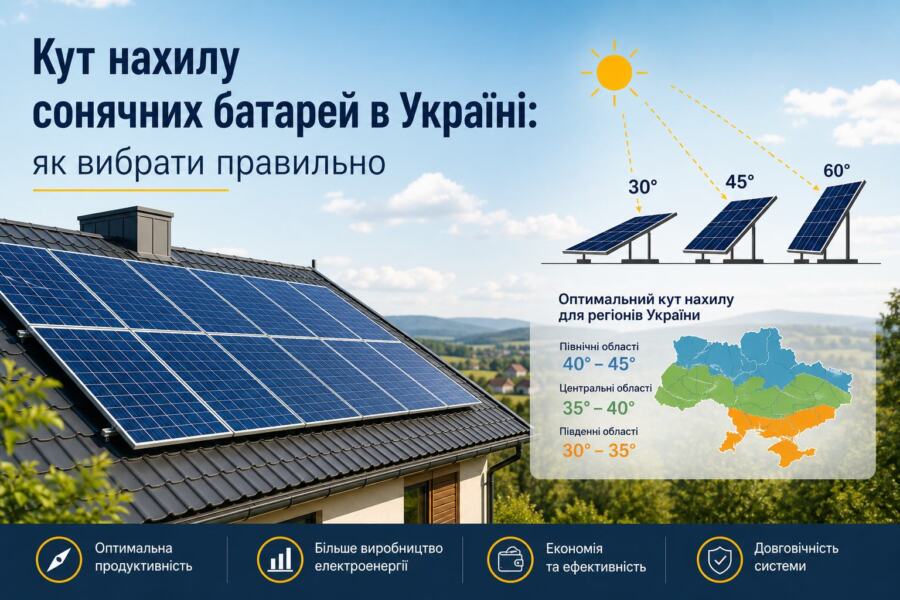
The tilt angle is the deviation of the panel plane from the horizontal. If the module lies almost flat, it catches the high sun well in the summer, but loses a significant part of the radiation in the winter. If it is placed too steeply, the situation is reversed: it works better in the cold season, but worse during peak summer hours.
For Ukraine, the geographical latitude of the area is often taken as a reference point. In practice, for most regions, the working range is 25–40°. For the annual balance sheet, the most common choice is 30–35°, for winter priority — 40–55°, for the elderly — 15–25°.
Real example: a house in Khmelnytskyi region with a 10 kW array after angle correction with 15° to 32° got the best autumn-winter generation without changing the number of panels. This is not a “magic” solution, but the normal operation of the geometry: in winter solar The rays fall at a low angle, so the module should be more vertical.
.
Another important factor is self-cleaning. On steeper slopes, snow, dust, and leaves fall off faster. On flat roofs, dirt accumulates, which not only results in a loss of kilowatt-hours, but also local overheating, uneven aging, and degradation of individual cells.
How to choose an angle for different regions of Ukraine
For the north of the country, they usually choose a slightly higher tilt than for the south, because the sun is lower there on average throughout the year. But the difference is not radical. What is more important is not the “perfect 2 degrees”, but a stable orientation to the south and the absence of shading from chimneys, antennas, trees and neighboring buildings.
The practical logic is this: if the system operates all year round and must be as efficient as possible without manual adjustment, a compromise angle is set. If it is a seasonal facility - a dacha, an agricultural facility, a pumping station, basic autonomy - the angle is adjusted to the period when electricity is needed the most.
| Operating mode | Recommended angle | What gives |
| Annual balance sheet | 30–35° | The most consistent generation throughout the year |
| Winter priority | 40–55° | Better angle for low sun, less snow |
| Summer priority | 15–25° | Maximum during the high sun period |
For roof systems, it is important to consider one more thing: it is not always possible to set the exact angle due to the architecture of the roof. In this case, the installation of solar power plants includes correction using supports, triangular frames or adjustable nodes. This is especially true for flat roofs, where without a special solution the modules simply will not work effectively.
For facilities in the Dnipro and central regions, the range is practically justified 30–33°. For Lviv or Volyn region they often take 32–38°, for the Odessa region, a slightly smaller slope is possible if the owner wants more summer production. But you should always calculate the specific object, and not rely on the average figure.
How to install a solar panel correctly: geometry, orientation, shading
The first principle is orientation to the south. There is an acceptable deviation, but if the panel “looks” to the east or west, the annual generation profile changes. For houses with daytime consumption, this is sometimes even beneficial, but for autonomy and battery systems, a classic southern exposure is usually better.
The second principle is to take shadows into account. Even a narrow shadow from a pipe on one module can reduce the output of an entire branch if the connection scheme is incorrectly selected. Therefore, before install a solar panel, you need to check the shadow trajectory in the morning, noon and evening, as well as at different times of the year.
The third principle is the height from the roof and ventilation. An air gap is required between the panel and the roof surface, otherwise the module will overheat. Overheating reduces voltage and power, especially in hot weather, when the surface temperature can be significantly higher than the air temperature. This applies not only to stand-alone systems, but also to network stations on 220V.
The fourth principle is to check the load-bearing capacity. If the roof is old, weak, or has a complex structure, the angle decision should be coordinated with the actual mechanics. In practice, it is sometimes better to reduce the slope by a few degrees, but maintain a safety margin and safe wind resistance.
For business facilities, warehouses and service stations, it is often advantageous to use a combined scheme: some of the panels are at an optimal angle, some are on ballast structures. This allows you to adapt the installation of solar power plants to the limitations of the roof and not exceed the permissible load.
Solar panel mounting: what is important for angle and safety
The mounting for solar panels is not a secondary element, but the foundation of the entire system. It is on it that it depends whether the array will hold up in the wind, whether the roof will not leak, and whether the angle will be maintained after a year of operation.
For pitched roofs, rack systems with roof hooks, anchors or special brackets are used. For flat roofs, triangular supports, ballast frames, sometimes combined solutions are used. For ground stations, metal or aluminum structures with precise geometry and corrosion protection are used.
Key requirements for fastening:
1. Resistance to wind and snow. If the region is open, without forest belts or high buildings, the load increases significantly.
2. Compatibility with the roof. Metal tiles, bitumen tiles, corrugated sheeting, rebated roofing — each material has its own sealing unit.
3. Adjustability. Systems with a correction range are convenient for precise angle adjustment.
4. Anti-corrosion protection. Zinc, aluminum, stainless steel are not savings, but resources.
A mistake that engineers often see: panels are placed on homemade metal frames without calculation. From the outside, the structure looks solid, but at the first strong gust of wind, vibration begins. And vibration means loosening of bolts, microcracks in the glass, and premature repairs.
Typical mistakes when installing solar power plants
The most common mistake is focusing only on the “pretty” appearance of the installation. Panels in one even row may look neat, but if there is a shadow under them, an incorrect angle or weak fastening, the system will work worse than a simpler but technically correct configuration.
The second mistake is ignoring seasonal bias. The owner looks at the output in June and concludes that everything is fine. And in January the system produces significantly less, although it is the winter energy that can be critical for backup power, a pump, a boiler, or a server room.
The third mistake is too small or too large an angle on a flat roof. With a small angle, the panels get dirty faster and retain water and snow. With a large angle, the windage increases, and therefore the requirements for fasteners and ballast increase.
The fourth mistake is the lack of maintenance allowance. If the modules are mounted close together, it is difficult to clean them, check the cables and connectors, and this affects their durability. In a real project, it is important to provide access, not just the starting generation.
The fifth mistake is buying equipment without reference to the task. When a client asks how to install a solar panel, the answer depends not only on the roof, but also on consumption. For a house with daytime load and for a facility with nighttime consumption, the optimal angle and scheme may be different.
Practical recommendations for private homes, businesses and energy independence
For a private house, it is most often worth starting with 30–35° and south orientation. If the roof does not allow it, it is better to compensate for this with high-quality construction and a correct electrical circuit than to try to forcefully “break” the architecture.
For business, not only kilowatt-hours are important, but also the payback of downtime. If a solar station powers refrigeration equipment, servers, ventilation or lighting, then the stability of generation is often more important than the theoretical maximum. Here, the installation of solar power plants must be carried out taking into account peak loads, reserve and service security.
For stand-alone systems and backup power, it is advisable to choose a larger angle more often, especially if active solar operation is expected in winter. In such a scenario, the panels are better able to self-clean from snow and return to operating mode faster after bad weather.
If you need components, solar panel mounts, advice on roof geometry, or a solution for a specific project, it is worth working with a supplier who understands not only sales, but also engineering installation. For local customers in the region, in particular through the dynaivtsi electrical shop, this is especially important: mistakes at the design stage later cost more than high-quality equipment.
Practical conclusion
The correct angle of inclination of solar panels in Ukraine is a compromise between annual generation, winter production, roof type and mounting reliability. For most objects, the operating range is 30–35°, but the final decision must be tied to the installation location, shadows, wind load and system task. High-quality calculation, correct fastenings for solar panels and professional installation of solar power plants give a greater effect than an attempt to “add power” without changing the geometry.