
Useful tips
Portable Solar Panel: How to Choose a Reliable One in 2026 for Gadgets

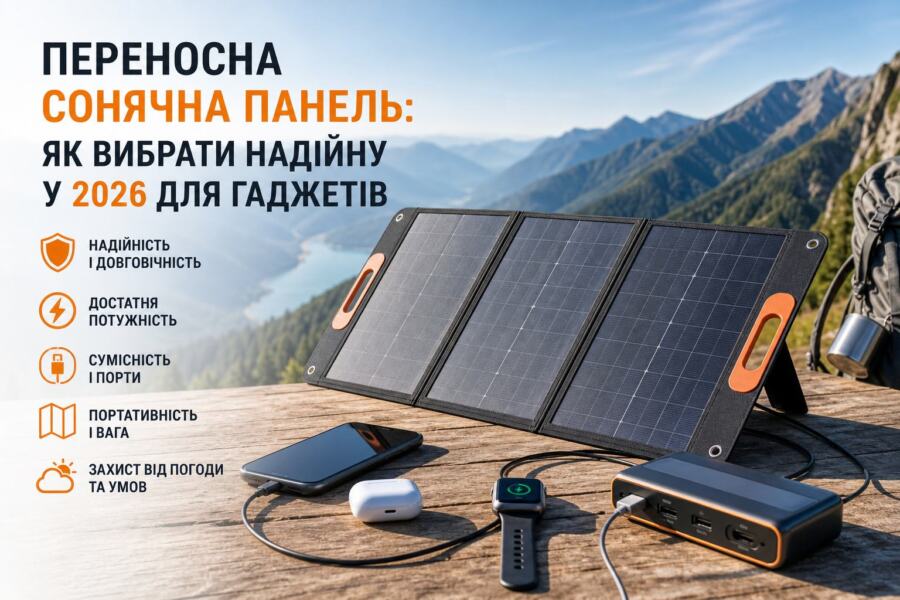
Portable solar panel for gadgets in 2026: what is important to consider
A portable solar panel in 2026 is not just a compact travel accessory, but a practical source of energy for smartphones, power banks, GPS navigators, cameras and wireless devices. It will come in handy on the road, during power outages, camping, fishing or on long trips without access to an outlet.
To choose a reliable model, it is important to look not only at the declared power, but also at the actual efficiency, output stability, device compatibility, and build quality. Well-chosen solar charger allows you to maintain the autonomy of gadgets without unnecessary compromises.
What should a solar panel for a phone and other devices be like?
If needed solar panel for phone, the main task is to ensure stable charging via USB without voltage surges. Smartphones are sensitive to unstable power supply, so cheap panels without a controller can charge slowly or even turn off when it is cloudy.
For daily use, you should focus on models with well-thought-out electronics and a practical folding format. Reliable portable solar charger should be lightweight, durable, moisture-proof, and compatible with major cable types.
- Power — 10–20 W is usually enough for a smartphone, 20–40 W is better for several gadgets.
- Charging controller — stabilizes voltage and reduces the risk of damage to devices.
- Panel efficiency — the higher it is, the better the work in diffused light conditions.
- Case protection — important for use in nature and on the road.
- Port set — USB-A, USB-C, and sometimes DC output for greater versatility.
Main types of portable solar panels
There are several formats on the market, each suited to different scenarios. Some models are designed for backpacking and everyday use, while others are designed for camping, emergency backup, or charging multiple devices at once. The choice depends on how much power you actually need.
| Panel type | Advantages | Disadvantages | Who is suitable for? |
|---|---|---|---|
| Folding thin panel | Lightweight, compact, convenient to take on a hike | Moderate power, dependent on the sun | For travelers, tourists, cyclists |
| Panel with built-in battery | Can store energy, convenient to use | Higher weight, more expensive design | For backup power and daily wear |
| Power bank panel | Optimal for charging the drive, more stable scenario | Not always convenient for directly powering gadgets | For users who want a daily energy reserve |
| Powerful multi-section system | High performance, multiple outputs | Larger dimensions, requires better placement | Camping, expeditions, long autonomous trips |
What characteristics to look for before buying
A common mistake is to choose a model based solely on the power figure on the box. In practice, what is more important is not the maximum theoretical figure, but how the panel behaves in normal conditions: in the morning, under clouds, in the shade, while driving. That is why it is worth evaluating several parameters at once before buying.
- Nominal and actual power. A compact model is enough for a phone, but for fast charging it is better to take a margin of watts.
- Voltage and current. Check if the panel supports 5V/2A or USB-C with PD mode if your devices require it.
- Output stability. High quality solar charger should not "fail" when lighting changes.
- Materials and protection. For trips to nature, shock-resistant panels, a fabric cover, and protection against dust and moisture are desirable.
- Weight and folding format. If the panel will be carried in a backpack often, every extra 200–300 grams makes a difference.
Which is better: charging the gadget directly or via a power bank?
The most reliable scheme for most users is to charge the power bank first, and then use it to power a smartphone, headphones, or watch. This allows reduce the impact of solar fluctuations light and get a more predictable result. Direct charging is possible, but it depends on the weather and the position of the panel.
If you need portable solar charger For short hikes, direct charging of the phone may be acceptable. But for daily backup or trips with several devices, it is better to have a "panel + power bank" connection.
- Direct charging — simpler, easier, fewer elements in the system.
- Through a power bank — more stable, safer, more convenient for multiple gadgets.
- Combined option — the best for autonomy on the road.
How to distinguish a reliable model from a weak one
High quality portable solar panel usually has clear technical specifications, real photos, normal equipment, and adequate manufacturer's statements. If the description promises "incredibly fast charging of any smartphone in 30 minutes" without specifying the conditions, this is a reason to be wary.
It's also worth looking at user reviews with practical tests, not just the overall rating. Comments about operation in cloudy weather, cable quality, ease of assembly, and power retention after several months of use are especially important.
- Signs of a good model: real technical data, overload protection, normal connectors, certification.
- Signs of a weak model: too low price, lack of specifics, unstable work, weak seams and fittings.
- Additional plus: the presence of stands or loops for mounting at an angle to the sun.
Practical tips for use in 2026
That solar panel for phone To work effectively, it is important to position it correctly. The panel should be facing the sun directly, without any shade from trees, a backpack, or the body of a car. Even partial shading can significantly reduce the output power.
It is equally important to monitor the cable and controller: a cheap, damaged cord can "eat" some of the energy or cause charging to be interrupted. If you plan to use it regularly solar charger, choose a model with a high-quality cable kit and the ability to replace accessories.
- Place the panel at an angle to the sun, not flat on the ground.
- Avoid overheating gadgets in direct sunlight.
- Charge your power bank during daylight hours, and your smartphone from it when needed.
- Check compatibility with your cables and connectors.
- Keep the panel dry and clean, especially after hiking or rain.
Frequently Asked Questions (FAQ)
Can it be portable? sunny panel completely replace the outlet?
For everyday home use - no, but how autonomous source for It is very useful for traveling and during power outages. It works best as a backup solution or as an addition to a power bank.
How much power is needed to charge a smartphone?
A 10–20 W panel is enough for one phone, but for more stable operation, it is better to take a model with a power reserve. If you plan to also charge headphones, a watch, or a power bank, you should look at 20–40 W.
Is it safe to connect your phone directly to a solar panel?
Yes, if it's good quality portable solar charging with built-in controller voltage and protection. Without stabilization, direct charging can be unstable, especially in variable cloud conditions.