
Useful tips
Solar panels for an apartment: how to choose a solution in 2026


Solar panels for an apartment: what really works in 2026
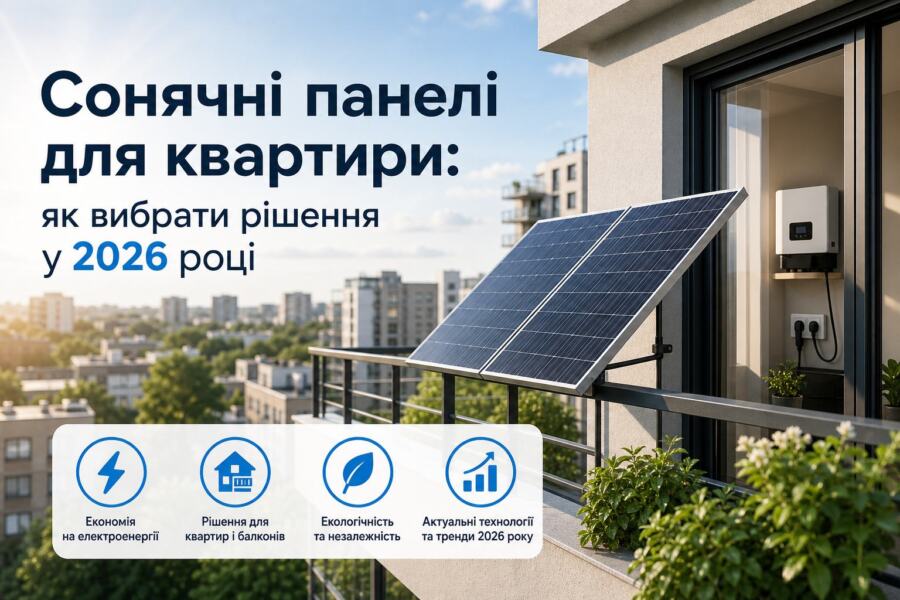
Solar panels for an apartment in 2026, it is no longer exotic, but a practical tool for reducing electricity costs and providing backup power for critical devices. But it is important to understand: in an apartment, it is almost never about full autonomy, as in a private house. Most often, it is mini solar power plant for an apartment, which compensates for part of the consumption or ensures the operation of individual devices during outages.
Before buying, you need to evaluate the area, access to the sun, the possibility of installation on a balcony or facade, as well as the rules of the management company and the condominium association. It is these factors that determine whether sunny energy in the apartment truly useful, or will it turn into an expensive compromise with no noticeable effect.
What solutions are suitable for an apartment?
In a high-rise building, the three most common scenarios are: a balcony station, a portable mini system, and a hybrid solution with a battery. Solar panels in a high-rise building have limitations in terms of area, weight, and mounting method, so the choice always starts with real conditions, not with capacity on paper.
For most apartments, the optimal format is one that powers a router, lighting, laptop, TV, chargers, or a small refrigerator via an inverter. If the goal is to reduce bills, you should look at systems with storage. If backup power is needed, the battery, inverter, and protection become a priority.
- Balcony solar power plant — panels on the fence, floor, or outer surface of the balcony.
- Mobile mini solar power plant — compact panels with controller and battery for reserve.
- Hybrid system — panels, inverter, battery and automatic load switching.
- Network diagram — partial coverage of daytime consumption without energy storage.
What to look for before buying
The first criterion is actual installation area. On a balcony, not only meters are important, but also orientation relative to the sun, the presence of shading from neighboring houses and the possibility of safe fastening. Even a high-quality panel will work poorly if it is in the shade for half the day.
The second criterion is energy consumption. In an apartment, you should first calculate which devices should be powered by the system, how much they consume per day, and what reserve of autonomy is needed. Then it is easier to choose the power of the panels and the capacity of the battery without overpaying.
- Estimate consumption per day: lighting, communications, appliances, household appliances.
- Check the installation location: balcony, loggia, facade, roof within the limits of the permit.
- Determine the system format: backup power or electricity saving.
- Choose an inverter by peak load power.
- Add battery, if work is required in the evening or during outages.
Comparison of popular solutions for an apartment
| Solution type | Advantages | Disadvantages | Who is suitable for? |
|---|---|---|---|
| Balcony solar panels | Easy installation, partial coverage of daily consumption | Limited space, dependent on lighting | To save electricity during the day |
| Mini solar power plant for an apartment with a battery | Backup power, autonomy for important devices | Higher price, need a quality inverter | For operation during outages |
| Portable station with panels | Mobility, does not require complex installation | Less power, limited operating time | For tenants and temporary solutions |
| Hybrid system | Balance between savings and reserves | More complex component selection | For users with higher consumption |
What power to choose in 2026
For a typical apartment, you don’t need to go for a large number of panels. Often, a 300–800 W system is enough for basic needs, or 1–2 kW if you need to power more equipment. It all depends on whether you just want to charge devices or plan to run several devices at the same time.
Main mistake — buy panels without an inverter or battery. If the inverter cannot withstand the starting currents, the system will shut down. If the battery is too small, the energy simply will not accumulate for the evening hours.
- 300–500 W — for router, lighting, gadgets, laptop.
- 500–1000 W — for a basic reserve with a TV and some household appliances.
- 1–2 kW — for an expanded mini solar power plant for an apartment with a battery.
- Over 2 kW — only if there is enough space, permits, and a clear usage plan.
Installation in a high-rise building: what is important to check
Installation in a high-rise building requires special attention to safety, structural loads and legal restrictions. The system should not be installed in a way that creates a risk of falling, overheating, shading of neighboring windows or damage to the facade. If in doubt, consult a specialist installer and check the building regulations.
It should also be noted that external panels are more susceptible to wind, dust and snow. For apartments, compact solutions on the balcony or inside the loggia are often more practical, where it is easier to monitor security and maintenance.
- Reliable fastening without risk to passers-by and residents.
- Protection from moisture and temperature changes.
- Access to the service to clean and check the contacts.
- Component compatibility panel, controller, inverter and battery.
Is solar energy profitable in an apartment?
The economic feasibility depends on the usage scenario. If the system is running every day and covers daily consumption, the payback will be better. If you buy panels only for occasional outages, then this is more of an investment in comfort and stability than in a quick financial gain.
Solar energy in the apartment especially useful where there are frequent power outages or significant daytime consumption through a home office. In 2026, demand is growing for compact systems that combine reserve and partial savings without complex industrial installation.
Common mistakes when choosing
Most often, buyers are guided only by the price or the declared power. This leads to the fact that the system does not correspond to the real load or quickly loses efficiency due to improper installation. It is worth evaluating the entire kit, not a separate panel.
- Purchase without calculating daily consumption.
- Ignoring shading on a balcony or facade.
- Choosing a weak inverter without power reserve.
- Lack of battery where autonomy is needed.
- Installation without checking for secure attachment.
Frequently Asked Questions (FAQ)
Is it possible to fully equip an apartment with solar panels?
In most cases, no, if we are talking about a typical city apartment. It is more realistic to cover part of the consumption or power critical appliances. Full autonomy is possible only with sufficient space, proper installation and a large battery reserve.
What is better? for the apartment: panels without a battery or mini solar power plant for an apartment with a battery?
If the main goal is to save energy during the day, you can do without a battery. If backup power and work in the evening are important, it is better to choose mini solar power plant for an apartment with battery and inverter.
Are they suitable? solar panels in a high-rise building for tenants?
Yes, but it is better to use portable or balcony solutions that are easy to dismantle. Permanent installation should be coordinated with the homeowner and management organization.
Which panels to be elected in 2026 for the balcony?
For a balcony, compact, high-efficiency modules with reliable mounting and a compatible charge controller are usually chosen. It is important that the system matches the available area and lighting mode, and not just be maximum in power.