
Useful tips
Solar power plant for home: how to design a system 2026


Solar power plant for home: how to design a system 2026
A solar power plant for a home in 2026 is no longer just a way to reduce electricity bills, but an engineering system that needs to be designed for specific loads, family lifestyles, and roof conditions. Mistakes at the calculation stage are costly: the system either doesn't cover the needs, or you overpay for excess power. That's why design should start not with the selection of panels, but with an analysis of consumption and operating scenarios.
In modern conditions, three approaches are most often considered: network, autonomous or hybrid solar station. The choice depends on whether backup power is needed, whether there are power outages, or whether complete energy independence is important. If the system is designed correctly, rooftop solar panels can provide a stable portion of a home's needs for many years to come.
How to determine which solar power plant for your home you need
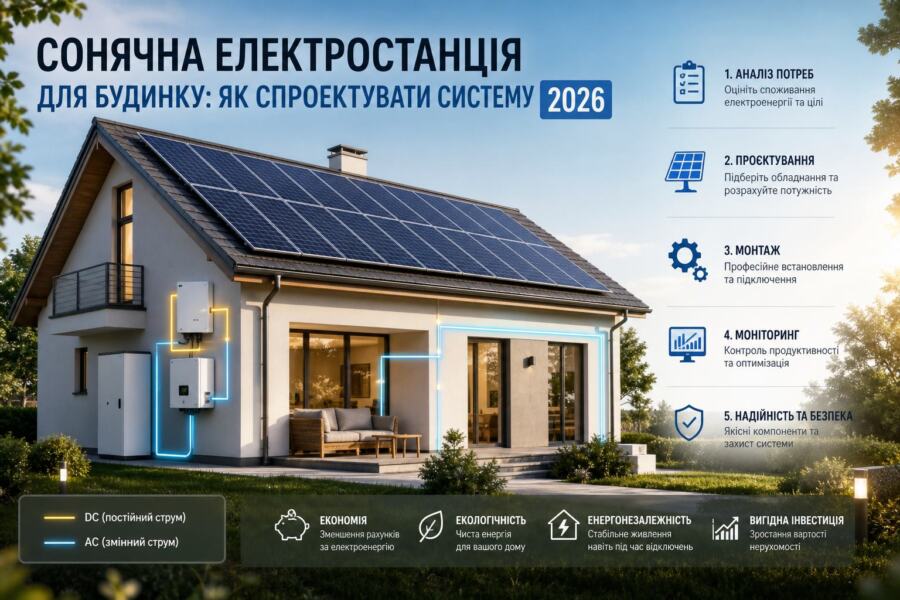
The first step is to create an energy profile for your home. This requires understanding not only your total monthly consumption, but also your peak loads, daily schedule, and critical appliances. For example, heating, boilers, pumps, refrigerators, air conditioners, and electric vehicle charging all generate different power needs.
Next, you need to determine the goal of the system. For some, it is important to simply reduce costs, for others, to obtain autonomous power supply for the house during outages, and for others, to create a reserve with the ability to sell excess to the grid. The configuration of the inverter, batteries, and the number of photovoltaic cells depends on this.
- Network system — works together with the external power grid and reduces consumption from it.
- Autonomous system — does not depend on the network, but requires batteries and precise power balance.
- Hybrid solar station — combines grid, solar and battery operation, providing redundancy and flexibility.
Practical rule: If the house often loses power or has critical appliances, it is better to immediately focus on a hybrid configuration, rather than a purely networked one.
Power calculation: where to start designing
To design the system correctly, you need to take meter data or monthly bills for 12 months. But this is not enough: it is important to take into account seasonality, as in winter generation is lower and consumption is often higher. Therefore, the design for 2026 should be based on the real load profile, not on average assumptions.
As a guideline, a system of 5 to 15 kW is often considered for a medium-sized household, but the exact figure depends on consumption and roof area. If the goal is to cover only daytime consumption, the capacity can be reduced. If the home needs to be powered autonomously at night and during outages, a battery pack is added to the project.
- Determine the average daily consumption in kWh.
- Find the peak loads of the simultaneously turned-on appliances.
- Estimate how much energy is needed at night and during emergency outages.
- Calculate your desired level of autonomy: 4, 8, 12 or 24 hours.
- Select the power of the inverter, batteries, and solar panel array on the roof.
Comparison of types of systems for a private house
| System type | Advantages | Disadvantages | When to choose |
|---|---|---|---|
| Network | Lower cost, simple circuit, high efficiency during the day | Does not work during network outages | If the main goal is to save on bills |
| Autonomous | Complete independence from the network, stability in remote locations | Higher price due to batteries, more complicated calculation | For homes without a reliable grid connection |
| Hybrid solar station | Backup power, flexibility, mains and battery operation | More expensive than network, requires high-quality design | If you need both savings and protection against outages |
Solar panels on the roof: what to check before installation
The roof is not just a place to place modules, but part of the entire energy system. Before installation, it is necessary to assess the load-bearing capacity, angle of inclination, orientation to the south, shading from trees, chimneys, dormer windows and neighboring buildings. Even partial shading can significantly reduce output if the correct connection scheme is not used.
It is also important to consider the roofing material, the condition of the waterproofing and accessibility for maintenance. Solar panels on the roof should be installed in a way that does not create a risk of leaks and at the same time provides a ventilation gap. For complex roofs, it is often advisable to make not the maximum, but the optimal placement of the modules.
- Orientation — preferably south or directions close to it.
- Tilt angle — is selected for seasonal generation and geography of the facility.
- Shading — is minimized even at the project stage.
- Load on the structure — checked before installation begins.
- Service access — must be retained for inspection and cleaning.
How to choose an inverter, batteries and protection
The inverter is the heart of the system, converting direct current from panels and batteries into alternating current for household appliances. It is chosen not only for power, but also for peak current, number of MPPT inputs, compatibility with batteries and the possibility of backup mode. For It is better to take an inverter at home. with a power reserve so that it does not work at the limit of its capabilities.
A battery pack is needed when you plan nighttime consumption, backup power, or full-fledged autonomous power supply for your home. Most often, LiFePO4 batteries are chosen for modern systems because of their durability, stability, and higher useful capacity. But it is important to correctly calculate the energy reserve: a battery that is too small will discharge quickly, and a battery that is too large will unnecessarily increase the budget.
Mandatory safety elements:
- circuit breakers and fuses;
- overvoltage protection;
- grounding and lightning protection;
- cables with appropriate cross-section;
- ventilation for the battery room;
- monitoring system operation via an application or controller.
Ukrainian market overview 2026: current models and estimated prices
A wide range of equipment is available on the Ukrainian market to implement the designed system in 2026. Prices vary depending on the brand, availability of an official warranty, and technical specifications. Below is a breakdown of the main components of a solar power plant with specific models and current price ranges.
1. Solar panels (Photovoltaic modules)
The current standard is monocrystalline panels using N-type technology (in particular TOPCon/HPDC), which have higher efficiency in low or diffuse light and a lower annual degradation rate.
Longi Solar LR5-72HTH (585 W) / LR7-72HTH (615-620 W): high-efficiency panels with a low temperature coefficient, resistant to overheating.
Price: 3,500 – 4,000 ₴ per piece.
Jinko Solar Tiger Neo N-type (575-585 W): one of the market leaders in terms of generation in cloudy weather.
Price: 3,600 – 4,200 ₴ per piece.
JA Solar JAM72D30 Bifacial (530-535 W): double-sided panels. They are advisable to mount on ground metal structures or a light roof, as they provide up to 15–20% of additional generation due to light reflected from the ground or roof.
Price: 3,500 – 3,900 ₴ per piece.
2. Hybrid inverters
The heart of the system, responsible for intelligently managing energy flows between the sun, battery, house and the general grid.
3. Rechargeable batteries (LiFePO4)
Modern home solar power plants use 48 V (51.2 V) lithium iron phosphate batteries. They are safe, do not emit gases, and can withstand more than 6,000 deep discharge cycles (DoD 80–90%).
Deye SE-G5.1 Pro-B / SE-F5 Pro-C (5.12 kWh, 48V): branded low-voltage batteries from Deye. Perfectly synchronized with inverters of the same name via CAN bus, correctly transmitting data to BMS.
Price: 35,000 – 42,000 ₴
Pylontech US3000C (3.5 kWh, 48V): A time-tested modular brand. Convenient for building racks where you can gradually increase capacity by purchasing new units.
Price: 37,000 – 40,000 ₴
Pylontech US5000 (4.8 kWh, 48V): increased capacity in one standard housing.
Price: 51,000 – 55,000 ₴
Dyness BX51100 / HinaESS Hi-5 (5.12 kWh, 48V): popular and reliable modular batteries, which are direct competitors to Deye and Pylontech, but often benefit from a more flexible pricing policy.
Price: 36,000 – 40,000 ₴
Examples of estimates for typical configurations (turnkey)
During the final design, it is worth considering that in addition to the inverter, panels and batteries, the budget of the solar power plant must include: a protection kit (AC/DC circuit breakers, RCDs, fuses, grounding), a special solar cable with a cross-section of 6 mm², holders for panels on the roof (aluminum or galvanized profile) and the cost of installation (usually 15–20% of the cost of iron).
Configuration #1: Optimal single-phase hybrid for 5–6 kW
Designed for complete autonomy of critical lines of the house (pumping station, refrigerators, lighting, Internet, heating boiler automation + alternate switching on of the washing machine or electric kettle during the day).
Hybrid inverter (6 kW, 1 phase): ~45,000 ₴
LiFePO4 battery (5.12 kWh, 1 pc.): ~38,000 ₴
Solar field (10 panels of 585 W, total 5.85 kW): ~38,000 ₴
Cables, fasteners, protective automation: ~20,000 ₴
Installation and commissioning works: ~22,000 ₴
Total system budget: 150,000 – 173,000 ₴ (approximately $3 700 – $4 300)
Configuration #2: Powerful 10 kW three-phase hybrid
A solution for large houses that allows you to practically not limit household comfort during emergency or planned power outages. Provides operation of air conditioners, deep well pumps, air conditioning systems and parallel charging of an electric car from the sun.
Hybrid inverter (10 kW, 3 phases): ~85,000 ₴
LiFePO4 batteries (2 pcs. 5.12 kWh, total 10.24 kWh): ~76,000 ₴
Solar field (18 panels of 585 W, total ~10.5 kW): ~68,000 ₴
Protection kit, reinforced roof structures, switching: ~35,000 ₴
Installation work, transportation costs, installation supervision: ~45,000 ₴
Total system budget: 290,000 – 320,000 ₴ (approximately $7 200 – $8 000)
What parameters are especially important in 2026?
In 2026, the emphasis shifts to energy efficiency, load management, and integration with a «smart» home. The system should not just produce electricity, but also manage consumption: turn on the boiler during peak generation hours, reduce the load in the evening, prioritize critical lines.
Modern solar power plant for home should be scalable. If a family plans to buy an electric car, a heat pump, or expand their living space, it is better to take this into account at the start. Otherwise, you will have to redo the infrastructure, cable routes, and protection.
- Scalability — possibility to add panels or batteries without a complete system replacement.
- Flexible load management — priority for important consumers.
- Monitoring — real-time control of generation, charging and consumption.
- High-quality switching — reliability of switching between the network, inverter and reserve.
Typical design mistakes
The most common mistake is to buy equipment without an accurate energy calculation. As a result, the system may be weak during peak hours or too expensive for actual needs. The second mistake is to ignore shading, which causes some generation to be lost even in good weather conditions.
The role of cables, protection, and proper installation is also often underestimated. Even high-quality solar panels on the roof will not give the expected result if there is a weak connection, an incorrectly selected inverter, or there is no reserve for critical consumers. Design should be systemic, not a set of individual purchases.
- Overestimating or underestimating system power.
- Lack of analysis of shading in different seasons.
- Incorrect choice of inverter for real loads.
- Savings on protection, cables and mounting elements.
- Failure to account for future consumption expansion.
Frequently Asked Questions (FAQ)
Which solar power plant for home is best for backup during outages?
The best solution is usually a hybrid solar station, as it can operate with the grid, batteries, and provide backup power to key consumers.
Can solar panels be installed on a roof without reinforcing the structure?
It is possible only after a technical check of the roof's load-bearing capacity. For light roofs, old buildings or complex structures, a separate calculation is required.
What is more important: more panels or bigger batteries?
It depends on the purpose of the system. For energy savings during the day, panels are more important, while for autonomous power supply of the house at night and during outages, batteries are more important. In most cases, a balance of both components is needed.
A properly designed system provides not only savings, but also manageability, predictability, and comfort. If you immediately take into account the consumption profile, roof features, backup scenarios, and expansion prospects, a solar power plant for a home will operate stably for many years and meet the real needs of the family.