
Useful tips
Battery for a solar station: which one to choose in 2026?


Battery for a solar station in 2026: what to choose for home and business
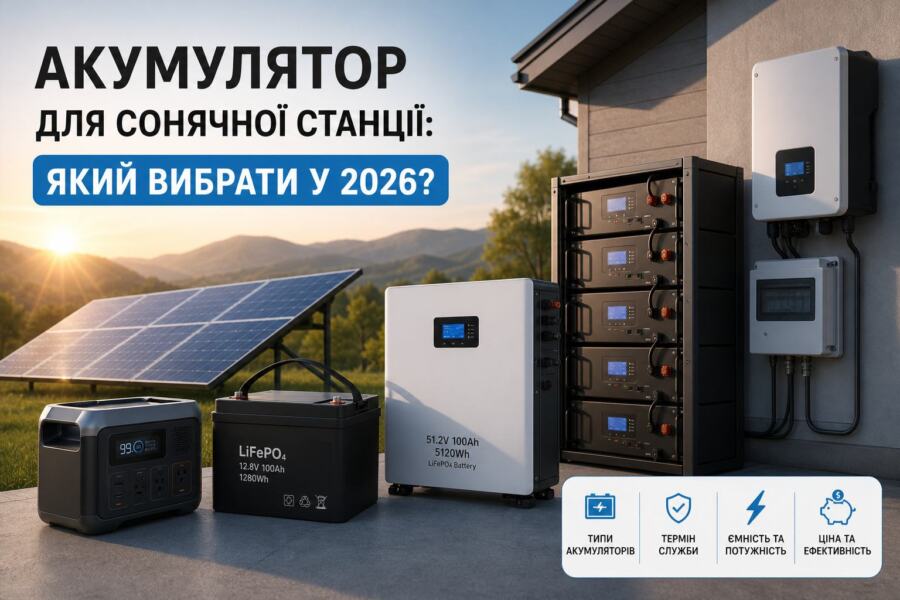
Correctly selected battery for solar station determines not only the autonomy of the system, but also its real economic efficiency. In 2026, the market will be dominated by lithium solutions, primarily LiFePO4 for solar power plants, but in some scenarios gel batteries are still appropriate. The choice depends on the inverter capacity, consumption profile, budget and resource requirements.
If the battery is selected incorrectly, the solar panels will not be able to fully compensate for peak loads, and the inverter will operate unstable. Therefore, before purchasing, it is important to evaluate not only the capacity, but also the permissible charge and discharge currents, the number of cycles, the temperature regime and compatibility with the charge controller.
Which battery for solar panels is relevant in 2026?
Today, the main choice for modern solar power plants is lithium batteries based on LiFePO4 technology. They have high cyclicity, deep discharge tolerance and better energy efficiency compared to lead-acid counterparts. That is why LiFePO4-based solar panel battery is becoming the standard for private homes, offices and small commercial properties.
Gel and AGM batteries have not disappeared from the market, but they are more often chosen for budget or backup systems with moderate loads. They are easier to integrate, but are inferior in resource, depth of discharge and charging speed. If the solar power plant operates daily, and not only in emergency mode, lithium is almost always more profitable in the long run.
Main types of batteries for solar power plants
To avoid overpaying and losing efficiency, it is worth understanding the difference between the main technologies. For solar stations, three categories of batteries are most often considered, each of which has its own strengths and weaknesses.
- LiFePO4 — the best choice for most modern solar power plants due to its resource, safety, and stable operation.
- Gel battery for inverter — an affordable solution for small systems and backup power.
- AGM — a compromise option with an average resource, which quickly loses relevance in large systems.
| Battery type | Cycle life | Depth of discharge | Charging speed | Scope of use |
|---|---|---|---|---|
| LiFePO4 | 4000–8000+ | 80–100% | High | Home, business, daily work of the SES |
| Gel | 600–1500 | 50–70% | Medium or low | Reserve, budget systems |
| AGM | 400–1200 | 50–60% | Medium | Small backup solutions |
Why LiFePO4 for solar power plants became the standard in 2026
LiFePO4 for solar power plants are chosen primarily for their long service life and high stability of operation. Such batteries better tolerate daily charge-discharge cycles, do not lose capacity as quickly as lead-acid counterparts, and maintain a greater useful energy reserve. For the owner, this means fewer replacements and a lower cost of ownership over the entire life cycle of the system.
Another important advantage is its compactness and lower weight. This is especially noticeable when the battery pack is placed in a technical room, closet or limited space. In addition, LiFePO4 works better with modern hybrid inverters and monitoring systems.
- High resource — pays off in systems with daily use.
- Safer chemistry compared to other lithium technologies.
- High efficiency charge and discharge.
- Allows for deeper discharge without significant damage to the resource.
When is a gel battery appropriate for an inverter?
Gel battery for inverter remains a practical option if you need an inexpensive system with low cycle intensity. For example, it could be a summer cottage, a small house with infrequent outages, or backup power for individual consumers. In such cases, the overpayment for LiFePO4 is not always economically justified.
At the same time, gel models have important limitations. They do not like high charging currents, tolerate deep discharge worse and restore energy reserves from solar panels more slowly. If the system is operated daily or has significant peak loads, their resource decreases quickly.
How to choose the right battery capacity
You shouldn't choose the capacity "with a margin by eye." You need to base it on daily consumption, the number of days of autonomy, and the permissible depth of discharge. For battery for solar station An error in calculation can lead to the system being either too expensive or not covering real needs.
For an initial assessment, it is convenient to follow this logic: first determine the daily consumption in kWh, then add a reserve for the night and cloudy days, and then take into account the inverter efficiency and the permissible battery discharge. For LiFePO4, the capacity reserve can be planned more precisely, since this technology works stably with deeper use.
- Calculate the average daily electricity consumption.
- Determine how many hours or days the system should operate without the sun.
- Check the permissible depth of discharge of the selected battery.
- Compare the battery charging current with the capabilities of the controller and inverter.
- Leave a margin for future load expansion.
What to look for before buying
The same capacity on the label does not guarantee the same practical efficiency. Two 100 Ah batteries may have different life spans, different current limits and different behavior under load. Therefore, you need to check not only the numbers in the characteristics, but also the quality of the BMS, the reputation of the brand and compatibility with your inverter.
- System voltage — 12, 24, 48 V or higher, depending on the project.
- Maximum charge and discharge current — critical for powerful inverters.
- Availability of BMS — mandatory for LiFePO4.
- Operating temperature range — important for unheated rooms.
- Solar controller compatibility — especially for non-standard configurations.
What is better for home and what is better for business?
For a private house in 2026 year, LiFePO4 is often the best choice for solar power plants with a properly selected BMS and inverter. Such a system works stably every day, provides high autonomy and does not require frequent maintenance. If this is a temporary or backup solution, you can also consider gel batteries.
For business, the requirements are even stricter: the predicted resource, high efficiency under load and the possibility of scaling are important. In commercial projects, lead-acid technologies are almost no longer able to compete with lithium ones. That is why modern battery for solar panels in the business segment, these are most often LiFePO4 modules.
Frequently Asked Questions (FAQ)
Which battery for solar station is the best in 2026?
The best all-round choice is LiFePO4. It has a longer lifespan, higher efficiency and is better suited for daily solar power plant operation.
Can a gel battery for an inverter be installed in a modern solar system?
Yes, if the system is standby or operates with a small load. But for daily cyclic use, gel batteries are less profitable than LiFePO4.
How long does LiFePO4 last for solar power plants?
On average, 4,000–8,000 cycles or more, depending on cell quality, depth of discharge, and operating conditions. This is significantly longer than most lead-acid solutions.