
Useful tips
How to clean solar panels: engineer's tips for safe care

A solar panel only works stably when its surface allows maximum light to pass through. Any layer of dust, snow, soot, bird droppings or mineral deposits reduces the output. In practice, even a thin film of dirt can take away from 5% to 20% generation, and with dense pollution - even more.
Question, how to wash solar panels, at first glance simple, but a mistake in care can easily turn prevention into repair. The wrong water, a stiff brush, pressure washing, working on a hot surface or without power can damage glass, seals, cables and connectors.
For a private home, farm, warehouse or commercial facility service solar power plants should be regular and technically competent. Cleaning is not «cosmetic» - it is part of energy efficiency and safety.
It is especially important to understand, Why is the power dropping? solar panel not only in summer, but also in winter. A decrease in generation can be caused by dirt, shading, icing, snow, element degradation, problems with the inverter or cable connections. Therefore, maintenance is not a single action, but a system of checks.
What exactly reduces the output of solar panels?
The most common cause is banal pollution. Road dust, salt from winter snowpack, industrial deposits, pollen, leaves, and dirt from rain from roofs accumulate on the glass and create shading. If the array is installed at a small angle, the water after rain does not wash away the dirt completely, but leaves stains.
The second reason is local shadows. Even a small shadow from a pipe, antenna, branch, or snowdrift can reduce the return of an entire string of cells. In series-connected systems, one weak spot pulls down the entire chain.
The third factor is temperature. In the heat, modules work worse, so overheating due to dirt, poor ventilation under the array, or improper installation also eats up power. If you notice a steady drop in generation for no apparent reason, you should check not only the cleanliness, but also the contacts, MC4 connectors, cable routes, and inverter parameters.
The practical guideline is simple: if a panel looks «almost clean,» it does not mean that it is performing at its rated capacity. In real-world conditions, the difference between an ideal and a dirty surface can easily add up to losses over months, not days.
How to clean solar panels without risking damage
You should start with safety. Before any maintenance, you need to limit access to the electrical part, follow the manufacturer's instructions and work when the modules are not heated by the sun. Ideally, early in the morning, in cloudy weather or after sunset. Hot glass experiences thermal stress when in contact with cold water.
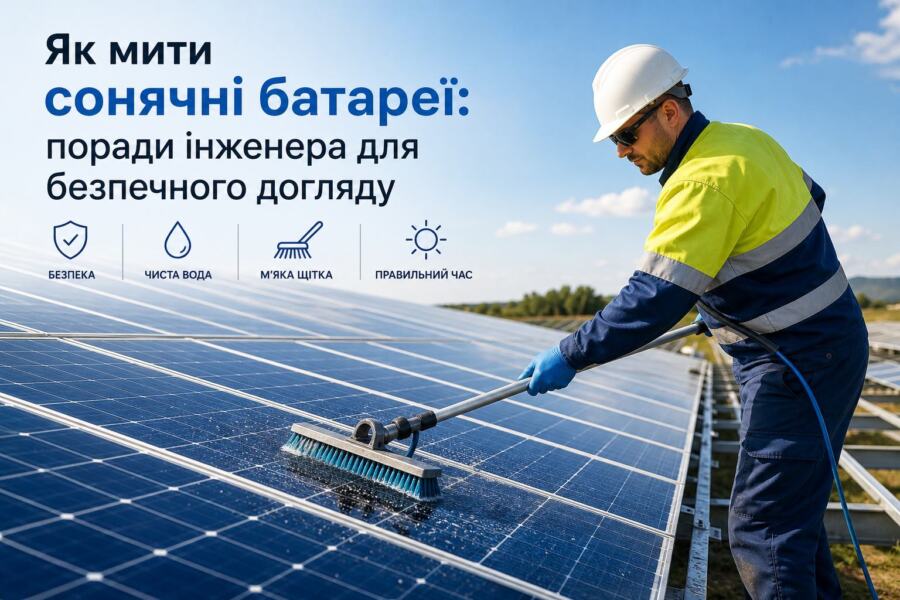
For basic cleaning, soft water, a sponge or brush with a non-aggressive bristle, and a weak, low-pressure jet are sufficient. Hard abrasives, metal scrapers, dry rags with sand, household chemicals with ammonia or acids can damage the anti-reflective coating. The glass will then lose some of its light transmission forever.
The optimal order of work: first wash off loose dust, then carefully remove stubborn stains, then rinse with clean water without detergent residue. If the water is hard, salt stains will remain on the glass. For large stations, it is better to use demineralized water.
It is especially important not to pour water into connectors, junction boxes and cable entry points. This is where hidden defects most often appear after improper care. For an engineer, the main criterion is not "to make it shine", but to ensure that the unit remains airtight and functional.
| Method | Advantages | Risks |
| Soft water + sponge | Safe glass cleaning | Access to panels required |
| High pressure washer | Quickly | Damage to seals, leaks |
| Dry wiping | Without water | Scratches from dust and sand |
.
Cleaning solar panels in winter: what is allowed and what is prohibited
Cleaning solar panels in winter has its own specifics. The main problem is snow, ice and low temperature. If the snow layer is dense, the module may not produce energy at all. But it should be cleaned very carefully: a hard shovel, a metal scraper or a blow to the glass can leave microcracks.
A safe option is a soft brush with a telescopic handle or a special plastic scraper without sharp corners. If the snow is dry and loose, you can gently sweep it away. If it is an ice crust, it is better not to peel it off with force: the risk of damaging the module is higher than the potential benefit of a few hours of generation.
In winter, you should not pour warm or hot water on the panels. A sharp temperature drop leads to micro-damage to the glass and sealant. It is also undesirable to use salt, reagents or any abrasive mixtures - they leave marks and accelerate the aging of the surface.
On steep-angled roofs, it is sometimes sufficient to simply wait for the snow to melt naturally. In many cases, proper installation with the correct slope and without unnecessary shadows will reduce the need for manual intervention. But if the system is critical for autonomous power supply, winter maintenance should be scheduled.
What to wash, how often and what tools to use
The frequency depends on the installation location. In a city, near a highway or industrial area, modules become dirty faster. For a private home, it is usually enough to inspect several times a year and wash as needed. For commercial facilities, the schedule should be more regular, because even a small drop in production translates into direct financial losses.
A practically safe set of tools: a soft brush, a non-abrasive sponge, a bucket of clean water, a hose without strong pressure, microfiber for extreme cases, gloves and safety equipment for working at height. If you have access to demineralized water, that's a plus.
It is undesirable to use household glass cleaners if they contain aggressive components. Also, you should not use hard car brushes if they have sand on them. One wrong move and scratches will appear on the glass, which will accumulate dirt even faster over time.
For large service facilities solar It is better to plan power plants according to the regulations: visual inspection, control of fasteners, checking the voltage of the circuits, inspection of the inverter, cleaning of surfaces and recording the results. This allows not only to clean, but also to see the degradation trend.
Typical mistakes of owners and real consequences
The most common mistake is to wash in direct sunlight in the heat. At this point, the glass is heated, the water evaporates quickly, stains remain on the surface, and sudden contact with cold water creates thermal stress. It is better to work in the evening or early in the morning.
The second mistake is using a high-pressure washer. The module may look undamaged from the outside, but pressurized water gets into micro-cracks, washes away the sealant, corrodes the contacts, and accelerates failure. This is especially critical for roofs and equipment that operates year-round.
The third mistake is trying to «restore» the panel by polishing. The anti-reflective coating is not intended for abrasive treatment. After such a loss, it may be irreversible, and guarantee — lost.
The fourth mistake is to ignore periodic inspection of the electrical part. If after washing the generation has not resumed, the reason may not be dirt, but connections, shading or a malfunction of the inverter. That is why the question Why is the power dropping? solar panels It is necessary to consider it comprehensively, and not just look for visible dust.
When to get a professional inspection and what to check along with the wash
A professional inspection is recommended after strong winds, hail, dust storms, prolonged snowfalls, or if the system suddenly loses some of its output. In such cases, it is necessary to check not only cleanliness, but also fastening, glass integrity, cable condition, connector tightness, insulation resistance, and inverter operation.
For self-powered facilities, it is especially important to check the battery pack, if the system has one. A fault in an adjacent circuit may look like "dirty panels," although the cause is completely different. In solar energy mistake Diagnostics often costs more than the washing itself.
If the modules are installed high, on a large area or on a complex roof, it is better not to take risks. Working at height without insurance is dangerous, and improper access can damage both the panels and the roof. In such conditions, it is more practical to involve a service approach than to carry out artisanal cleaning.
For a technically literate owner, the main criterion is simple: a clean panel is good, but a working system is more important. That's why maintenance of solar power plants should include both visual inspection and electrical control.
Practical conclusion
For the system to work stably, you need to not only know, how to clean solar panels, but also to adhere to safe technology: soft tools, no pressure, no abrasives, no overheating of the glass and no risk to tightness. Cleaning solar panels in winter are performed even more carefully, without ice, salt, and sudden temperature changes.
Regular inspection, generation control and timely maintenance of solar power plants give more effect than the occasional "wash when dirt is visible". If the product has fallen, you need to check the entire link: surface, shadows, connections, inverter and fasteners. For a safe and long-lasting result, the electro shop advises to act according to the technical regulations, and not by eye.