
Useful tips
IP camera lens: how to choose focal length and viewing angle


A correctly selected IP camera lens determines not only the width of the scene, but also the real suitability of video surveillance for security. The same camera with different focal lengths can either monitor the entire yard or clearly show a face at the entrance. An error in the selection of optics often costs more than the camera itself: there is a recording, but it is impossible to identify a person.
In security practice, the main parameter is not “how many megapixels”, but what fragment of space falls into the frame and with what level of detail. That is why focal length cameras observation and the viewing angle should be assessed before purchase, not after installation. For an apartment, shop, warehouse or private house, the tasks will be different.
Most often, the choice comes down to two popular options: viewing angle cameras 2.8 or 4 mm. The difference between them seems small only on paper, but in reality it is critical for door, parking space, corridor or perimeter control. The wrong choice leads to either a too wide but “small” image, or a narrow frame where important events are lost at the edges.
To choose optics without mistakes, you need to understand the basic principles: how it works ip lens cameras, which gives a small and large focus, how the mounting height, distance to the object, lighting and resolution affect. For the home or business owner, this means a simple rule: the camera should not just “see”, but perform a specific task - surveillance, access control or recognition.
How focal length affects the picture
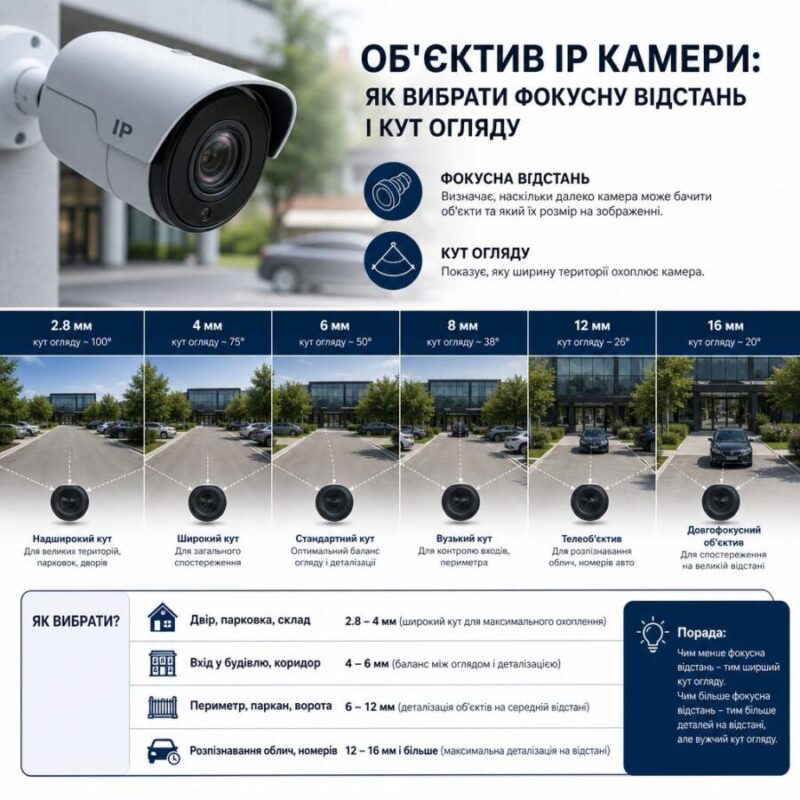
Focal length is the distance from the optical center of the lens to the sensor, which directly determines the scale of the object in the frame. The smaller the value, the wider the angle of view and the more of the scene is captured in the image. The longer the focal length, the narrower the angle and the better distant objects are visible.
The most common fixed lenses for surveillance cameras are 2.8 mm, 3.6 mm, 4 mm, 6 mm, 8 mm. Conventionally: 2.8 mm — this is a broad overview, 4 mm — a compromise between frame width and detail, 6 mm and more — for targeted control of a separate area. If you need to cover a room or an entrance group, short-focus optics will win. If you need to see a car license plate at a certain distance — a different logic is needed.
In practice, one camera with 2.8 mm at the entrance may show the entire site, but the faces at the edge of the frame will be small. The same model with 4 mm will give less of a “panorama”, but will increase the people in the center and make identification easier. This is the key to the choice: first determine what is more important - the area or the detail.
Marker: .
Camera viewing angle 2.8 or 4 mm: what to choose
It is convenient to compare the two popular tricks through the task. For a corridor, small shop, children's room, office reception or entrance door, 2.8 mm is often enough. For an entrance, yard, garage entrance, checkout area or small warehouse, 4 mm is often better.
| Parameter | 2.8 mm | 4 mm |
| Viewing angle | wider | narrower |
| Detailing at a distance | lower | higher |
| Best scenario | area control | face and access control |
| Typical mounting height | 2.2–3 m | 2.5–4 m |
If the camera is placed above the door and you need to see everyone who approaches the entrance, 2.8 mm are often more convenient. But when faces need to take up more pixels, 4 mm gives a better result. This is especially noticeable in an electronics store or other retail space: a wide-angle camera shows the room well, but does not always allow you to make out facial expressions or small actions near the shelf.
A typical mistake is to take the “maximum wide” option so that “everything fits in”. As a result, the recording shows a lot of space, but people are like small figures. For security, not just landscapes are important, but useful information: who entered, where they went, what they took, whether there was access to the door or cash register.
Another mistake is to expect high resolution to correct poor focus. 4 MP or 8MP really adds detail, but they don't change the geometry of the scene. If the camera looks too wide, faces can still be small. So the lens and sensor have to work together, not separately.
How to choose a facial recognition camera
How to choose facial recognition camera — it's not just about megapixels. For a stable result, the face should occupy a sufficient part of the frame, be without strong backlight, without motion blur, and without excessive camera tilting downward. If a person enters the frame at a high angle from above, part of the facial features are lost.
For the entrance to a house or office, it is advisable to orient the camera so that the face passes a few meters away and is not too small. Narrower viewing angles work better here, often 4 mm or even more, depending on the distance. To control faces, it is not enough to simply “look at the door” - you need to adjust the observation point so that the object is in the center of the frame, not on the edge.
У in a store or warehouse To recognize people at the cash register or checkout point, a separate camera is often placed: one for general viewing, the other for the identification zone. This is a more correct scheme than one universal camera “for everything”. At a separate point, you can select the focal length of the surveillance cameras for a specific distance and not sacrifice quality.
A practical guideline: if the camera is 2–4 m from the face, it is often enough 2.8 mm for general control and 4 mm for better detail. If the distance is greater, more precise optics or a camera with a varifocal lens are needed. It is also important to consider lighting: in a dark corridor, even the correct focus will not save you if there is no high-quality IR illumination or normal light.
Practical scenarios for home, apartment and business
For a private house, control of gates, gates, parking, entrance and backyard is most often required. On the perimeter, wide optics are convenient to cover more territory, and at the entrance - a more “aimed” camera. That is, one system can contain 2.8 mm, 4 mm, and 6 mm, depending on the task.
For an apartment, the main focus is the front door, the hallway and, if necessary, the kitchen or windows. Here, very long focal lengths are usually not needed. A camera with 2.8 mm often provides sufficient control of the room, and for a vestibule or doorway the best solution would be 4 mm, if it is important to recognize the faces of guests.
For business, the logic is different. A store needs separate zones: entrance, cash register, sales floor, warehouse, service exit. At a cash register or access point, recognition is more important than a wide view. In a hall, on the contrary, it is important to see all the movement. In warehouses, the critical zone is the gate, loading and aisles between racks, where more precise optics work better.
In real life In editing, the “one camera” scheme often wins. — one scenario.” For example, a camera is placed near the front door with 4 mm, and for the yard - a model with 2.8 mm. This approach provides both territory control and normal identification of people without unnecessary system overload.
Installation, height and common mistakes
Focal length only works in conjunction with the correct mounting height. If the camera is mounted too high, faces in the frame will be distorted due to the downward angle, and small objects will lose detail. For entrances and identification areas, it is usually better to place the camera lower and closer to the person's path of movement.
Another important factor is the direction of the sun and the lighting. Even a good ip camera lens will not help if bright light from a window or gate constantly enters the frame. In this case, you need to change the installation angle, use WDR and consider protection from direct light.
For power supply, installation discipline is also important. If used 12V, you need to choose the right power supply for the current and avoid large voltage drops on long cables. For network systems PoE more convenient, because it simplifies wiring and increases reliability. In large installations, you should not pull the power supply chaotically: this provokes unstable operation, especially outdoors and in cold weather.
To avoid mistakes, it is worth remembering a few practical rules:
1. Do not place the wide-angle camera too far from the subject if faces are needed.
2. Don't expect 8MP to automatically replace the correct focus.
3. Do not mount the camera at a strong downward angle unless absolutely necessary.
4. Don't skimp on lighting in dark areas.
5. Do not mix the tasks of “surveying the territory” and “recognition” at the same point, if it can be separated.
How to read specifications before buying
Before choosing a camera, it is important to look not only at the model name, but at the full set of parameters: focus, viewing angle, resolution, matrix type, IR range, WDR, microphone availability, power supply and connection method. This is how equipment is selected in a professional online electronics store, and not “by a pretty picture” from the product card.
If the description only states “wide angle” without a specific focal length, this is not very informative. For a clear choice, you need numbers: 2.8 mm, 4 mm, 6 mm etc. It is also important to look at the declared operating mode: for the street - body protection, for night shooting - backlight, for the office - recording quality in the desired area.
From a technical point of view, the most reliable approach is to first draw a diagram of the object: where there will be entrances, where people will move, where recognition is needed, and where general control is enough. After that, select a specific camera model and lens. This sequence reduces the risk of buying the “wrong” viewing angle and then having to redo the installation.
Practical conclusion
For most tasks, the choice comes down to a simple principle: 2.8 mm — when a broad overview is needed, 4 mm — when details are more important, especially faces and movement in the passage area. The focal length of surveillance cameras should be selected for a specific distance to the object, installation height and lighting conditions. If the task is recognition, do not save on the right optics: the best result is not given by the “cheapest camera”, but by a competently selected IP camera lens and the right installation location.