
Useful tips
Mini ups for routers: why cheap models fail quickly


Mini ups for the router often bought “on the spur of the moment”: so that the Internet does not disappear during outages, so as not to reboot the router after each blackout and not to drag a large UPS to it. The idea is really convenient, but this is where many people fall into the trap: cheap ups It works fine on the outside, but after a few months, voltage drops, short battery life, overheating, or complete failure begin. The reason is almost always the same - saving on batteries, circuitry, and protections.
In order not to buy a device “for one season”, it is important to understand how it works. mini ups for the router, why is it so important in it 18650 battery, and which UPS malfunctions most often occur in budget models. For a home user, this is not just a technical issue: a low-quality mini-UPS can not only discharge earlier, but also damage the router, ONU terminal or modem due to unstable voltage.
Why mini UPS has become so popular
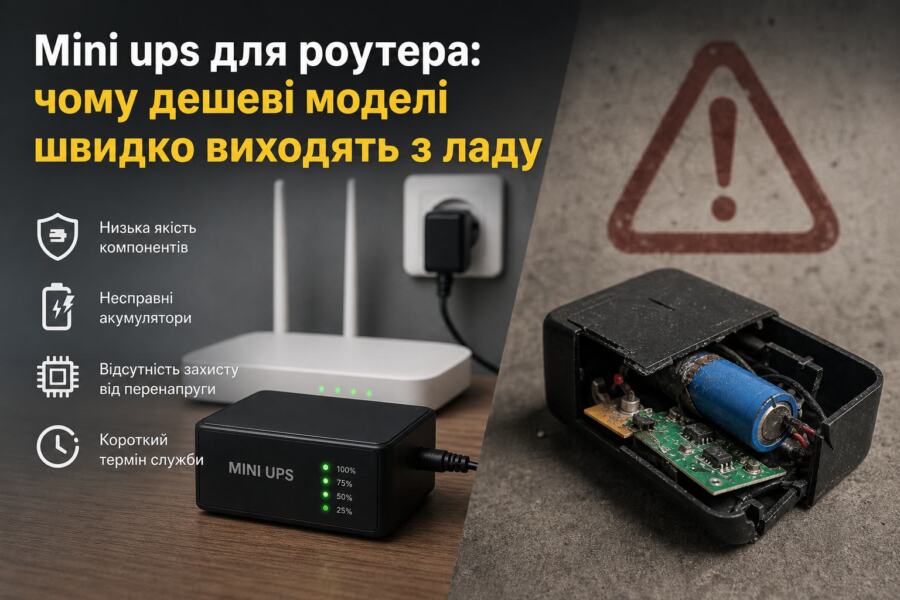
For a home network, backup power is no longer a luxury, but a practical necessity. A router, optical terminal, IP camera, or smart home hub often needs to operate continuously. That is why mini ups for the router has become so popular: it is compact, quiet, does not require a separate room like a generator, and is easily connected between the power supply and the consumer.
But behind the simple form lies an important difference between a quality device and a problematic cheap model. A normal mini UPS has:
- to hold steady 12 V, 9 V or 5 V depending on the load;
- automatically switch when the network disappears;
- have protection against overcharging, deep discharge and short circuit;
- not to overheat during long standby mode;
- work with the declared capacity not only “on the box”, but also in real conditions.
It is at these points that cheap solutions “fall”.
How does a mini UPS work and where is its weak point?
Essentially, a mini-UPS is a small backup power supply unit with a battery, a charge controller, a switching circuit, and a boost or buck converter. In normal mode, it powers the router from the mains and simultaneously charges the battery. When the electricity goes out, the device automatically switches to battery power without interruption or with minimal failure.
Most often, the weak point is the power part. If a cheap one is installed 18650 battery of unknown origin, the actual capacity may be half or even three times less than the declared one. For example, the case says “8800 mAh”, but in fact there are cells with real 1200–1800mAh. As a result, the router, which should work for 4–5 hours, turns off after 40–60 minutes.
Another problem is saving on the control board. Cheap circuits often use simple components without proper heat dissipation and without sufficient current reserve. This leads to typical UPS malfunctions: unstable voltage, “dumps” at peak load, coil squeak, strong heating and battery degradation.
Why cheap models fail quickly
The lifespan of a cheap backup power supply is usually shortened not by a single defect, but by a combination of small flaws. The most common reasons are:
- Questionable batteries. Many budget models use unbranded 18650 cells with inflated capacity and poor current output.
- Lack of normal charge balance. If there are several elements inside, and the balancing is weak or absent, one element will age faster than the others.
- Weak voltage converters. A cheap DC-DC module may not be able to withstand the real current of the router, especially if a camera or ONU is also connected to it.
- Poor cooling. Components are working at their limits, heat builds up, and the life of electrolytic capacitors drops.
- There is no complete protection. After a deep discharge, the battery degrades quickly, and sometimes the board itself fails.
- Inflated specifications. The label may say “36W”, but in reality the device only consistently holds 12–15W.
A separate problem is the cheap power adapters that come with such devices. If the power supply sags in voltage, the UPS starts charging the battery incorrectly, which shortens its life even when electricity is almost constantly available.
18650 battery: why it determines the resource
18650 battery — The most common format of lithium-ion cells in compact UPSs. Its popularity is explained simply: sufficient energy density, relatively small size and ease of mass production. However, this is often where the main problem of budget devices lies.
What you should know about 18650:
- the real quality of the item is more important than the nominal number on the sticker;
- a normal element has passport characteristics, internal resistance and a clear origin;
- “no name” batteries can lose capacity after just a few cycles;
- Bad cells do not hold the load well, which can cause the UPS to shut down earlier than expected.
For example, a router consumes 6–10 W, and ONU still 5–8 W. If a mini UPS is declared at 20W, but it has weak 18650s, during peak load the voltage may “sag”, and the device will start to reboot. From the user’s side, this looks like mysterious instability of the Internet, although The reason is a weak battery..
Signs of poor quality 18650 battery in the mini UPS:
- very fast discharge even at low load;
- strong heating during charging;
- noticeable loss of battery life after 2–3 months;
- uneven operation after full charging;
- the battery swells or changes shape.
Importantly: If the case starts to heat up more than usual or there is a smell of electronics, it is better to turn off such a UPS immediately.
Typical UPS faults in cheap mini UPSs
When users complain about UPS malfunctions, most often do not mean a complete breakdown, but unstable behavior under load. This may be an imitation of proper operation, when the indicators are lit, but the power supply is actually “floating”.
The most common symptoms are:
- The router reboots when the power goes out.
- Working time is half as long, than promised by the manufacturer.
- UPS keeps beeping or it heats up even without turning off.
- After a few months the battery stops charging to full level.
- The output voltage is “walking”, which makes the router unstable.
In practice, it often looks like this: a person buys cheap ups for router, connects everything correctly, but at the first long disconnection the internet disappears after an hour. After that it turns out that the device is not designed for real load, and inside there are elements of dubious quality.
| Sign of a problem | Probable cause | What to do |
|---|---|---|
| Fast discharge | Weak 18650 battery or overrated capacity | Check the actual capacity, replace the elements with high-quality ones |
| The router is rebooting. | Voltage sag at peak current | Reduce the load or choose a UPS with more power reserve |
| Strong heating | Board overload, poor cooling | Do not operate the device further, check the power compliance |
| Does not charge fully | Problem with charge controller or power supply | Check the adapter and charging board |
How to choose a mini UPS for your router without disappointment
To avoid buying a device that will break in a few months, focus not on price alone, but on features and design. Too low a price almost always means a compromise: either weak batteries, or a bad board, or both.
When choosing, pay attention to the following parameters:
- Output voltage: 5V, 9V, 12V or universal outputs - must match your equipment.
- Power: with a margin of at least 20–30% from actual consumption.
- Battery type and capacity: preferably a clear origin 18650 or other quality battery.
- Switching time: the smaller, the better for the router and optical terminal.
- Protect: from overcharging, overdischarging, short circuit, overheating.
- Cooling system: even passive cooling must be thought out.
A rule of thumb: if your router consumes up to 10 W, and ONU before 8 W, you shouldn't take the UPS "up close". It's better to have a power reserve than to constantly work at the limit. It is working at the limit that kills cheap micro-UPS the fastest.
Common user mistakes that accelerate breakdowns
Even a good backup unit can be ruined by improper use. This happens even more often with cheap models, as they are less forgiving of mistakes.
- Connecting a “foreign” power supply. If the adapter has the wrong voltage or low current, the UPS will operate unstable.
- Overload. To one mini UPS connect router, ONU, camera, amplifier and several other small consumers.
- Storage in the heat. Lithium-ion cells really don't like high temperatures.
- Continuous deep discharge. If the battery is regularly drained, its lifespan decreases faster.
- Ignoring overheating. If the case is hot, this is not “normal,” but a signal of a problem.
A particularly dangerous habit is to leave a cheap UPS under load continuously without checking the temperature. If the device is only slightly warm, that's normal. If it's so hot that it's uncomfortable to touch, the life of the components is already reduced.
How does a cheap UPS differ from a normal one?
The difference between a high-quality and a budget device is often not external, but internal. Both may have a similar body and the same advertising promise, but the actual behavior will be completely different.
A normal mini UPS usually has better:
- voltage stabilization components;
- charging control;
- protection against emergency modes;
- soldering quality and thermal paths on the board;
- the quality of the power supplies themselves.
У cheap ups Savings usually manifest themselves in such little things:
- thinner conductors and weak connectors;
- lack of real current reserve;
- exaggerated capacity figures;
- simple controller without adequate protection;
- minimal testing before sale.
If you need truly uninterrupted Internet operation, it is better to buy a model with decent specifications once than to change inexpensive “disposable” solutions several times.