
Useful tips
Backup power for an apartment without a generator: how to organize it correctly


Backup power supply for the apartment without a generator is a very real solution if you correctly assess your needs, select the equipment and do not try to “start everything at once”. Most city apartments do not need a noisy gasoline unit: a competently assembled circuit based on UPS for home, battery, inverter for home or compact energy independence systems. This approach allows you to support lighting, internet, router, laptop, phone charging, sometimes a refrigerator and even a boiler, if the system is designed correctly.
The problem is that most people buy equipment “by sight”: they take a weak UPS for a PC, connect a refrigerator to it, and then wonder why it turns off. Or they buy a large inverter, but forget about a battery of sufficient capacity. The result is the same - money is spent, and the backup power supply works unstable. To prevent this from happening, it is important to understand what kind of loads you want to support, how many hours it should work, and what type of backup is suitable for the apartment.
What is backup power for an apartment and what tasks does it solve?
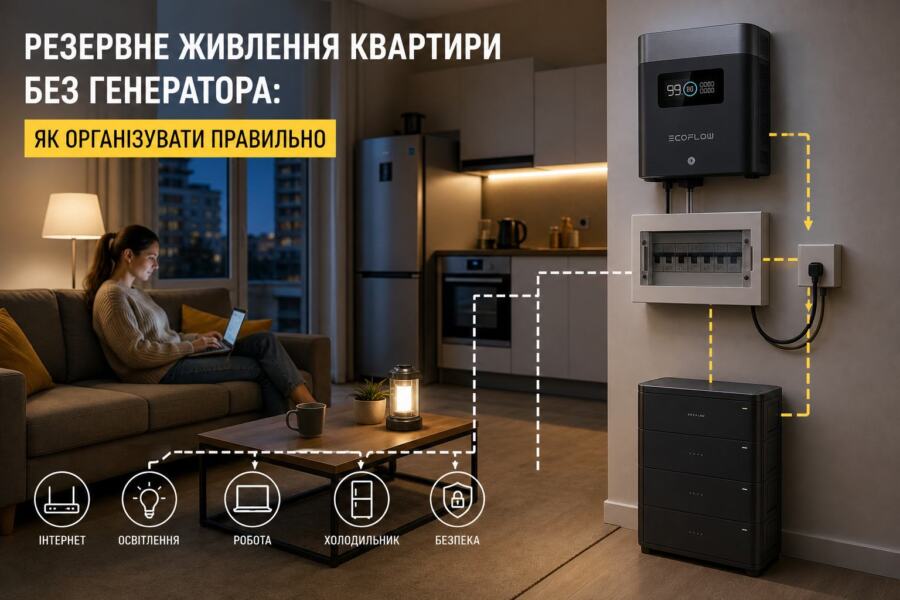
Backup power supply for the apartment — is a system that automatically or manually picks up the load when the 220 V network is disconnected. It can provide operation of individual consumers or the entire important circuit of the apartment: Internet, lighting, security alarm, circulation pump, gas boiler, medical equipment, chargers, and household electronics.
The main goal of such a system is not to create full autonomy for a week, but to provide comfort and safety during short and medium-term outages. For an apartment, this is usually the most rational scenario. Full autonomy with large batteries and a powerful inverter is also possible, but it is more expensive, more complex and requires more space.
In practice, backup power solves several problems:
- supports communication and access to the Internet;
- allows you to work or study from a laptop;
- maintains lighting in rooms and corridors;
- helps power the boiler or pump if necessary;
- protects equipment from sudden voltage drops;
- gives you time to turn off appliances without panic if the shutdown is delayed.
Looking at it pragmatically, what is most often needed in an apartment is not a “home generator,” but a well-thought-out backup circuit for 2–8 hours for critical devices.
What backup power options without a generator actually work?
Three solutions are most often used for apartments: UPS, inverter for home battery-powered and compact Mini UPS. Each option has its own niche.
1. Mini UPS — is a small backup unit for a router, ONU, video surveillance cameras, and sometimes a modem. It is cheap, compact, quiet, and very convenient for the Internet. But its power is small, so it cannot power an iron, refrigerator, or kettle.
2. UPS for home — is a mid-range solution suitable for PCs, routers, boilers, lighting and some household loads. Depending on the type, the UPS can be offline, line-interactive or double-conversion. For apartments, inverter UPSs or line-interactive models for sensitive equipment are usually most often used.
3. Home inverter + battery — the most universal scheme. It allows you to independently choose the battery capacity, inverter power and list of consumers. It is this configuration that most often becomes the basis of practical energy independence systems in the apartment.
In short: for the Internet - Mini UPS, for a small set of equipment - UPS, for a flexible and scalable solution - an inverter with a battery.
How to correctly determine what exactly needs to be fed
The biggest mistake is to try to reserve the entire apartment without calculations. First, you need to make a list of consumers who really matter during a power outage. Not all equipment needs to be powered at the same time.
It is convenient to divide the load into three categories:
- Critical — Internet, router, lighting, boiler, pump, security.
- Desirable — TV, laptop, chargers, small refrigerator.
- Undesirable for reserve — boiler, electric stove, heaters, washing machine, kettle, hairdryer.
It is based on this classification that the apartment's backup power supply is built. If you try to turn on powerful heating devices in the backup, the battery will drain very quickly, and the inverter may go into protection.
Example: router consumes 8–15 W, optical terminal — 5–10 W, LED lighting in the room — 10–40 W, laptop — 40–90 W. Together it can only be 100–150 W, and such a scheme does not require a bulky station. But if you add a refrigerator, starting currents appear, and a different level of equipment is required.
How to calculate inverter power and battery capacity
That inverter for home worked stably, you need to choose it with a power reserve. For small-scale apartment tasks, it is often enough 600–1000 W, but it depends on the composition of the load. If a refrigerator or boiler is planned, the reserve must be increased.
There is a simple rule: the inverter must have a margin of 20–30% from the actual total load, and for devices with starting currents - even more. A refrigerator, pump, compressor or some boilers can briefly consume several times more than the nominal.
For a battery, it is not only the capacity in ampere-hours that is important, but also the actual energy in watt-hours. For example, 12 V battery 100 Ah has a nominal value of approximately 1200 Wh, but less is actually available due to inverter losses and depth of discharge limitations. If it is a lead acid battery, the usable capacity may be around 500–700 Wh. The situation is better for LiFePO4 - much more is available.
The approximate calculation logic is as follows:
- sum up the power of all devices that will operate simultaneously;
- multiply by the number of hours of autonomy;
- add a margin for inverter losses;
- take into account the battery type and permissible depth of discharge.
For example, if the total load is 120 W, but autonomy is needed 5 hours, then you need at least 600 Wh useful energy. Taking into account losses and reserves, it is advisable to look at the battery for no less than 800–1000 Wh.
Comparison of basic solutions for an apartment
| Decision | What is it suitable for? | Advantages | Limitation |
|---|---|---|---|
| Mini UPS | Router, ONU, cameras | Compactness, quiet operation, low price | Low power, not for household appliances |
| UPS for home | PC, boiler, lighting, network equipment | Automatic switching, failure protection | Limited autonomy without an external battery |
| Home inverter + battery | Comprehensive backup power supply for the apartment | Flexibility, scalability, greater autonomy | Requires competent installation and calculation |
| Portable charging station | Small household loads, mobile scenario | Simplicity, a ready-made solution | Higher price per kWh, limited maintainability |
Which battery to choose: lead-acid or LiFePO4?
For energy independence systems In an apartment, either lead-acid or lithium-iron-phosphate batteries are most often used. And the difference here is not only in price.
Lead-acid batteries cheaper at the start, but have a shorter lifespan, are heavier, do not tolerate deep discharges well, and require more careful operation. They can be considered if the budget is limited and autonomy is not needed every day.
LiFePO4 more expensive, but last longer, withstand cycles better, are lighter and have a higher useful discharge percentage. This is a very practical option for an apartment, especially if power outages are frequent or a compact solution is needed.
What to pay attention to when choosing:
- system voltage: 12 V, 24 V or 48 V;
- permissible charge and discharge current;
- cycle life;
- availability of BMS in lithium batteries;
- warranty and compatibility with an inverter or UPS.
If the system is planned for longer use, it is better to immediately look towards LiFePO4. It is more expensive at the start, but is often more profitable per cycle and per year of operation.
How to organize backup power without a generator in practice
The most convenient scheme for an apartment looks like this: 220 V network → protection → inverter or UPS → load that needs to be backed up. The battery is connected to the inverter or to special UPS equipment. In the event of a power outage, the source automatically switches to the battery.
In practice, three scenarios can be distinguished:
- Only internet and communication — Mini UPS for router and ONU.
- Critical household loads — UPS for the boiler, router, and part of the lighting.
- Full backup circuit — a home inverter with a battery and a separate line to important outlets.
The latter option is best suited for those who want to really control the load. For example, you can separate outlets for a router, laptop, chargers, and lighting. Then, during a power outage, there is no temptation to plug a kettle into the same line and “land” the battery in 10 minutes.
For convenience, it is worth considering:
- a separate reserve group consumers;
- automatic or manual switch power sources;
- overload protection and short circuit;
- battery charge control;
- ventilation for the battery pack.
Typical mistakes when organizing backup power for an apartment
Most problems arise not from bad equipment, but from improper use. Here's what happens most often.
- They buy a UPS “with a margin” without calculating the battery. The inverter itself is powerful, but the battery is small - the autonomy is minimal.
- Connect powerful devices, that are not intended for reserve: kettle, heater, iron.
- Ignore starting currents refrigerator, pump or compressor.
- Save on cables and protection, which causes heating, losses and emergency shutdowns.
- They put the battery in an inconvenient place without normal temperature and access.
- Compatibility is not checked between the inverter, UPS and battery type.
Another mistake is to try to power the entire apartment through extension cords. This is inconvenient, dangerous, and doesn't scale well. It's much more correct to make a backup line once with proper protection and a clear connection logic.
What not to do with an inverter and UPS in an apartment
There are a few things that are either strictly forbidden or highly undesirable to do if you want safe backup power.
- Do not plug generator or inverter sources “into the socket” without the correct circuit is (Incomplete: max_output_tokens)