
Useful tips
Solar panels for cars, boats and caravans: how to choose 2026


Solar panels for cars, boats and caravans in 2026 are no longer a niche accessory, but a practical solution for autonomous power supply. They help maintain battery charge, power a refrigerator, lighting, navigation and small electronics without constant connection to the grid. The main thing is to choose the right type of panel, controller, battery and installation method for a specific vehicle.
Solar panels for cars: what tasks do they solve?
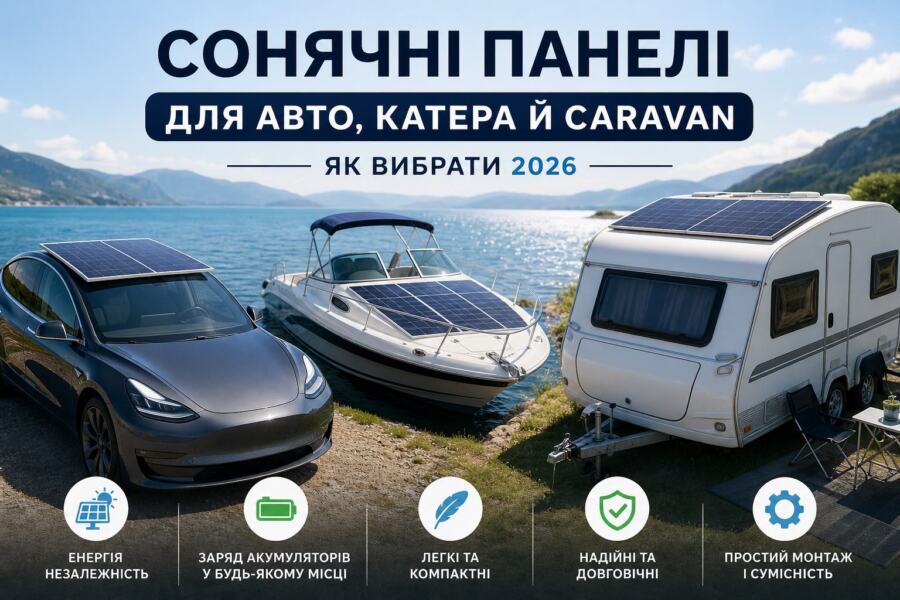
For a car, camper or van, a solar system is most often needed not for full-fledged movement, but for energy independence while parked. The most popular scenario is charging a car battery from the sun, when the car is parked, in the field, on vacation or during a long idle period. This reduces the risk of deep discharge and extends the battery life.
Another important option is powering additional equipment. When traveling, this can include:
- compressor refrigerator;
- chargers for laptops and smartphones;
- LED lighting;
- pumps, routers, fans;
- inverter for low-power equipment.
If you need it solar panel on car roof, it is important to consider not only power, but also dimensions, aerodynamics and mounting method. For city cars, it is critical not to overload the roof and not to create noise at speed. For camper vans and minibuses, on the contrary, it is advisable to install stationary solutions with a larger energy reserve.
What are solar panels and what to choose in 2026
In 2026, three types of solutions will dominate the market: monocrystalline, polycrystalline and flexible panels. For transportation, monocrystalline modules are most often chosen due to their higher efficiency and better performance in limited space. If the roof area is small, this type provides the most energy per square meter.
Flexible panels are suitable when low weight and installation on a curved surface are required. At the same time, they usually age faster and are less resistant to overheating than rigid modules. For a car, boat or caravan, it is worth looking not only at the price, but also at the operating conditions.
| Panel type | Advantages | Disadvantages | Best use |
|---|---|---|---|
| Monocrystalline | High efficiency, compactness, stable operation | Higher price | Car, caravan, boat with limited space |
| Polycrystalline | More affordable cost | Less efficiency, more area | A solution without strict location restrictions |
| Flexible | Light weight, easy installation on curved surfaces | Lower durability, sensitivity to heat | Boat, car roof with complex geometry |
| Folding portable | Mobility, quick installation | Manual scheduling and theft protection required | Temporary parking, camping, nature trips |
Solar panels for boats: what to look for
Solar panels for boats must operate in more difficult conditions than automotive ones. Here, moisture, saline environments, vibrations, and constant exposure to the sun and splashes are important. Therefore, it is necessary to choose modules with high-quality sealing, a durable coating, and corrosion-resistant fasteners.
On a boat, a solar system often powers navigation, pumps, lighting, echo sounder, refrigerator, and gadget charging. If the hull or deck has limited space, it is advisable to install several compact panels rather than one large module. This makes it easier to place the system without losing usable space.
- Choose a marine version with anti-corrosion fittings.
- Use cables with UV protection and high-quality cable glands.
- Install a controller with overload and reverse polarity protection.
- Provide ventilation for the battery compartment.
How to choose the power for a car, boat or caravan
The most common mistake is to buy a panel «with a margin of safety». First, you need to calculate your daily energy consumption: how many watt-hours your devices consume per day. Then you can determine what panel power and battery capacity you need for stable operation.
The following scenarios can be used as a guide:
- 30–100 W — recharging a stationary car, battery support, small loads.
- 100–200 W — basic autonomy for a camper or caravan.
- 200–400 W and more — refrigerator, lighting, partial operation of the inverter, longer parking periods.
For an accurate calculation, seasonality must be taken into account. In winter, efficiency is lower due to short daylight hours and a smaller angle of incidence of the sun. In summer, the system works much better, but overheating can also reduce the actual return.
Controller, battery and inverter: without which the system will not work
The panel itself is just a source of energy. For the system to be safe and efficient, you need a charge controller, a suitable battery and, if necessary, an inverter. It is the controller that manages the charge and protects the battery from overcharging and deep discharge.
For modern systems in 2026 is the best MPPT controllers work. They use the energy of the panel more efficiently, especially in variable lighting, cloudiness and partial shading. PWM controllers are cheaper, but less effective for difficult operating conditions.
What to consider when choosing:
- Battery: AGM, GEL, LiFePO4 — each type has its own charging requirements.
- Controller: preferably with a current reserve of at least 20–30%.
- Inverter: only needed when powering 220 V equipment.
- Wiring: The cable must match the current and line length.
Mounting on a car roof: practical safety rules
If planned solar panel on car roof, you can not neglect the fastening and sealing. Unreliable installation will lead to leaks, noise, damage to the paintwork or even loss of the panel while driving. For permanent solutions, it is better to use standard or certified fastenings.
It is also important to leave a gap for ventilation, as overheating reduces performance. On the roofs of vans and caravans, it is appropriate to install low-profile aluminum frames. If the panel is flexible, the surface must be carefully prepared, otherwise delamination will appear over time.
- Check the permissible roof load.
- Choose a location without constant shading from antennas, sunroofs, or the trunk.
- Route the cable through the sealed cable entry.
- Check the reliability of the fastening after the first ride.
What is important when choosing in 2026
The market is becoming more technological, and in 2026, it is no longer enough for the buyer to look only at the power. The efficiency factor, resistance to high temperatures, warranty, type of cells, protection class and compatibility with your battery are also important. For a car, boat and caravan, the same panel may behave differently.
Evaluate the following criteria before purchasing:
- power in real conditions, and not just on the label;
- dimensions and weight;
- controller type;
- resistance to vibrations and moisture;
- warranty conditions and service availability.
For those who are often autonomous, it is better to take a module with a power reserve. For short trips and battery maintenance, a compact system is enough. In a boat and caravan, the balance between area, weight and charging stability works best.
Frequently Asked Questions (FAQ)
Can I charge a car battery directly from the sun?
Yes, but only through a suitable charge controller. Directly connecting the panel to the battery without a controller is dangerous and can damage the battery.
What power is needed for solar panels on the roof of a car?
30–100 W is often sufficient to support a battery. If you need to power additional devices or a refrigerator, you should consider 100–200 W and higher.
Are regular solar panels suitable for a boat?
Not all of them will be suitable. For a boat, it is better to take modules with marine protection, anti-corrosion fittings, and resistance to moisture, salt, and vibrations.