
Useful tips
Wire cross-section for UPS battery: how to correctly calculate the cable


An incorrectly selected cable between the battery and the UPS or inverter is not a trifle, but a cause of overheating, voltage sag, protection tripping, and accelerated wear of the entire system. For 12V, 24V і 48V The calculation scheme is the same in logic, but the consequences of an error are different: the lower the voltage, the greater the current and the thicker the wire required.
Many users focus only on the "inverter power" and forget about the line length, conductor material, type of terminals and the actual load mode. That is why the question arises, Why are the inverter wires getting hot?, although everything on the case is supposedly selected correctly. Wire cross-section for UPS battery is determined not "by eye", but through current, length of the line and permissible voltage drop.
In everyday life, this is critical for backup power for boilers, routers, servers, pumps, alarms, as well as for small offices and retail outlets. If needed buy power wires for UPS or pick up battery connection cable to the inverter, it is important to understand why a cheap thin wire turns into a heating element, and not a reliable element of the system.
Below is a practical one calculation cable for battery without unnecessary theory, but with specific rules that actually work in home and commercial installations.
Why cable cross-section determines safety and stability of operation
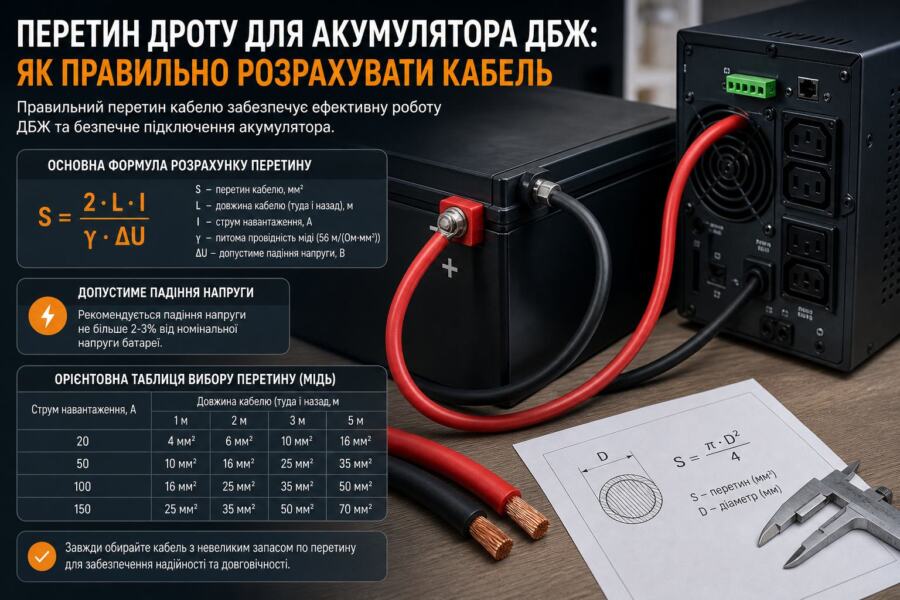
Cable between battery and UPS operates in high current mode at low voltage. For example, an inverter with a power of 1000 W on the bus 12V can consume more than 90 A taking into account losses. This is no longer a "domestic load", but a power line, where every extra milliohm gives noticeable heating.
The main problem is voltage drop. If the wire is too thin, the inverter sees a lower voltage than is present at the battery terminals and may shut down before the battery is actually discharged. In addition, energy losses increase, the terminals heat up, the insulation ages, and the contact points lose elasticity.
In real objects, this is very easy to see: the light flickers under load, the inverter fan is constantly at maximum, the cable is warm or hot near the terminals. If this has already happened, the problem is often not in the battery, but in the wrong cross-section or weak crimping.
For power lines, not only the cross-section is important, but also the type of conductor. Copper has lower resistance and better conductivity than aluminum, so copper flexible conductors are almost always used for battery connections. cables. For short and powerful connections, this is the de facto standard.
How to calculate wire cross-section for 12V, 24V and 48V
The basic formula is simple: current = power / voltage. Then add a margin for inverter losses, starting currents and heating. For domestic systems, a margin of 20–30% is laid, and for longer routes - even more.
Selection guideline: the lower the system voltage, the higher the current and the larger the wire cross-section required for 12V 24V 48V. For the same power line 48V always easier to install than 12V, because the current is three times less compared to a 12-volt system.
Practical example: inverter 1500 W. On 12V it is close 125–140 A taking into account losses. On 24V — approximately 65–75 A. On 48V — about 32–38 A. That is why 12-volt systems require a much thicker cable.
| System voltage | Inverter power | Estimated current | Practical cable cross-section |
| 12V | 1000–1500 W | 90–140 A | 25–50 mm² |
| 24V | 1000–3000 W | 45–120 A | 16–35 mm² |
| 48V | 2000–5000 W | 25–90 A | 10–25 mm² |
This is a guide table for short runs of up to a few meters. If the cable is longer than 1.5–2 m in one direction, the cross-section often needs to be increased by a degree, especially in 12V-systems. For example, for 1 kW at a distance of 2 m, it is better not to save and take a margin for the cross-section than to later look for the cause of heating.
It is important to note that the specified cross-section is the copper core. If a cheap cable is marked "4 mm²", the actual effective cross-section is sometimes smaller. This is a typical market problem, due to which cable for connecting the battery to the inverter you need to buy from trusted suppliers.
What affects wire heating and line losses?
The first factor is length. The resistance of a conductor increases with length, so the calculation always includes a «round trip» path. For a battery system, this means that the actual length of the circuit is twice the distance between the devices.
The second factor is the quality of the contact. Even a thick cable will overheat if the ferrule is crimped poorly, the bolt is loose, or there is oxidation on the terminal. In such cases, the temperature rises locally near the contact, not along the entire length of the wire.
The third factor is the load mode. The inverter can operate not at average, but at peak power. A refrigerator, pump, compressor, electric motor or deep discharge of a battery create short but high currents. That is why the cable is selected not only for the nominal, but also for the starting modes.
The fourth factor is the method of laying. If the wire is bundled, lies next to hot elements or is closed without ventilation, the permissible load is reduced. In dense panels and cabinets, the cross-sectional area should be larger than in open installation.
Practical cable selection for residential and commercial systems
For a backup boiler, router, lighting and basic consumers, it is usually enough 24V-systems with cable 16–25 mm², if the inverter is within 1000–2000 W and the distance to the battery is short. This is a good balance between price, size and losses.
For 12V inverter on 1.5–2 kW the cable may already be 35–50 mm². Here you should not put a thin wire "temporarily": at such currents even a few extra tenths of an ohm give noticeable overheating. It is in 12-volt systems that the question most often arises, Why are the inverter wires getting hot?.
For 48V systems, the cable is more compact, but the quality requirements are no less. If you need to power a server, cash register equipment, a security system or several critical lines, a 48-volt solution often wins precisely because of lower currents and better efficiency over longer routes.
In electrical installation practice, a simple rule applies: if there is doubt between two cross-sections, take the larger one. The cost of a thicker cable is usually less than the cost of a lost battery, burnt terminals, unplanned downtime, or a damaged inverter.
Installation, tips, fuses and common mistakes
The cable should be mounted with crimped copper lugs, not "twisted and pressed." Crimping should be done with a press so that the contact is tight and stable. After that, it is advisable to close the connection point with heat shrink with glue or high-quality insulation.
Be sure to install a fuse or DC circuit breaker as close as possible to the battery. This protects the line from short circuits, which at low voltages produce huge currents. For battery systems without protection, even a brief touch with a tool can cause an accident.
Typical mistakes: thin wire "for testing", aluminum instead of copper, unnecessarily long loops, connection through weak terminal blocks, connection of different metals without adapters, lack of current reserve. Another common problem is poor contact at the point of tightening the nut: everything is fine on the outside, but under load, heating occurs.
When needed power wires for UPS buy, pay attention to the actual cross-section, flexibility of the core, quality of insulation and the presence of a cable for the necessary terminals. For installation in narrow places, it is better to take a soft multi-core copper wire, rather than a hard wire.
How to choose a cable without error for a specific task
If the inverter is 1000 W and the system 24V, usually enough 10–16 mm² for a short route. For 1500–2000 W on 24V better to focus on 16–25 mm². For 12V the same capacities require much larger cross-sections - often 35 mm² and above.
If the distance between battery and UPS greater than 2 m, lay an extra margin. The longer the cable, the more each centimeter affects the losses. In backup power systems, a short and thick line is always more reliable than a long and «economical» one.
For a country house, an apartment with a backup of communications or a small business, it is convenient to make a selection in combination: battery voltage, inverter power, line length, type of load. This is how the correct battery cable calculation, and not by copying someone else's solution without checking the original data.
If you need a solution for a specific inverter, it is worth immediately choosing a cable with a temperature margin and a current gap. This is especially important in places where the equipment operates daily, not from time to time.
Practical conclusion
Correct wire cross-section for UPS battery is determined by three parameters: High-voltage, current і length. For 12V you need the thickest cable, for 24V — moderate, for 48V — the most advantageous in terms of losses. If the wires are heating up, in most cases the problem is a thin cable, poor contact, or lack of current reserve.
For reliable operation, use a flexible copper cable, high-quality terminals, the correct fuse and do not skimp on the cross-section. This is how the stable operation of the UPS, inverter and battery without overheating and emergency shutdowns - whether for home, or for business, or for the object of the electro shop in Dunayivtsi.