
Useful tips
Lithium iron phosphate battery: overview, pros and cons


Lithium iron phosphate batteries are often called the smartest compromise between safety, resource and real convenience in household power systems today. I have seen many solutions - from ordinary lead batteries to complex hybrid stations, and I can say simply: if you need reliable lithium battery for home, which withstands daily cycles, is not afraid of deep discharges and serves for years, then LiFePO4 — one of the strongest options. But, like any technology, it has its limitations, and you need to know about them before buying, not after the first installation error.
What is a lithium iron phosphate battery and how is it different?
Lithium iron phosphate battery is a type of lithium battery where the cathode is made based on LiFePO4. It is this chemistry that provides good thermal stability and high cycle life. Simply put, there are no such aggressive processes inside such a battery as in some other lithium systems. Because of this, it less warm, works more stably і better tolerates regular charge/discharge cycles.
Main technical features
– Nominal voltage of one cell — 3.2 V
– Typical assemblies for everyday life — 12.8 V, 25.6 V, 51.2 V
– Working life — often 3000–6000 cycles, and in quality solutions and more
– Permissible depth of discharge — usually 80–100%
– Weight is less than lead-acid counterparts of the same capacity
For home installations, this means not just “lasting longer,” but also that the battery provides a stable voltage almost until the very end of the discharge. This is important for inverters, pumps, routers, lighting, and other equipment that does not like sagging.
Advantages of LiFePO4 in real-world applications
If we consider lithium home battery not from advertising, but from practice, its advantages are immediately visible.
1. High resource
Lead-acid batteries lose their life quickly if they are regularly discharged below 50%. In LiFePO4 this situation is much less critical. That is why lifepo4 100ah often installed in systems where there are daily cycles: backup power, solar panels, autonomous homes, mobile power systems.
2. Better efficiency
The charge/discharge efficiency of LiFePO4 is usually high. Less energy is lost to heat, which is especially noticeable when you charge the battery from the sun or from a limited mains source. In practice, this means more usable energy at night or during outages.
3. Deep discharge without “killing” the battery
Most quality LiFePO4 can work with 80% and even 100% DoD. For the user, this means that from the nominal 100Ah you actually get much more useful capacity than from a lead-acid battery of the same number on the nameplate.
4. Stable voltage
The voltage in LiFePO4 is kept more even. This is very important for inverters, lighting, boilers and electronics. Less sag means fewer automation errors.
5. Less weight
For portable solutions, summer cottages, campers, boats and compact cabinets this is a big plus. Pull 30–50 kg A lead block is much heavier than a battery with similar useful energy but less mass.
Cons that sellers are often reluctant to talk about
No battery is perfect. And if you plan to buy lifepo4 battery, you need to look not only at the pros, but also at the limitations.
1. Higher starting price
Yes, LiFePO4 is more expensive up front. But I always advise you to consider not the price per battery, but cost of one cycle. If the battery lasts 3–5 times longer, then an expensive start often turns out to be more profitable.
2. Sensitivity to low temperature when charging
One of the key nuances is charge below 0°C can damage the elements if there is no protection or heating. You can discharge in the cold, but you can't charge, or only under the conditions specified by the manufacturer. This is not a trifle, but a real safety rule.
3. BMS required
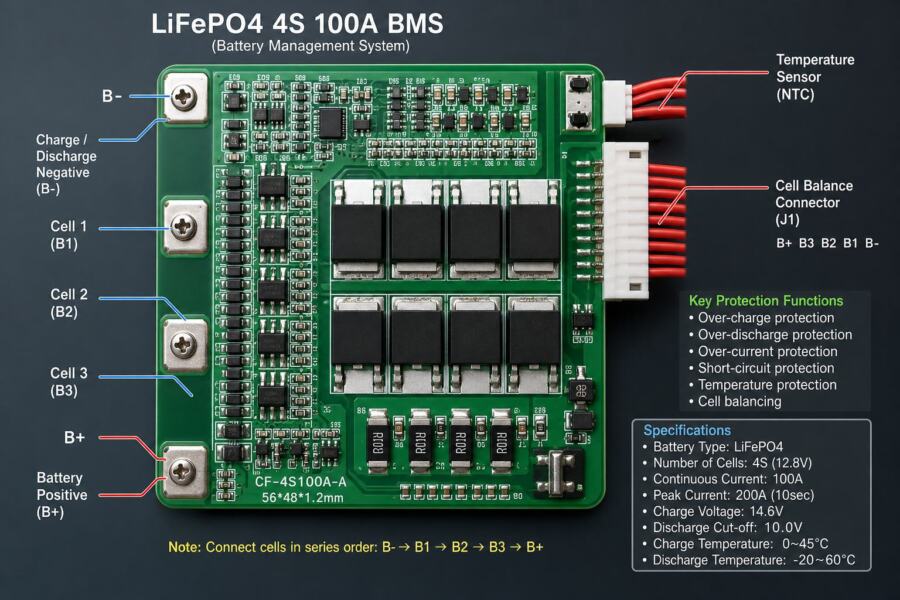
For normal operation, it is necessary BMS — battery management system. It controls cell balance, protection against overcharging, overdischarging, overloading and overheating. Without a quality BMS, a good LiFePO4 can easily turn into a risky product.
4. Not every charger is suitable
LiFePO4 cannot be charged with “anything”. It requires correct charge profile. If you use an unsuitable charger, the battery will either not be charged or will not work properly.
Comparison with other battery types
Below is a short technical table that clearly shows the difference in household use.
| Parameter | LiFePO4 | AGM/GEL lead |
|—|—:|—:|
| Cycle resource | 3000–6000+ | 300–1200 |
| Permissible depth of discharge | 80–100% | 30–50% |
| Weight | Lower | Higher |
| Voltage stability | High | Medium/low |
| Resistance to frequent cycles | Very high | Low |
| Purchase price | Higher | Lower |
| Charging requirements | High | Simpler |
| Chemical safety | High | High, but worse efficiency |
This table shows the main thing: if needed lithium battery for home For regular use, LiFePO4 almost always wins in terms of overall economy. If you need a rare “just in case” backup, then sometimes you can get by with a cheaper solution.
Where LiFePO4 is particularly relevant
For home backup power
For a router, boiler, circulation pump, lighting, video surveillance, and refrigerator, LiFePO4 is a very practical option. It provides predictable operating time and tolerates frequent outages well.
For solar systems
Solar panels love batteries that can be charged and discharged daily without a sharp drop in resource. Here lifepo4 100ah — one of the most popular formats because it scales well and is convenient for modular solutions.
For mobile objects
Campers, motorhomes, boats, mobile workshops - where weight, life and safety are important. LiFePO4 is often better than classic lead.
How to choose the right LiFePO4 battery
When a person wants buy lifepo4 battery, it is often caught on a beautiful capacity figure. But you need to look wider. I advise you to check the following things:
1. Real capacity, not just the inscription on the case
– Look for accurate data in amp-hours and watt-hours.
– For 12.8 V 100 Ah useful energy approximately 1280Wh.
2. Availability of a quality BMS
– Surge protection
– Deep discharge protection
– Short circuit protection
– Cell balancing
3. Maximum charge and discharge currents
– You need the battery to withstand your specific load.
– Inverter on 1000–2000 W may require significant peak current.
4. Temperature regime
– Especially important for garages, unheated spaces, and outdoor closets.
5. Warranty and origin of cells
– A bona fide manufacturer does not hide specifications.
– If the data is blurred, it is a reason to be wary.
When is the lifepo4 100ah format optimal?
– For a medium-power home inverter
– For router, lighting, TV, boiler
– For a small solar system
– For reserve on 2–8 hours depending on the load
But if you have energy-intensive equipment - a boiler, an electric stove, an air conditioner - one lifepo4 100ah may not be enough. Here we need to calculate the consumption in Tue·h, and not look at the number “100 Ah” as something universal.
Practical rules for installation and operation
Most errors when operating LiFePO4 occurs not because of the battery itself, but because of incorrect connection.
What to do
– Use charger with LiFePO4 profile
– To bet fuse near the battery
– Observe the correct cable cross-section
- Do not charge at below 0°C, unless permitted by the manufacturer
– Ensure ventilation and proper fastening
– Check the tightness of the contacts
What you can't do
– Do not connect the battery directly to “any” charger
– Don’t ignore BMS
– Do not store the battery fully discharged for months
– Do not overload the inverter with peak currents for which it is not designed.
– Do not place LiFePO4 without protection in a system where overheating or short circuit is possible.
What to look for before buying
As an engineer, I always advise against going for the cheapest option. When you want buy lifepo4 battery, look at the system as a whole:
– what inverter do you have;
– what is the maximum load power;
– is there solar charging;
– will the battery stand in the cold;
– whether the power cables of the system correspond.
And another important point: if you need lithium battery for home precisely as a reserve, and not as a “fashionable box”, then be sure to calculate the energy reserve at least 20–30% from above. This will provide a quiet operating mode and preserve the resource.
Conclusion from Engineer Gennady
Lithium iron phosphate battery — it is not just a modern battery, but a practical solution for those who need resource, stability and safety. Its main strengths are — a large number of cycles, deep discharge, stable voltage and good performance in systems with frequent outages. The main disadvantages are: higher price, charging requirements and sensitivity to charging in the cold. If you choose a quality product, choose the right BMS, charging profile and cable part, such a battery will work for a long time and predictably. My practical advice is simple: do not buy “by the watts on the box”, but design the system for your real loads and temperature conditions.
Frequently Asked Questions (FAQ)
Can LiFePO4 be fully discharged?
Yes, can, but it is better to work within the range recommended by the manufacturer. This extends the resource.
Is lifepo4 100ah suitable for boiler?
Yes, if you correctly calculate the inverter consumption and autonomy time. For boiler with circulation pump this is often a good option.
Can LiFePO4 be charged in winter?
No, you cannot charge below 0°C., if there is no heating or special protection.
Should I buy a LiFePO4 battery instead of an AGM?
If you need frequent work, deep discharges and a long service life - yes, it is worth it. If the reserve is rarely used and the budget is limited, AGM may be a temporary compromise.