
Useful tips
Water leak sensor: reliable protection against flooding and smoke


Flooding in an apartment or house almost always happens suddenly: a flexible pipe has cracked, a washing machine has leaked, a thread on a boiler has broken, a pipe in a technical room has frozen. As a result, the owner gets not only water on the floor, but also damaged electricity, spoiled decoration, conflicts with neighbors and significant repair costs. That is why water leak sensor It has long ceased to be an “option for perfectionists” and has become a basic element of home security.
When the system is working properly, it reacts not after an hour or after the water has reached the corridor, but in the first seconds of moisture appearing. This is especially important for a private house: the consequences of a leak in the boiler room, near the accumulator or boiler can go far beyond the boundaries of one room. In an apartment, timely operation often saves both your property and the ceiling of the neighbors below.
The second area of protection is no less important: home fire safety. When there is an autonomous power supply, inverter, batteries or backup lines, not only water sensors should work in the apartment, but also wireless smoke detector. In real engineering systems, these two types of control are often combined into one logic: a water leak signals a pipeline failure, and smoke signals a threat of fire, overheating of wiring, or a problem with equipment.
A properly assembled flood and fire alarm system does not require complex maintenance, but it does require proper installation, compatible devices, and an understanding of their limitations. This is where people often save money and then overpay for the consequences.
How does a water leak sensor work and why does it trigger on time?
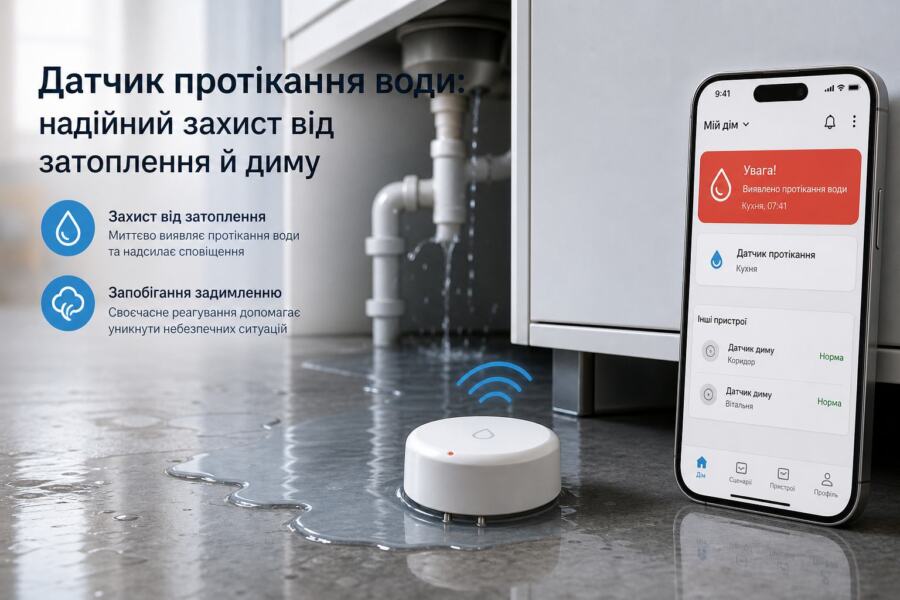
Most household water leak sensors They work on a simple principle: on the bottom of the case there are electrodes or contact pads that close when water appears between them. The controller detects changes in resistance or the appearance of conductivity and transmits a signal to a relay, siren, hub or “smart home” system.
From an engineering point of view, not only sensitivity is important, but also the stability of operation. A sensor that is too “nervous” can react to condensate or drops after cleaning, and a sensor that is too “lazy” will miss the early stage of an accident. High-quality solutions take into account the geometry of the contacts, protection against false alarms, and the type of connection: wired or radio channel.
In wired systems, the signal is usually more reliable and does not depend on the battery in the sensor, but laying a cable is not always convenient. Wireless models are installed faster, are suitable for ready-made repairs and are especially useful where it is important to minimize installation work. At the same time, they require regular maintenance: checking the battery, radio communication and correctness of communication with the central module.
A common mistake is to place one sensor “somewhere near the entrance to the bathroom”. Water, as a rule, does not flow in a straight line. It collects at the lowest point, hiding under the washing machine, in a niche under the boiler or in a corner near the ladder. Therefore, the correct installation location is determined not by the seller, but by the logic of your room: where the risky connections are located, where there are floor level differences and where the water will go in the first minutes of an accident.
.
Anti-flood system: what does complete protection consist of?
A separate sensor only gives an alarm signal. Full-fledged anti-flood system has a much broader function: not just to report water, but to automatically stop the water supply at the facility. It usually consists of sensors, a central controller, electrically operated ball valves, a power source and, if necessary, a notification channel via GSM, Wi-Fi or a local siren.
The most effective scenario is as follows: the sensor detects moisture, the controller instantly gives a command to the electric drive, and the tap shuts off cold and/or hot water. For a domestic system, it is important that the tap has emergency manual control and did not require complex service. In an apartment, this often saves from flooding during the absence of the owner. In a private house, it prevents a serious accident in the boiler room, where water can quickly get on electrical equipment.
In practice, solutions with backup power work best. If the anti-flood system is powered by a 220 V network, then it becomes vulnerable when the electricity goes out. That is why normal projects include a backup from a battery or other source so that the sensors and controller remain active even during an emergency shutdown. For houses with solar panels panels, inverter and battery, this is especially logical: all critical automation can operate from a single energy architecture.
| Parameter | Wired system | Wireless system |
| Assembling | More complex, requires cables | Fast, without gating |
| Communication reliability | High, independent of radio channel | Depends on battery and signal |
| Service | Minimum | Batteries need replacing |
| Best scenario | New construction, renovation “from scratch”, technical premises | Completed renovation, apartment, local security |
| Integration | Well suited for complex automation systems | Convenient for quick expansion |
A typical mistake is to buy only sensors without an actuator. In this case, the owner will find out about the accident only when the water has spread across the floor. If the goal is protection, not just notification, then an electric faucet is not an “additional option”, but a mandatory element.
Wireless smoke detector: why you need it in a house with backup power
Wireless smoke detector especially appropriate where an autonomous power supply has already been installed or a redundant electrical system has been built. When the house has an inverter, battery, solar panels or UPS, it is logical to add another level of control - early detection of smoke. This is relevant for the boiler room, electrical panel room, room with batteries, kitchen, corridor near bedrooms.
The principle of operation depends on the type of sensor. The most common household models use an optical method: inside the camera there is an LED and a photodetector, and smoke particles change the scattering of light. Such sensors respond well to smoldering, but can abuse the signal in dusty areas. That is why they are not placed near ventilation grilles, in workshops with a lot of dust or where steam is often formed.
You should not rely on just one type of alarm in your security system. A smoke sensor will warn of a fire, but it will not replace automatic disconnection of a problematic line or protection of the battery pack. For rooms with batteries, it is also important to consider ventilation and temperature control, because overheating of batteries and contact connections often begins unnoticed.
Practice shows: if a private house has a boiler, water heater, circulation pumps, inverter and battery, it is advisable to design not separate “point” sensors, but an interconnected system. If water leaks from the boiler, the water is turned off, if there is smoke in the technical room, the alarm is turned on, and the owner receives a message on the phone. This approach corresponds to the modern idea of fire safety at home і reliable technical protection.
Where to install sensors: apartment, private house, boiler room, kitchen
Correct placement is half the battle. The most risky places for an apartment are: under the sink, near the washing machine and dishwasher, under the boiler, near the risers and in the bathroom. If there is a heating collector or underfloor heating system, it is advisable to install the sensor in the collector cabinet: leaks there are sometimes not immediately visible, but the consequences are very expensive.
In a private house, the boiler room, pump room, technical room, the area near the water tank and the places where the mains pass through the ceiling are added. At these points, water can appear due to a microcrack, a hose break or a leak in the fitting. If the room has several levels or stairs, the sensor is placed at the point where the liquid will enter first.
The principle is different for smoke detectors. They are placed on the ceiling, not close to the walls and not on the kitchen hood. A big mistake is to place wireless smoke detector in a corner “so as not to get in the way.” Smoke accumulates unevenly under the ceiling, and the wrong place can delay activation. In the sleeping area, it is better to have a notification in the hallway and near the exit from the bedrooms.
Another practical tip: do not hide the sensors under solid decorative elements. If there is a solid tray under the washing machine and the sensor lies above the level of possible flooding, it simply will not perform its function. Water must physically reach the contacts.
Common mistakes during selection and installation
The most common mistake is focusing only on price. A cheap sensor without normal compatibility with the controller or without stable notification may turn out to be a useless purchase. The second problem is mixing different ecosystems without checking communication protocols. If the controller does not understand the device, the anti-flood system will become a set of separate elements without a common logic.
The third mistake is ignoring the power source. For reliable operation, it is critical that the system does not lose functionality during a power outage. If you have inverter with batteries, check whether the controller and drives are powered by the backup bus, and not just from the “normal” network. For autonomous objects, it is advisable to provide a backup voltage at the level 12 V or 24 V, depending on the equipment model and actuators.
The fourth mistake is the lack of testing after installation. The sensor may be installed correctly, but the signal may not pass to the central module due to a weak radio channel, incorrect polarity, a discharged battery, or an error in the settings. The check should include not only the sound of the siren, but also a complete shutdown of the water and receiving a message, if provided.
The fifth mistake is neglecting service. Batteries in wireless sensors do not last forever, contacts can oxidize, and dust in the smoke sensor chamber worsens its sensitivity over time. Every few months, it is useful to conduct a brief inspection: whether the sensor has shifted, whether the contacts have been closed by accidental moisture, whether errors have appeared on the controller.
How to combine water and smoke protection with autonomous power supply
У houses with solar panels With panels, an inverter, and a battery bank, security automation must work as reliably as lighting or a refrigerator. Water leak sensor and wireless smoke detector It is advisable to connect to a line that remains active when switching to reserve. If this is done correctly, the system will not “fall asleep” when the network disappears, and the owner may be absent.
For smart integration, it is important to consider energy consumption. The sensors themselves consume little, but the GSM module, radio hub, siren and crane drives require significantly more. Therefore, the battery reserve should be real, not theoretical. In technical solutions for buildings, at least several hours of autonomy for critical systems are often built into them, and better - a day or more if the object is remote or often left unattended.
A reliable scheme looks like this: sensors detect an accident, the controller makes a decision, actuators shut off the water or give an alarm, and power comes from the main or backup bus without a pause. This is what distinguishes a professional approach from “set the alarm and forget it.”.
When the system is well thought out, the owner receives not just a set of gadgets, but a practical tool for reducing risks. This is especially important in houses with many hidden communications, expensive equipment and complex electricity. Here you can no longer rely on chance or hope that “nothing will happen”.