
Useful tips
Wireless home alarm: reliable protection against robbery


Wireless alarm systems have long ceased to be a "luxury for the wealthy." For an apartment, private house, cottage or office, it is a practical tool that really reduces the risk of theft and reduces the response time to intrusion. Unlike old wired systems, modern kits are quickly installed, do not require wall gating and are easily scalable for changes in layout or new control zones.
The most important thing in such systems is not the fact of the siren itself, but the logic of operation: sensors record the event, the hub processes the signal, the user receives a notification, and when connected to the security system, the response team can start its departure. That is why when choosing, you should look not only at the price, but also at the communication protocol, autonomy, radio channel range, protection against jamming, and the quality of the mobile application.
For many homeowners, the key question is not «do I need an alarm system?» but «which system to choose so that it doesn’t fail at a critical moment.» In practice, the most common mistakes are made by those who save on sensors, install them without taking into account heat sources and animals, or buy equipment without backup power. As a result, the system either responds with errors or fails to communicate during a power outage.
Below is a technical but understandable breakdown of how a wireless home alarm system works, what should be included in the basic kit, and how to choose a solution for your apartment or house without unnecessary expenses.
How wireless alarm works and why it is effective
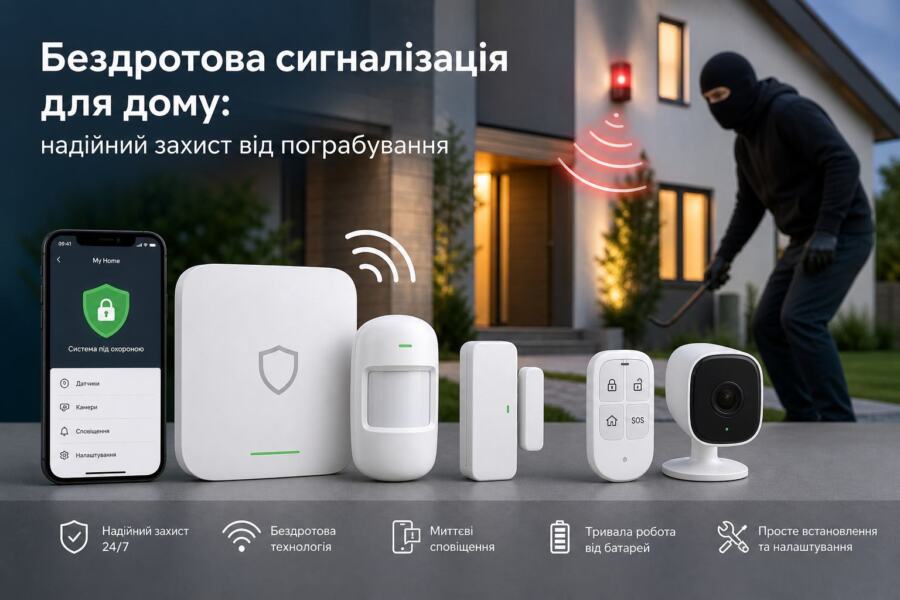
A wireless security system consists of a central hub, sensors, siren, controls and a communication channel. The sensors communicate with the hub via a radio channel, and the hub transmits the event to the user via the Internet, GSM or connection to the security console. When attempting to break in, not only the siren is important, but the entire chain: detection, confirmation, sending an alarm, reaction.
The main advantage of wireless solutions is quick installation. In an apartment, you can install the system in a few hours without spoiling the repair. In a private house, it is easy to add sensors to the garage, entrance door, terrace, first floor windows, utility rooms. If a new risk zone appears later, for example, a workshop or a separate warehouse, a new device is simply added to the system.
In practice, the effectiveness of the alarm system does not depend on the number of sensors, but on the competent coverage of vulnerable areas. For example, in an apartment on the 7th floor, sensors for the entrance door, balcony and several motion sensors in the corridor and common area are often enough. In a house with several entrances, a wider scheme is needed: perimeter, vestibule, boiler room, first floor windows, garage. It is for this logic that you should choose a kit when planning buy wireless alarm.
Autonomy should be evaluated separately. If the power is turned off in the house, the system should not "fall asleep". A normal alarm system should operate from the hub's backup battery and support the sensors for a certain time without the network. For household systems, it is critical that the backup lasts at least a few hours, and preferably longer, especially when the object is often left unattended.
Another important point is the protection of the communication channel. High-quality systems use encryption, tamper control, sensor status checking, and notification of loss of communication. This is not a marketing trifle, but the real basis of reliability: if an attacker tries to jam the signal, the user should receive an alarm about the jamming or disappearance of the device.
What sensors are needed for an apartment and a private house?
The basic set usually includes a door opening sensor, motion sensor for alarm, siren, hub and key fob or keypad for disarming/arming. But for real protection this is not always enough. The right set depends on the architecture of the home, the number of entrances and the habits of the residents.
The opening sensor reacts to the opening of a magnetic contact. It is placed on the front door, balcony door, first floor windows, garage door. This is a simple but very important element: it is triggered even before a person enters the room. For an apartment, such a sensor is the first line of defense.
The motion sensor uses infrared technology: it detects changes in the thermal field in the control area. It is placed in the corridor, in the passage between rooms, near the stairs in the house. Many users make the mistake of installing it opposite a window, radiator or air conditioner. In such conditions, false alarms are possible. Therefore, it is important to consider not only the layout of the room, but also heat sources, the movement of curtains, and pets.
It is useful to add glass breakage, water leakage, smoke and gas sensors to the house. The alarm then performs not only a security function, but also an engineering function. For example, if a pipe bursts, water can cause more damage than thieves themselves. And a smoke detector in the boiler room or kitchen often saves from much more serious losses than theft.
When installing the system for a family with children or pets, you need to pay attention to the "anti-animal" mode and the correct mounting height. A cheap motion sensor installed without taking into account the weight and behavior of the animal will constantly provoke false alarms. This is one of the main reasons why people are disappointed in wireless complexes in the first month of operation.
In a two-story house, it makes sense to divide the security into groups: night mode, when only the perimeter and the first floor are active, and full mode during absence. This logic is convenient and safe: residents can freely move around the bedrooms without turning off the entire system.
Comparison of popular solutions: standalone, remote and smart system
Before choosing a kit, it is useful to understand how the basic types of systems differ. Some scenarios are sufficient for an apartment, others for a house. Below is a practical comparison that will help you assess which option is right for your facility.
| System type | Key benefits | Limitation | Who is it suitable for? |
| Autonomous | Low price, easy installation, local siren | No professional response, dependence on the owner's attention | Cottage, garage, small apartment as a basic level of protection |
| Remote control | Transmission of the alarm to the control panel, response team departure, security discipline | Monthly subscription fee, you need to configure the object correctly | Apartment with valuable property, house, office, shop |
| Smart with mobile control | In-app notifications, scripts, remote control | Requires stable internet and proper cybersecurity | A modern house, apartment, where smartphone control is important |
If you need it apartment security panel, it is important to check the compatibility of the equipment with the security company. Not every kit integrates equally well with the consoles. For businesses and higher-end homes, solutions that support both local control and alarm transmission to the security console and mobile notifications are more often chosen.
In practice, a hybrid option works best: a hub with a siren, an app for the owner, and a connection to the remote control. This provides a double loop — you see the event immediately on your phone, and security receives the signal regardless of where you are.
Why Ajax security systems are often chosen for homes
Among modern solutions, the following stand out: Ajax security systems. They are often chosen for their combination of convenience, communication range and thoughtful mobile control. For the homeowner, this is important, because the system should not only work, but also be understandable in daily use. If the security system is difficult to manage, people start to disable some of the functions or stop installing an alarm system at all.
The strength of such systems is a well-thought-out ecosystem. Various sensors can be connected to one hub: motion, opening, glass breakage, flooding, smoke, sirens, keyboards, key fobs, relays. This allows you to build not just security, but comprehensive home protection. For example, in a private house, you can separately monitor the entrance, yard, technical room, and accident risks.
Another advantage is device status monitoring. The user receives notifications about low battery, loss of connection, alarm, door opening, and security mode change. This is convenient for a home user, and for an engineer, it is a sign that the system is not "silent" but is constantly self-diagnosing.
However, it is worth remembering that even the best platform does not compensate for installation errors. If the sensor is placed in a "blind" zone, directed at a heat source or covered by furniture, the efficiency drops sharply. Therefore, when choosing a system, it is important not only to choose the brand, but also to design it correctly.
How to install the system correctly and avoid common mistakes
The first typical mistake is underestimating the perimeter. In a house, people often only secure the front door, forgetting about the balcony, terrace, first-floor windows, garage doors, and doors to the yard. Criminals rarely break down the strongest entrance if there is an easier way. Therefore, the protection scheme should start not with the rooms, but with potential entry routes.
The second mistake is the incorrect placement of the motion sensor for the alarm. If it «looks» at a battery, a sunny window or a rotating fan, false alarms appear. This is not a small thing: after several false alarms, people begin to ignore the message. In a real situation, this is dangerous. It is optimal to place the sensors in the corner of the room with access control, and not in a direct line to the heat source.
The third mistake is the lack of backup power. If the facility is left unprotected during a power outage, an attacker can take advantage of the moment. A good system should have a battery in the hub and, if possible, a backup in the siren and communications. For a house where the power goes out regularly, this is critical.
The fourth mistake is installing without checking the radio connection. In large buildings, especially with monolithic ceilings or metal structures, the signal may weaken. Before final installation, it is worth testing the connection level at all points. If the building is complex, it is better to immediately provide a repeater or another hub placement scheme.
The fifth mistake is the lack of usage scenarios. The system should not only be "all-inclusive", but also be tailored to the real habits of the family. Night mode, partial security, temporary disabling of one zone, entry delay - all this makes operation comfortable and reduces the number of errors.
What to look for when deciding to buy a wireless alarm system
When needed buy wireless alarm, focusing only on price is a bad strategy. You need to evaluate at least seven parameters: type of communication, range, autonomy, number of zones, compatibility with the remote control, availability of a mobile application and quality of battery life. It is these characteristics that determine whether the system will be truly useful, and not decorative.
For an apartment, compactness, quick installation and convenient control from a smartphone are important. For a private house, the range of the radio channel, the stability of operation through several walls, the presence of a backup communication channel and the possibility of expansion come to the fore. If the object is large, the system must support not only motion and opening sensors, but also additional devices without losing stability.
In addition to technical specifications, pay attention to service and availability of consumables. A high-quality hub is good, but if after a year it is difficult to find a compatible sensor or battery, operation becomes more difficult. That is why for long-term use it is better to take an ecosystem, rather than a random set of devices.
It is also useful to consider possible scenarios: short departures, night security, long absence, renting out the property, security during renovations. In each case, the set of functions may be different. For example, for a rented apartment, access rights, event log and flexible user management are especially important.
When remote security is truly justified
Apartment remote control security makes sense (Incomplete: max_output_tokens)