
Useful tips
Inverter overheating: main causes and how to avoid it


Inverter overheating (in UPS, solar systems or off-grid power systems) is one of the most common problems, leading to reduced efficiency, automatic shutdown, reduced service life and even equipment failure. Modern inverters have protection against overheating, but it is better to prevent the problem than to deal with the consequences.
Why does the inverter overheat?
The inverter converts direct current (DC) to alternating current (AC), and this process is accompanied by energy loss in the form of heat. If there is too much heat, the temperature inside the device exceeds safe limits (usually 40–60 °C for normal operation, above 75–85 °C - protection is triggered).
Main causes of inverter overheating
Here are the most common reasons, compiled from user experience and manufacturer recommendations:
- Insufficient ventilation and poor cooling The inverter is installed in a closed cabinet, near a wall without a gap, or in a room without air circulation.
- High ambient temperature Direct sunlight, boiler room, attic or garage in the heat.
- Overload Connecting devices whose power exceeds the rated power of the inverter (especially those with high starting current - boilers, pumps, refrigerators).
- Dust and dirt contamination Dusty vents and radiators block heat dissipation.
- Fan problems The fan is broken, clogged with dust, or running at low speed.
- Connection problems Weak contacts, thin cables, oxidation - all this creates additional resistance and heat.
- Too much DC-oversizing (for solar inverters) Number solar panels significantly exceeds the recommended inverter power.
- High battery temperature or faulty components Old battery, capacitor problems, etc.
How to avoid inverter overheating: practical recommendations
- Choose an inverter with a power reserve of 20–30%.
- Install in a cool, well-ventilated area (temperature no higher than 25–30 °C is ideal).
- Leave at least 20–30 cm of free space around the device.
- Clean dust regularly (1–2 times a year).
- Use additional active cooling (fans with thermostat).
- Check the quality of cables and contacts.
- For solar systems — Install a sun visor.
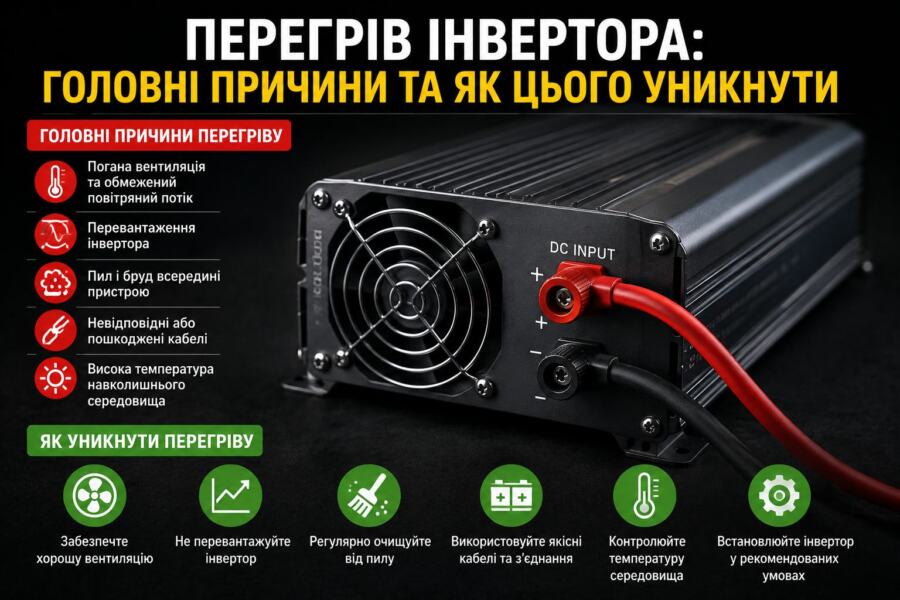
Table: Causes of overheating and solutions
| № | Cause of overheating | Symptoms | How to Avoid/Solution |
|---|---|---|---|
| 1 | Insufficient ventilation | Fast heating even under low load | Leave gaps, mount vertically on the wall, add fans |
| 2 | High ambient temperature | Overheating in the heat, protection tripping | Move to a cool place, protected from the sun. |
| 3 | Overload | Heating when turning on powerful appliances | Choose a more powerful inverter, do not exceed 80% load |
| 4 | Dust pollution | Constant heating, fan noise | Regular cleaning with a vacuum cleaner or compressed air |
| 5 | Broken fan | The inverter is hot, but the fan does not spin | Fan replacement |
| 6 | Bad contacts/thin cables | Local strong heating of cables | Use cables of appropriate cross-section, check tightness |
| 7 | Excessive DC-oversizing | Overheating on sunny days | Follow manufacturer's recommendations (usually 1.2–1.5 times) |
| 8 | Internal faults | Heating even without load | Diagnostics in service, capacitor replacement |
Inverter overheating is almost always the result of improper installation or maintenance. If you follow simple rules - clean regularly, do not overload and place the device correctly - your the inverter will last 8–12 years no problem.
Advice: If the inverter often turns off due to overheating — Don't ignore it. It's better to find and fix the cause right away than to buy a new device.
Do you have a specific model? inverter or UPS? Write to me — I will give you more specific recommendations for your situation.