
Useful tips
Solar panels for heating: how to choose a reliable solar system 2026


Solar panels for heating in 2026 are not only a way to reduce energy bills, but also a practical solution for homes where autonomy and stability of heat supply are important. Most often, this does not mean electrical modules, but solar collectors, which convert solar energy into heat for water or heating systems. For a solar system for a house to work effectively, it is important to choose the right type of collector, tank volume, connection diagram and level of protection against overheating and freezing.
Solar panels for heating: how the system works and where it is most effective
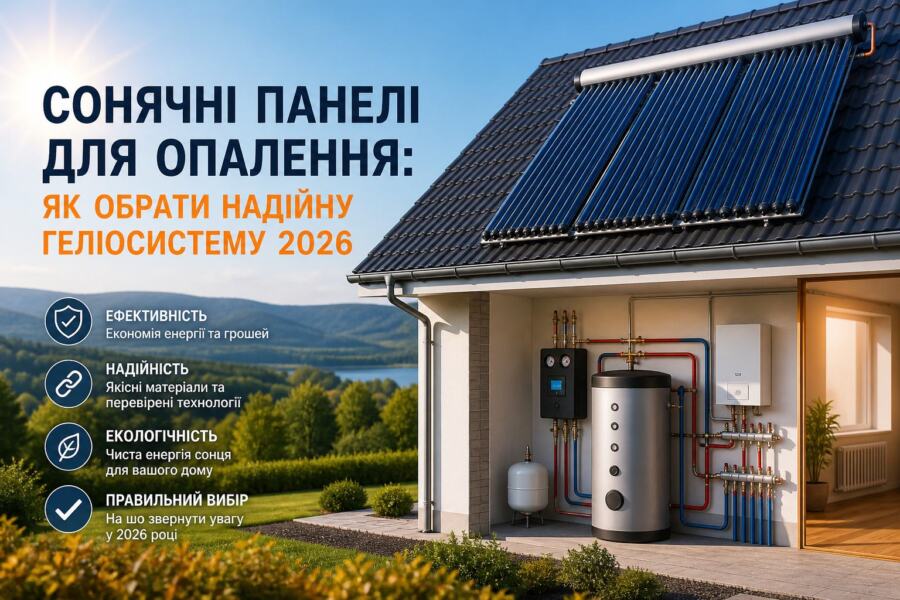
A solar system for a house consists of collectors, a coolant, a circulation circuit, a heat accumulator and automation. The sun heats the absorber in the collector, the heat is transferred to the liquid, and then to the water in the tank or the coolant of the heating circuit. In the warm season, such the system often fully covers the solar needs DHW, and in the off-season it can significantly reduce the consumption of gas, electricity or solid fuel.
The best results are obtained in houses with high thermal insulation, low-temperature heating and a clear schedule of hot water consumption. If the system is designed to support heating, and not just for water heating, a larger collector area and a correctly selected storage tank are required. That is why the choice of equipment should not be made only by price - the climate, roof area, south orientation and actual heat load are important.
What are the types of solar collectors and which one to choose for your home?
For household tasks, flat or vacuum cleaners are most often used. solar collectors. Flat models are simpler, cheaper and work well in the season with high insolation. Vacuum ones retain heat better in winter and are more efficient in cold weather, but are more expensive and require more quality installation.
When choosing, you need to consider not only the climate, but also the mode of use. If you need mainly solar hot water, a fairly compact system with a moderate collector area. If the priority is partial heating support, then it is worth considering more productive models, a larger accumulator tank and automation that prevents the system from overloading in the summer.
- Flat plate collectors — optimal for spring, summer and early fall.
- Vacuum collectors — better for the cold season and cloudy weather.
- Hybrid solutions — suitable for combining DHW and heating support.
- Forced circulation systems — more versatile for private homes.
Comparison of the main types of solar systems
| System type | Advantages | Disadvantages | Who is suitable for? |
|---|---|---|---|
| Flat plate solar collectors | Affordable price, simple design, easier installation | Less effective in cold weather and weak sunlight | Houses with a primary focus on summer DHW |
| Vacuum collectors | High efficiency in cold weather, better heat preservation ability | More expensive, more vulnerable to poor installation | For regions with cold winters and connection to heating |
| Solar system with heat accumulator | Stable heat supply, less losses, higher autonomy | Requires space and precise design | For homes with regular hot water consumption |
| Combined solar system for the house | Can work both for DHW and for heating support | More complex automation, higher initial investment | For owners who want maximum savings throughout the year |
What to look out for before buying in 2026
A reliable solar system for your home starts with the right calculation. It’s not enough to simply choose an expensive kit – you need to assess the heat demand, roof area, angle of inclination, number of residents and usage scenario at different times of the year. For heating, power reserve and compatibility with low-temperature systems, such as underfloor heating or fan coils, are especially important.
The quality of the components also plays a key role. The coolant must be designed for low temperatures, the heat accumulator for a working volume with a margin, and the automation for precise control of the pump, valves, and overheating protection. If the system is mounted on the roof, it is important to check the load-bearing capacity of the structure and the reliability of the fasteners.
- Calculate the actual heat load of the house, and don't focus only on the area.
- Evaluate your consumption pattern: only DHW or also heating support.
- Select the type of collector according to the climate and season of work.
- Anticipate heat accumulation, otherwise some of the energy will be lost.
- Check automation and protection from overheating, freezing and air jams.
Common mistakes when choosing solar heating
One of the most common mistakes is buying a system without a heat engineering project. In this case, the solar panels for heating may be too small or, conversely, excessive for a particular house. In the first case, there will be no expected savings, in the second - the system will operate unstable, especially in summer.
Another problem is savings on installation. Incorrect angle of inclination, poor pipe insulation, lack of high-quality antifreeze or incorrect choice of location for the tank sharply reduce efficiency. Also, do not ignore service: a solar system for a house requires periodic checking of pressure, coolant condition and automation operation.
- Incorrect calculation of the collector area.
- Lack of sufficient heat storage.
- Poor compatibility with the existing heating system.
- Poor installation of pipelines and thermal insulation.
- Ignoring service and seasonal equipment inspections.
How to choose a reliable solar system for your home in 2026
If you need a system primarily for hot water, you should choose a solution focused on solar hot water with a sufficient tank and high-quality thermal insulation. If the goal is to reduce heating costs, the priority should be productivity, vacuum technology or a combined scheme. In any case, reliability is determined not only by the brand, but also by the compliance of the equipment with real operating conditions.
The best choice is a system that works predictably, is easy to maintain, and provides significant savings without complicated settings. Before buying, it is advisable to get a quote from a specialist, compare 2–3 sets, and check warranty conditions. This is how solar panels for heating turn from a marketing idea into a practical solution for everyday comfort.
Frequently Asked Questions (FAQ)
Can solar collectors completely replace the boiler in winter?
In most private homes, no. In winter, solar collectors usually work as an auxiliary heat source, with the boiler or other heating source taking on the main load.
Which is better for DHW: flat plate or vacuum collectors?
Flat plate collectors are often sufficient for the warm season. If higher efficiency is required in the cold season or the system will also operate for heating, vacuum collectors are more often chosen.
How much space is needed for a solar system for a home?
The exact area depends on consumption, type of collectors and tank volume. For a compact solar hot water A smaller area is sufficient, and a significantly larger supply of collectors and heat storage is required to maintain heating.