
Useful tips
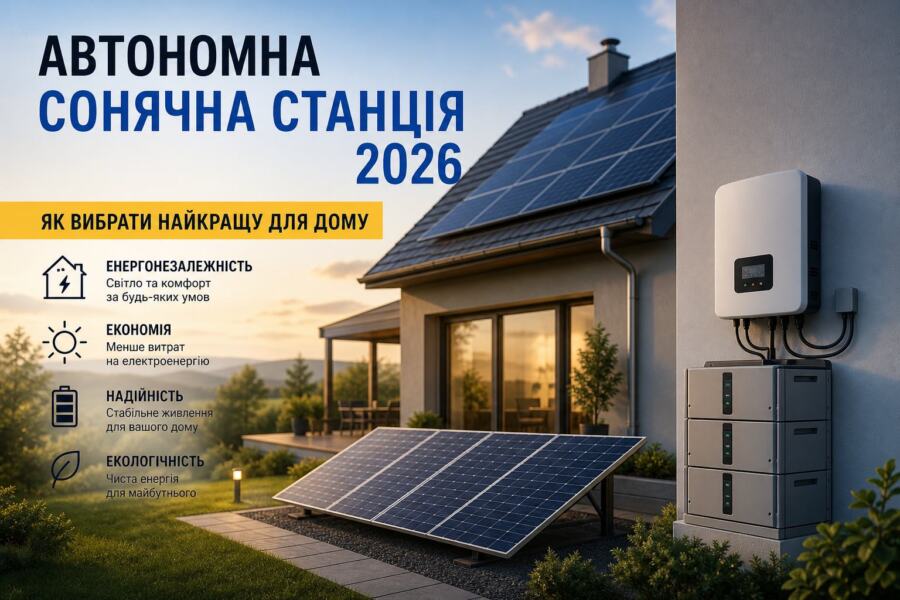
Autonomous solar station 2026: how to choose the best one for your home


In 2026 autonomous solar station for a private house is no longer exotic. This is a practical solution for stable power supply during outages, rising tariffs and the need for energy independence. But for the system to really work effectively, it must be selected not “by eye”, but based on real daily consumption, operating mode and future reserves.
For the home, they often consider not just a set of panels and batteries, but a complete off-grid system with inverter, charge controller, protection and battery pack. It is the quality of these components that determines whether the station will be able to power a refrigerator, lighting, pump, router, boiler, and other critical equipment without failures and overloads.
What is included in an autonomous solar station for the home
To choose the right configuration, it is important to understand what elements the system consists of. Each component affects the performance, service life and cost of the project. In 2026, the most rational approach is considered to be the selection of a balanced set, not a minimum.
- Solar panels for house — convert light into electricity.
- Charge controller — controls the supply of energy to the batteries.
- Inverter — converts direct current into alternating current 220 V.
- Batteries — store energy for the evening, night, and cloudy weather.
- Protection and switching — automation, fuses, disconnectors, SPD.
The most common mistake is to buy only panels without calculating the energy storage. For autonomous solar station It is the battery pack that determines whether the house will have light after sunset and on cloudy days. Therefore, the emphasis should be placed not only on the power of the panels, but also on the storage capacity.
How to calculate the system capacity for your home
You should start with daily consumption. To do this, sum up all the devices that need to be powered by the system and take into account their operating time. Separately identify critical loads: lighting, refrigerator, pump, internet, boiler, security system.
The practical algorithm looks like this:
- Make a list of all consumers.
- Determine the power of each appliance in watts.
- Multiply the capacity by the hours of operation per day.
- Sum the result and add 20–30% to the stock.
- Separately check the starting currents of equipment with motors.
For example, if a house consumes 4–6 kWh per day, the system should be designed so that it does not operate at the limit. For such a scenario, a combination of medium-power panels and batteries with a reserve of 1–2 days of autonomy is often chosen. This provides comfort and reduces the load on the equipment.
Why LiFePO4 for Homes Will Become the Standard in 2026
When it comes to energy storage, the most common recommendation is LiFePO4 for home. These are lithium iron phosphate batteries, which have high cycling performance, stable performance and better safety compared to traditional lead-acid batteries. For daily use, they are much more profitable in the long run.
Their key advantages:
- Long cycle life — usually several times longer than AGM/GEL.
- Deeper permissible discharge without significant loss of resource.
- Stable voltage during loading.
- Fast charging from the sun or the network.
- Compact and lighter weight for the same usable capacity.
If the system is planned not as a reserve for rare outages, but as a daily source of energy, LiFePO4 is almost always the most rational choice. They are the ones best suited for modern off-grid systems, where not only capacity is important, but also stability over the years.
Comparison of the main types of batteries
Before making a purchase, it's worth comparing popular solutions in terms of lifespan, price, and ease of use. This will help you understand what you're paying for and what compromises you'll have to make in real-world use.
| Battery type | Resource | Depth of discharge | Advantages | Disadvantages |
|---|---|---|---|---|
| AGM | Average | Moderate | Lower starting price, simplicity | Shorter life, sensitivity to deep discharges |
| GEL | Average | Moderate | Better durability than AGM | Heavier, more expensive, slower to charge |
| LiFePO4 | High | High | Long life, fast charging, stability | Higher starting cost |
For a home station in 2026, it is not the cheapest that will most often win, but most profitable in terms of life cycle option. If the system is used daily, LiFePO4 covers the initial difference in price due to its resource and efficiency.
Which solar panels for the house to choose?
Solar panels for a home should be selected taking into account the roof area, orientation, shading and climate. In 2026, monocrystalline modules are most often used, as they have higher efficiency and are better suited to limited space. If the roof is small, this is especially important.
What to pay attention to when choosing:
- Power of one module — to conveniently collect the necessary generation.
- Efficiency — the higher it is, the more energy from the same area.
- Temperature coefficient — affects work in the heat.
- Manufacturer's warranty — an indicator of trust in the panel.
- Shading resistance — critical for roofs with pipes, trees, and neighboring buildings.
You should not focus only on the peak power in the passport. The actual generation depends on the season, the installation angle, the direction to the south and the losses in the cables and the inverter. That is why autonomous solar station should be designed with a margin, not “tight”.
How to choose an inverter and charge controller
The inverter is the heart of the system, which must withstand not only the nominal load, but also the starting load. For household appliances, it is important that it gives a pure sine wave, otherwise there may be malfunctions in the operation of pumps, refrigerators, boilers and electronics. The inverter power is selected with a margin relative to the simultaneous load.
The charge controller can be PWM or MPPT.. For modern off-grid systems almost always more appropriate MPPT controller, because it uses the energy of the panels more efficiently, especially in cold weather and with changing light. This gives more useful generation without increasing the area of the array.
Practical guidelines:
- Inverter - pure sine wave, power reserve 20–30%.
- MPPT controller — higher efficiency and better performance in real conditions.
- System voltage — must match the capacity and configuration of the batteries.
Typical mistakes when choosing an autonomous solar station
Many problems arise not from bad equipment, but from poor design. People often buy a kit based on the principle of “enough for a TV and a refrigerator”, and then wonder why the system quickly discharges or does not handle the load.
- Underestimation of daily consumption and lack of stock.
- Batteries that are too small for night and cloudy periods.
- Incorrectly selected inverter without starting current reserve.
- Savings on protection, cables and quality installation.
- Installing panels without considering shading and orientation.
Another common mistake is to set the system up for summer generation only. In winter, the output drops, so solar panels for home must be calculated taking into account the worst months if autonomy is to be real, not nominal.
What to consider when choosing the best system in 2026
The best autonomous system is not the most expensive or the most powerful, but the one that matches your consumption pattern. For one family, a backup scheme for basic needs is enough, for another, full autonomy with a few days of energy reserve. It is necessary to assess not only today's needs, but also a possible increase in load.
Signs of a well-chosen system:
- Real energy reserve for 1–2 days of autonomous operation.
- Panels with sufficient generation even in less than ideal weather.
- LiFePO4 for home as the base of the battery pack.
- Pure sine wave inverter and power reserve.
- High-quality installation with protection against overvoltage, overload and short circuit.
If you need a truly reliable autonomous solar station, you shouldn't sacrifice components for short-term savings. In 2026, the optimal solution for a home is a balanced kit, where panels, inverter and batteries are matched to a specific consumption schedule and seasonal conditions.
Common home scenarios
The approach will vary for different homes. Some may need backup power only for critical appliances, while others may need complete energy autonomy with the ability to operate off-grid. That’s why there is no one-size-fits-all solution.
- Backup scenario — power supply for lighting, internet, refrigerator, boiler.
- Mixed scenario — partial coverage of daily consumption and battery charging.
- Complete autonomy — main or complete power supply for the house without dependence on the network.
For backup mode, a more modest configuration is often sufficient, while for full autonomy, a larger panel area, a more powerful inverter, and a significant battery reserve are required. In any case off-grid system must be designed to withstand peak loads and seasonal generation failures.
Frequently Asked Questions (FAQ)
How many panels are needed for an autonomous solar station in a private house?
The number of panels depends on your daily consumption, region, season and available area. As a guide: the higher the load and fewer sunny hours in winter, the larger the array you need. It is better to make an accurate calculation taking into account the least productive month.
Are LiFePO4 suitable for home use as primary batteries?
Yes, this is one of the best options. for home solar system. They have a long service life, tolerate regular charge/discharge cycles well and ensure stable operation of the station. For daily use, this is usually the most rational solution.
What is more important: the power of the panels or the capacity of the batteries?
A balance is needed. The panels determine how much energy the system can generate, and the batteries determine how much energy it can store for nighttime and cloudy weather. If one of these elements is chosen incorrectly, the system will operate unstable. For example, an excess of panels with a small battery capacity will lead to wasted generation, and a battery that is too large will simply not have time to charge in a short daylight.
How much does an autonomous solar station cost in Ukraine?
The price of the equipment depends on the power of the inverter, the total generation of the panels and the capacity of the battery pack. Three main classes of systems have been formed on the Ukrainian market, which are most often chosen for private homes.
Estimated cost of the equipment set
Please note: The cost of finished objects usually does not include consumables (power cable, roof mounting systems, automatic protection) and professional installation. This adds about 15–25% of the cost of the equipment to the total estimate.
Practical tips for choosing an autonomous system
To ensure that the investment in energy independence pays off and the station operates without emergency shutdowns, it is worth following several rules when making a choice.
Consider the voltage of the battery pack. For systems with a capacity of up to 3 kW, it is allowed to use 12 V or 24 V batteries. For stations from 5 kW and above, only 48 V is the standard. The higher the system voltage, the lower the currents passing through the wires, which reduces equipment heating and increases overall efficiency.
Pay attention to the brand and the ecosystem. The ideal option is to buy an inverter and battery from the same manufacturer (e.g. Deye, Must or LuxPower). This guarantees flawless communication between the devices via CAN or RS485 bus, thanks to which the built-in battery management board (BMS) accurately transmits the charging parameters to the inverter.
Choose an inverter with a pure sine wave. Household appliances that have transformers or asynchronous motors (boilers, old refrigerators, water pumps) refuse to work or quickly burn out if the inverter produces a modified (quasi) sine wave.
Prepare the right place for LiFePO4. Although lithium iron phosphate batteries are the safest and most durable, they cannot be charged at temperatures below 0°C. Plan to install the battery pack exclusively in a heated technical room of the house.
Your own autonomous solar station is not just a way to save on tariffs, but above all a guarantee of safety and comfort for your family. Careful preliminary calculation will save you from disappointments and ensure stable operation of the system for decades to come.