
Useful tips
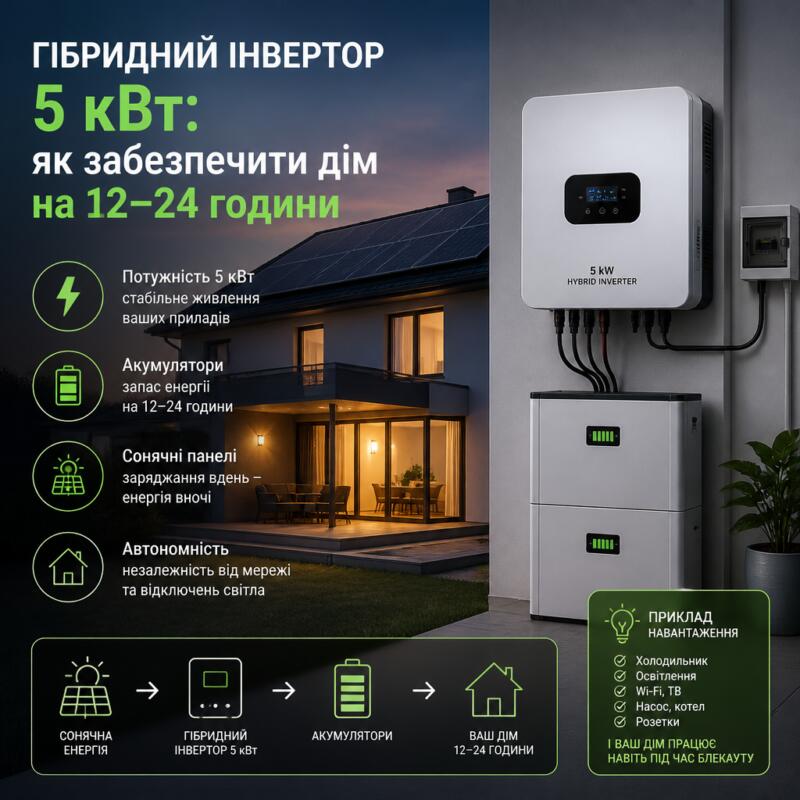
5 kW Hybrid Inverter: How to Power Your Home for 12–24 Hours


Hybrid inverter 5 kW in combination with a LiFePO4 battery, it can provide light, operation of the boiler, refrigerator, pumps, internet and household appliances during long outages. But the figure 5 kW means only the maximum load power, not the duration of autonomous operation. To get a reserve for 12–24 hours, you need to separately calculate the house's consumption, battery capacity, starting currents, and losses during energy conversion.
What does 5 kW hybrid inverter power mean?
The inverter converts the battery's direct current into the usual 230 V. Model on 5 kW capable of simultaneously powering devices with a total real power of up to 5000 W, unless the manufacturer has set other limitations.
A typical load for a private house might look like this:
- gas boiler — 80–180 W;
- refrigerator — 70–200 W during compressor operation;
- circulation pump — 40–100 W;
- borehole pump — 700–1500 W;
- lighting — 50–300 W;
- router and network equipment — 10–40 W;
- TV or laptop — 50–150 W;
- electric kettle — 1500–2200 W.
It is important to consider not only the constant power, but also the peak power. The refrigerator compressor or the pump motor can briefly consume in during start-up. 2–5 times more than the rated value. Therefore, the inverter must withstand the corresponding overload.
For a single-phase house 5 kW is usually sufficient for priority consumers. However, it is not advisable to turn on the boiler, kettle, iron, washing machine and pump at the same time. The backup system should support critical appliances, not duplicate the power grid without restrictions.
How to determine daily home consumption
Battery capacity is not calculated by the maximum power of the device, but by the energy it will use over a certain period of time. The formula is simple:
Energy, kWh = power, kW × operating time, h.
If the boiler consumes 120 W and works a total of 10 hours per day, its costs will be:
0.12 kW × 10 h = 1.2 kWh.
The refrigerator does not consume its rated power continuously. The compressor turns on periodically, so it is more convenient to refer to the energy consumption indicator on the label or measure the consumption with a socket wattmeter over a 24-hour period.
| Consumer | Estimated consumption | Work per day | Energy consumption |
|---|---|---|---|
| Gas boiler | 120 W | 10 hours | 1.2 kWh |
| Refrigerator | 120 W | 8 hours total | 0.96 kWh |
| Circulation pump | 60 W | 12 hours | 0.72 kWh |
| Lighting | 120 W | 6 hours | 0.72 kWh |
| Router and optical terminal | 25 W | 24 hours | 0.6 kWh |
| Laptop and TV | 150 W | 4 hours | 0.6 kWh |
| Together | — | — | 4.8 kWh |
To the resulting figure, you need to add the inverter's own consumption and conversion losses. A practical margin is 15–25%. For the given example, the daily system demand will be approximately 5.8–6 kWh.
Calculation of LiFePO4 battery for 12–24 hours
LiFePO4 battery for home has several advantages: high cycle life, stable voltage, fast charging and the ability to use most of the nominal capacity. Safe calculated depth of discharge for daily use is approximately 80–90%.
The required nominal capacity can be determined as follows:
Battery capacity = consumption ÷ inverter efficiency ÷ allowable depth of discharge.
If the house spends 6 kWh in 24 hours, the inverter efficiency is 92%, and the battery is planned to be discharged to 90%, the calculation will be as follows:
6 ÷ 0.92 ÷ 0.9 = 7.25 kWh.
So, for a day of autonomy, a battery of approximately 7.5–8 kWh. For 12 hours with the same consumption profile, about 4 kWh.
Common configurations:
- 51.2 V, 100 Ah — 5.12 kWh nominal, approximately 4.3–4.6 kWh of useful energy;
- 51.2 V, 150 Ah — 7.68 kWh nominal;
- 51.2 V, 200 Ah — 10.24 kWh nominal.
For the inverter on 5 kW it is better to use a class battery system 48 V, actually 51.2 V for LiFePO4. At full load, the current from the battery can exceed 100 A. In a 24 V system it would be about twice as large, which increases the requirements for cables, contacts and protection.
Frequently Asked Questions (FAQ)
Can I plug a 5 kW inverter into a regular outlet?
No, an inverter of this power is connected directly to the house's input panel through a separate circuit breaker and a reverse switch for the reserve input.
How many years will a LiFePO4 battery last?
Modern LiFePO4 units withstand 4,000 to 6,000 discharge/charge cycles, which corresponds to approximately 10–12 years of daily use.
Will the inverter work without solar panels?
Yes, a hybrid inverter can work as a powerful uninterruptible power supply (UPS), charging the battery from a regular city grid or generator.
Connection with 5 kW hybrid inverter and LiFePO4 The battery is the best basic solution for a private home. It provides instant automatic switching during power outages, provides high peak power and leaves the possibility of connecting solar panels at any time without replacing equipment.